Pakistani forces kill six militants in shootouts near border with Afghanistan — military

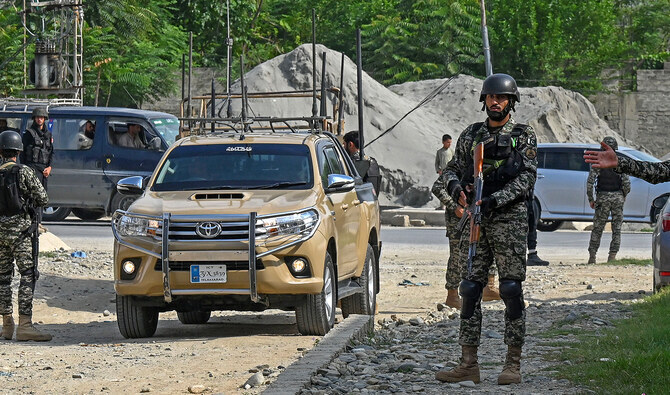
In this file photo, taken on July 31, 2023, security personnel stand guard at the site of a bomb blast in Bajaur district of Khyber-Pakhtunkhwa province. (AFP/File)
Short Url
Updated 04 November 2024
Follow

Pakistani forces kill six militants in shootouts near border with Afghanistan — military

  • Pakistan’s Khyber Pakhtunkhwa province, which borders Afghanistan, has witnessed a number of attacks recently
  • Pakistan blames the surge in militancy on militants operating out of Afghanistan, Kabul denies the allegations

ISLAMABAD: Pakistani security forces have killed six militants in two separate engagements in the country’s northwestern Khyber Pakhtunkhwa (KP) province, the Pakistani military said on Monday.
A militant was killed in an exchange of fire during an intelligence-based operation in North Waziristan’s Dosali area, according to the Inter-Services Public Relations (ISPR), the military’s media wing.
In the second incident, Pakistani forces intercepted a group of militants while infiltrating the country’s border with Afghanistan in the South Waziristan district. Five militants were killed as a result.
“Pakistan has consistently been asking Interim Afghan Government to ensure effective border management on their side of the border,” the ISPR said in a statement.
“Interim Afghan Government is expected to fulfil its obligations and deny the use of Afghan soil by Khwarij [militants] for perpetuating acts of terrorism against Pakistan.”
Khyber Pakhtunkhwa, which borders Afghanistan, has witnessed a number of attacks by the Tehreek-e-Taliban Pakistan (TTP) and other militant groups that targeted security forces convoys and check posts, besides targeted killings and kidnappings of law enforcers and government officials in recent months.
Pakistan has frequently accused neighboring Afghanistan of sheltering and supporting militant groups, urging the Taliban administration in Kabul to prevent its territory from being used by armed factions to launch cross-border attacks.
Afghan officials, however, deny involvement, insisting Pakistan’s security issues are an internal matter of Islamabad.



Pakistan urges revival of long-paralyzed SAARC as bloc marks 40th charter anniversary

Updated 4 sec ago
Follow

Pakistan urges revival of long-paralyzed SAARC as bloc marks 40th charter anniversary

  • PM Sharif says political rifts have stalled regional collaboration, calls for economic and digital connectivity
  • He mentions regional challenges requiring collective responses based on mutual trust, spirit of cooperation

ISLAMABAD: Prime Minister Shehbaz Sharif on Monday called for reviving the long-paralyzed South Asian Association for Regional Cooperation (SAARC), saying deeper economic collaboration and collective responses to shared challenges were essential as the bloc marked the 40th anniversary of its founding charter.

SAARC has been effectively dysfunctional since 2016, when its planned Islamabad summit collapsed after India withdrew following a militant attack it blamed on Pakistan. Islamabad denied involvement, but New Delhi’s decision prompted Afghanistan, Bangladesh and Bhutan to pull out, leading to the indefinite postponement of the summit.

Beyond the immediate rupture, SAARC was widely believed to have already become stagnant because of structural issues, including the India-Pakistan rivalry and New Delhi’s pivot toward alternative regional groupings.
Sharif extended his greetings to the peoples and the governments of “all SAARC member states” in a statement circulated by his office.

“When SAARC was established, over four decades ago, it was meant to provide an essential platform, to promote dialogue, foster cooperation and strengthen the bonds that bring our nations together,” he said.

“While these goals have, regrettably, remained elusive due to political considerations within the region, I commend the SAARC Secretariat for striving hard to provide its dedicated assistance as well as for its efforts to advance the organization’s goals and create opportunities for meaningful collaboration among the member states,” he added.

The prime minister noted his administration remained committed to the principles and objectives of the SAARC Charter.

“We believe that genuine cooperation, guided by sovereign equality, mutual respect and constructive engagement, can unlock South Asia’s vast potential and ensure a better tomorrow for all,” he said.

Sharif maintained the region needed stronger economic, digital and people-to-people connectivity to expand trade, investment, innovation and cultural exchange, adding that South Asian states faced shared pressures from poverty, climate-induced natural disasters, food and energy insecurity and public-health vulnerabilities.

These, he continued, required “collective responses based on mutual trust, goodwill and a spirit of cooperation.”

His statement did not directly mention India, though last week, his deputy, Ishaq Dar, urged a “reimagining” of South Asia’s fractured regional architecture, saying an 11-year freeze in dialogue with New Delhi had eroded prospects for long-term stability in one of the world’s most volatile regions.

Dar criticized the paralysis of SAARC, saying “artificial obstacles” needed to be removed for it to resume its role as a platform for economic cooperation, and argued the region would only achieve its political and economic potential if countries committed to cooperation and a future “where connectivity replaces divisions.”