

Trump talks about reporters being shot and says he shouldn’t have left White House after 2020 loss

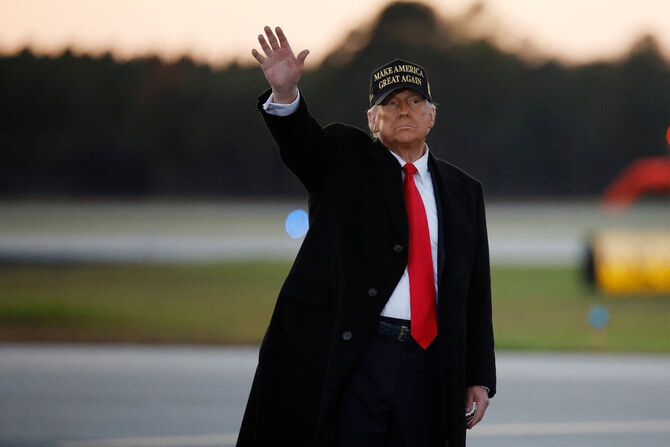
Republican presidential nominee Donald Trump waves to supporters at the conclusion of a campaign rally at Kinston Regional Jetport in Kinston, North Carolina, on Nov. 3, 2024. (Getty Images/AFP)
Short Url
Updated 04 November 2024
Follow

Trump talks about reporters being shot and says he shouldn’t have left White House after 2020 loss

  • With Election Day fast approaching, Trump continues to promote falsehoods about elections and argue that he can only lose to Democrat Kamala Harris if he is cheated
  • That’s what he did four years ago, kicking off a process of fighting the election results that culminated in the Jan. 6, 2021, insurrection at the US Capitol

LITITZ, Pennsylvania: Donald Trump gave a profane and conspiracy-laden speech two days before the presidential election, talking about reporters being shot and suggesting he “shouldn’t have left” the White House after his 2020 loss to Democrat Joe Biden.
In remarks Sunday that bore no resemblance to his standard speech in the campaign’s closing stretch, the former president repeatedly cast doubt on the integrity of the vote and resurrected old grievances about being prosecuted after trying to overturn his defeat four years ago. Trump intensified his verbal attacks against a “grossly incompetent” national leadership and the American media, steering his rally in Lancaster, Pennsylvania, at one point on to the topic of violence against members of the press.
The GOP nominee for the White House noted the ballistic glass placed in front of him at events after a gunman’s assassination attempt in July at a rally in Butler, Pennsylvania. Trump talked about places where he saw openings in that protection.
“I have this piece of glass here,” he said. “But all we have really over here is the fake news. And to get me, somebody would have to shoot through the fake news. And I don’t mind that so much.”
It was the second time in recent days that Trump has talked about guns being pointed at people he considers enemies. He suggested former Rep. Liz Cheney, a prominent Republican critic, wouldn’t be willing to support foreign wars if she had “nine barrels shooting at her.”

With less than 48 hours before Election Day, Trump continues to promote falsehoods about elections and argue that he can only lose to Democrat Kamala Harris if he is cheated, even though polls suggest a tight race.
Some of his allies, notably former chief strategist Steve Bannon, have encouraged him to prematurely declare victory on Tuesday even if the race is too early to call. That’s what Trump did four years ago, kicking off a process of fighting the election results that culminated in the Jan. 6, 2021, insurrection at the US Capitol.
For much of this year, Trump has run a relatively disciplined campaign that emphasized the issues and voters his aides believe could deliver him victory, even as he clung to false theories about voter fraud and went on frequent digressions stirring controversy. But that discipline is increasingly collapsing.
Trump in recent weeks has joked about golfer Arnold Palmer’s genitalia, continued using gendered or sexist language in his efforts to win over women and staged a rally at New York’s Madison Square Garden that included crude and racist insults that dominated headlines.
Trump co-campaign manager Susie Wiles, long credited with bringing order to his often-chaotic political operation, watched the former president silently from off stage Sunday.
His campaign later sought to clarify his meaning in talking about the media.
“President Trump was brilliantly talking about the two assassination attempts on his own life, including one that came within 1/4 of an inch from killing him, something that the Media constantly talks and jokes about,” campaign spokesperson Steven Cheung said in a statement. “The President’s statement about protective glass placement has nothing to do with the Media being harmed, or anything else.”
Harris was campaigning Sunday in Michigan, where she told a predominately Black church congregation in Detroit that God offers America a “divine plan strong enough to heal division.”
The two major candidates offered starkly different tones with the campaign almost at an end, as Harris said voters can reject “chaos, fear and hate.”
Trump usually veers from subject to subject, a discursive style he has labeled “the weave.” But outside the Lancaster airport, he went on long tangents and hardly mentioned his usual points on the economy, immigration and rote criticisms of Harris.
Trump referred to John Bolton, his former national security adviser and now a strident critic, as a “dumb son of a b— .” And he repeated familiar and debunked theories about voter fraud, alleging that Democrats could only win by cheating. Public polls indicate a tight and competitive race across the battleground states that will determine the Electoral College outcome.
“It’s a crooked country,” Trump said. “And we’re going to make it straight. We’re going to make it straight.”
Harris pushed back at Trump’s characterizations of US elections, telling reporters after the church service that Trump’s comments are “meant to distract from the fact that we have and support free and fair elections in our country.” Those “good systems” were in place in 2020, Harris said, and “he lost.”
The vice president said she trusts the upcoming vote tally and urged voters, “in particular people who have not yet voted to not fall for this tactic, which I think includes, suggesting to people that if they vote, their vote won’t matter.”
“Trump’s unhinged ramblings and dangerous rhetoric confirm what those closest to him have already told us: he is completely unfit to lead and would put our democracy and the rule of law at risk if given a chance,” Alex Floyd, a spokesperson for the Democratic National Committee, said in a statement, referring to former Trump aides who have warned against returning him to the White House, including retired military officers who said he’s a fascist.
Trump, for his part, acknowledged that he was sidestepping his usual approach with his conspiratorial speech. He repeatedly talked about disregarding the advice of his aides, repeating their feedback in a mocking voice and insisting that he had to talk about election fraud despite their objections.
Trump at one point suggested that he wouldn’t deliver this version of his speech again: “I hope you’ve enjoyed this,” he said, “because I’m only doing this one time.”
Indeed, his next speech a few hours later at an airport in Kinston, North Carolina, drifted between prepared remarks and familiar stories. Trump praised David McCormick, the businessman running for Senate in Pennsylvania, appearing to briefly lose track of his location but quickly recovering.
“Where’s David? Is he around some place?” Trump said. “You know we just left him. He’s a great guy.”
Some rallygoers began leaving almost immediately. One of them was Whitney Riley, 60, who said she desperately wanted to stay but had another event. She noted Trump started late.
“I got to see him land. I got to see him open,” said Riley, wearing Trump’s signature “Make America Great Again” hat and an American flag scarf. “And that’ll have to be enough.”


Ukraine to give revised peace plans to US as Kyiv readies for more talks with its coalition partners

Updated 10 December 2025
Follow

Ukraine to give revised peace plans to US as Kyiv readies for more talks with its coalition partners

  • Ukraine’s European allies are backing Zelensky’s effort to ensure that any settlement is fair and deters future Russian attacks.
  • The French government said Ukraine’s allies — dubbed the “Coalition of the Willing” — will discuss the negotiations Thursday by video

KYIV: Ukraine is expected to hand its latest peace proposals to US negotiators Wednesday, President Volodymyr Zelensky said, a day ahead of his urgent talks with leaders and officials from about 30 other countries supporting Kyiv’s effort to end the war with Russia on acceptable terms.
As tension builds around US President Donald Trump’s push for a settlement and calls for an election in Ukraine, Zelensky said his country would be ready for such a vote within three months if partners can guarantee safe balloting during wartime and if its electoral law can be altered.
Washington’s goal of a swift compromise to stop the fighting that followed Russia’s all-out invasion in February 2022 is reducing Kyiv’s room for maneuvering. Zelensky is walking a tightrope between defending Ukrainian interests and showing Trump he is willing to make some compromises.
Ukraine’s European allies are backing Zelensky’s effort to ensure that any settlement is fair and deters future Russian attacks.
The French government said Ukraine’s allies — dubbed the “Coalition of the Willing” — will discuss the negotiations Thursday by video. Zelensky said it would include those countries’ leaders.
“We need to bring together 30 colleagues very quickly. And it’s not easy, but nevertheless we will do it,” he said late Tuesday.
Zelensky’s openness to an election was a response to comments by Trump in which he questioned Ukraine’s democracy and suggested the Ukrainian leader was using the war as an excuse not to stand before voters. Those comments echo similar remarks often made by Russian President Vladimir Putin.
Zelensky told reporters late Tuesday he is “ready” for an election but would need help from the US and possibly Europe to ensure its security. He suggested Ukraine could be ready to hold balloting in 60 to 90 days if that proviso is met.
“To hold elections, two issues must be addressed: primarily, security — how to conduct them, how to do it under strikes, under missile attacks; and a question regarding our military — how they would vote,” Zelensky said.
“And the second issue is the legislative framework required to ensure the legitimacy of elections,” he said.
Previously, Zelensky had pointed out that a ballot can’t legally take place while martial law — imposed due to Russia’s invasion — is in place. He has also asked how a vote could happen when civilian areas of Ukraine are being bombarded by Russia and almost 20 percent of the country is under Moscow’s occupation.
Zelensky said he has asked lawmakers from his party to draw up legislative proposals allowing for an election while Ukraine is under martial law.
Ukrainians have on the whole supported Zelensky’s arguments, and have not clamored for an election. Under the law that is in force, Zelensky’s rule is legitimate.
Putin has repeatedly complained that Zelensky can’t legitimately negotiate a peace settlement because his five-year term that began in 2019 has expired.
US seeks closer ties with Russia
A new US national security strategy released Dec. 5 made it clear that Trump wants to improve Washington’s relationship with Moscow and “reestablish strategic stability with Russia.”
The document also portrays European allies as weak.
Russian Foreign Minister Sergey Lavrov praised Trump’s role in the Ukraine peace effort, saying in a speech to the upper house of parliament that Moscow appreciates his “commitment to dialogue.” Trump, Lavrov said, is “the only Western leader” who shows “an understanding of the reasons that made war in Ukraine inevitable.”
Trump’s peace efforts have run into sharply conflicting demands from Moscow and Kyiv.
The initial US proposal was heavily slanted toward Russia’s demands. To counter that, Zelensky has turned to his European supporters.
Zelensky met this week with the leaders of Britain, Germany and France in London, the heads of NATO and the European Union in Brussels, and then to Rome to meet the Italian premier and Pope Leo XIV.
Zelensky said three documents were being discussed with American and European partners — a 20-point framework document that is constantly changing, a document on security guarantees, and a document about Ukraine’s recovery.
Military aid for Ukraine declines
Europe’s support is uneven, however, and that has meant a decrease in military aid since the Trump administration this year cut off supplies to Kyiv unless they were paid for by other NATO countries.
Foreign military help for Ukraine fell sharply over the summer, and that trend continued through September and October, a German body that tracks international help for Ukraine said Wednesday.
Average annual aid, mostly provided by the US and Europe, was about 41.6 euros billion ($48.4 billion) between 2022–24. But so far this year Ukraine has received just 32.5 billion euros ($37.8 billion), the Kiel Institute said.
“If this slower pace continues in the remaining months (of the year), 2025 will become the year with the lowest level of new aid allocations” since the war began, it said.
This year, Denmark, Finland, Norway and Sweden have substantially increased their help for Ukraine, while Germany nearly tripled its average monthly allocations and France and the UK both more than doubled their contributions, the Kiel Institute said.
On the other hand, it said, Spain recorded no new military aid for Kyiv in 2025 while Italy reduced its low contributions by 15 percent compared with 2022–2024.