VALENCIA: Spain’s King Felipe VI and Queen Letizia on Sunday just after midday arrived in the Valencia region where devastating floods have killed more than 200 people, television images showed.
The royals, accompanied by Prime Minister Pedro Sanchez, visited Paiporta — one of the worst affected towns — and are due to move on to Chiva, another battered town close to Valencia, later in the day.
Hopes of finding survivors ebbed five days after torrents of muddy water wrecked towns and infrastructure in Spain’s worst such disaster in decades.
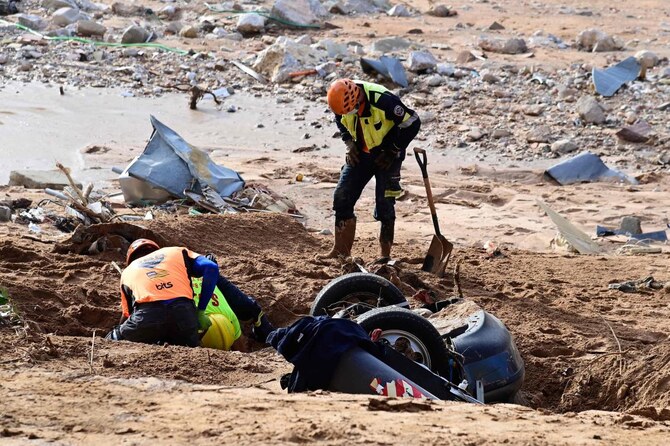
Nearly all the deaths have been in the Valencia region, where thousands of security and emergency services frantically cleared debris and mud in the search for bodies.
Describing “the worst natural disaster in the recent history of our country,” Prime Minister Pedro Sanchez said it was the second deadliest flood in Europe this century.
Sanchez was expected to accompany King Felipe VI and Queen Letizia as well as the Valencia region leader Carlos Mazon on a visit to the areas affected by the floods on Sunday, according to the premier’s office. The exact program of their visit has not yet been made public.
The monarchs’ visit comes as Spain’s meterological agency issued a fresh warning for heavy downpours in the Valencia region.
Up to 100 liters per square meter (22 gallons per square yard) of water could fall in the province of Castellon and the area surrounding the city of Valencia, the agency forecast.
It also sounded the alarm for torrential rain that may cause flooding in the southern province of Almeria, advising residents not to travel unless strictly necessary.
Restoring order and distributing aid to destroyed towns and villages — some of which have been cut off from food, water and power since Tuesday’s torrent — is a priority.
With Spain deploying an extra 10,000 troops, police and civil guards to the Valencia region, the country was carrying out its largest deployment of military and security force personnel in peacetime, Sanchez said.
Officers made around 20 arrests on Saturday evening for thievery and acts of looting, police said, with the authorities pledging to crack down on those taking advantage of the disaster to commit crimes.
Authorities — including Mazon — have come under fire over the warning systems before the floods, and some stricken residents have complained that the response to the disaster has been too slow.
“I am aware the response is not enough, there are problems and severe shortages... towns buried by mud, desperate people searching for their relatives... we have to improve,” Sanchez said.
In the ground-zero towns of Alfafar and Sedavi, AFP reporters saw no soldiers while residents shovelled mud from their homes and firefighters pumped water from garages and tunnels.
“Thank you to the people who have come to help us, to all of them, because from the authorities: nothing,” a furious Estrella Caceres, 66, told AFP in Sedavi.
In Chiva, a town west of Valencia which Spanish media reported may be visited by the monarchs, Danna Daniella said she had been cleaning her restaurant for three days straight and was still in shock.
“It feels like the end of the world,” the woman in her 30s said.
She said she was haunted by memories of the people trapped by the raging floodwaters “asking for help and there was nothing we could do.”
“It drives you crazy. You look for answers and you don’t find them.”
With telephone and transport networks severely damaged, establishing a precise figure of missing people is difficult.
Sanchez said electricity had been restored to 94 percent of homes affected by power outages and that around half of the cut telephone lines had been repaired.
Transport Minister Oscar Puente told El Pais daily that certain places would probably remain inaccessible by land for weeks.
Ordinary citizens carrying food, water and cleaning equipment have continued their grassroots initiative to assist the recovery, although authorities have urged people to stay at home to avoid congestion on the roads that would hamper the work of emergency services.
On Sunday, the Valencian government limited the number of volunteers authorized to travel to the city’s southern suburbs to 2,000 and restricted access to 12 localities.
The storm that sparked the floods on Tuesday formed as cold air moved over the warm waters of the Mediterranean and is common for this time of year.
But scientists warn climate change driven by human activity is increasing the ferocity, length and frequency of such extreme weather events.
Emergency services late on Saturday issued an updated toll of 213 people confirmed killed — 210 in the Valencia region, two in neighboring Castilla-La Mancha and one in Andalusia in the south.
Authorities have warned the toll could yet rise, as vehicles trapped in tunnels and underground car parks are cleared.


![]()

Spanish royals visit flood-hit region as fresh downpours loom
Short Url
https://arab.news/ccchq
Spanish royals visit flood-hit region as fresh downpours loom
- Hopes of finding survivors ebbed five days after torrents of muddy water wrecked towns and infrastructure in Spain’s worst such disaster in decades


Latest updates


Recommended


© 2026 SAUDI RESEARCH & PUBLISHING COMPANY, All Rights Reserved And subject to Terms of Use Agreement.