

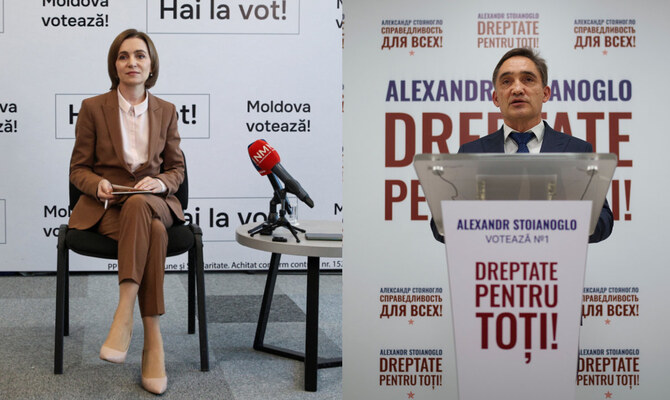

CHISINAU: Moldovans vote on Sunday in a presidential runoff that has been overshadowed by election meddling allegations and could see Moscow gain more influence in a diplomatic battleground between Russia and the European Union.
Pro-Western incumbent Maia Sandu, who has accelerated the southeast European nation’s push to leave Moscow’s orbit and join the EU, faces Alexandr Stoianoglo, an ex-prosecutor general backed by the pro-Russian Socialist Party.
The fortunes of Sandu, who set Moldova on the long path of EU accession talks in June, will be closely followed in Brussels a week after Georgia, another ex-Soviet state hoping to join, re-elected a ruling party seen as increasingly pro-Russian.
Stoianoglo says that as president he too would back EU integration but also develop ties with Russia in the national interest. He has vowed to try to revive cheap Russian gas supplies and said he would meet with President Vladimir Putin if Moldovans wanted it.
The outcome of the vote is likely to set the tone for next summer’s parliamentary elections where Sandu’s ruling party is expected to struggle to retain its majority and which will determine the stripe of the future government.
Stoianoglo’s East-West balancing rhetoric contrasts with Sandu’s four years in power, during which ties with the Kremlin have unraveled, a slew of Moscow’s diplomats have been expelled and she has condemned Russia’s invasion of neighboring Ukraine.
Moscow has said that her government is “Russophobic.”
Sandu portrays Stoianoglo as the Kremlin’s man and a political Trojan horse, painting Sunday’s vote as a choice between a bright future in the EU by 2030 and one of uncertainty and instability.
Stoianoglo says that is untrue and that she has failed to look out for the interests of ordinary Moldovans. He accuses Sandu of divisive politics in a country that has a Romanian-speaking majority and large Russian-speaking minority.
Fresh meddling allegations
The police have cracked down to try to avoid a repeat of what they said was a vast vote-buying scheme deployed by Russian-backed fugitive oligarch Ilan Shor in the first round and a referendum on the EU’s aspirations on Oct. 20.
Russia denies interfering, while Shor has denied wrongdoing. He lives in Russia and has openly called on people via social media to vote against Sandu and promised payment for following his instructions.
Sandu has said the meddling affected the Oct. 20 results and that Shor sought to buy the votes of 300,000 people, more than 10 percent of the population.
A Moldovan government source said Chisinau had notified several EU nations that it believed Russia would try to disrupt voting by Moldovan expatriates on Sunday at polling stations in their countries.
The source, who asked not to be identified, told Reuters polling stations in Italy, France, Germany, Spain, Canada, Romania, United States and Britain might be targeted by disruption including with the use of bomb hoaxes.
Moldovan voters living in the West are seen as largely pro-European and therefore more likely to support Sandu, who has championed Moldova’s effort to join the 27-nation bloc by 2030.
The referendum result went to the wire, delivering a slender win of 50.35 percent for the pro-EU camp.
Sandu won 42 percent of the vote in the first round, falling short of the 50 percent needed to win outright. Stoianoglo came second with 26 percent.
Stoianoglo is expected to benefit from protest votes against Sandu’s handling of the economy in the poor agricultural nation of fewer than 3 million people.
Moldova struggled with the aftermath of the COVID pandemic and the effects of Russia’s February 2022 invasion of neighboring Ukraine. That sparked a huge influx of refugees and sharply reduced Russian gas supplies, causing high inflation.
Ahead of the vote, Sandu campaigned with the slogan “Save Moldova.” The opposition was quick to counter with a parody slogan: “Save Moldova from Sandu.” (Reporting by Tom Balmforth; Editing by Cynthia Osterman)


