CHARLOTTE, North Carolina: Democrat Kamala Harris was greeted by an unusual sight as she arrived in North Carolina on Saturday: the red-white-and-blue airplane of Donald Trump, her Republican rival for the presidency.
As Harris descended from the vice presidential airplane Air Force Two at the Charlotte airport, Trump’s private Boeing 757 was parked on the tarmac nearby.
The close encounter was a dramatic illustration how the two candidates are focusing on a handful of states where Tuesday’s US presidential election will be won or lost.
It was the fourth day in a row that the candidates were campaigning in the same state. Only seven states, North Carolina among them, are seen as truly competitive.
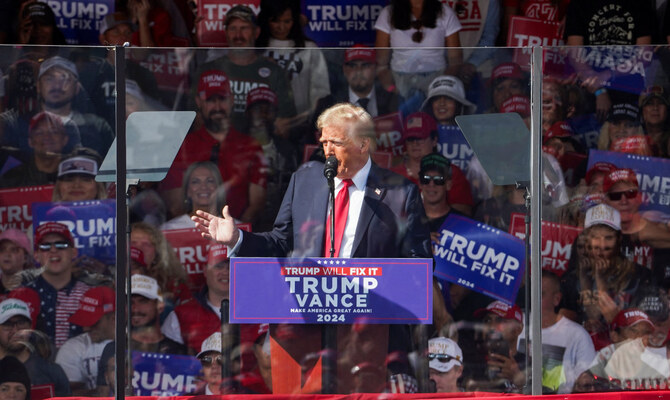
Harris was arriving for a rally in Charlotte, the state’s biggest city, while Trump had campaigned in suburban Gastonia a few hours earlier.
It was not clear whether Trump was on board his plane when Harris arrived.
With the election just three days away, Trump and Harris stuck to familiar themes at their appearances.
Trump said he would deport millions of immigrants if elected and warned that if Harris were to win, “every town in America would be turned into a squalid, dangerous refugee camp.”
Campaigning in Atlanta, Harris said Trump would abuse his power if he returns to the White House.
“This is someone who is increasingly unstable, obsessed with revenge, consumed with grievance, and the man is out for unchecked power,” she said.
More than 72 million Americans have already cast ballots, according to the Election Lab at the University of Florida, short of 2020’s record early-voting pace during COVID-19, but still indicating a high level of voter enthusiasm.
Some 4 million votes have already been cast in North Carolina, and the western counties that have been devastated by Hurricane Helene appeared to be voting at roughly the same rate as the rest of the state, according to Catawba College political science professor Michael Bitzer.
Trump criticized the federal government’s response to the disaster and repeated his false claim that aid had been diverted from the state to help immigrants entering the country.
He also said that residents of US suburbs, traditionally seen as a refuge from crime and other dangers, are under threat.
“The suburbs are under attack right now. When you’re home in your house alone, and you’ve got this monster that got out of prison, you know, six charges of murdering six different people,” he said. Violent crimes dropped in the US last year. However, Trump and his allies have emphasized crime on the campaign trail and falsely suggested immigrants are responsible.
North Carolina backed Trump in 2020 by a narrow margin of less than 1.5 percentage points and elected a Democratic governor on the same day, giving hope to both parties.
Trump was due to rally in Salem, Virginia, though the state is not likely to back him for president, before returning to North Carolina for an evening rally in Greensboro.
POLICY DIFFERENCES
Harris and Trump have very different policies on major issues including support for Ukraine and NATO, abortion rights, immigration, taxes, democratic principles and tariffs, which reflect that schisms between the Democratic and Republican parties. Republican House Speaker Mike Johnson said Friday that if Trump wins and Republicans control Congress, his party would “probably” repeal the CHIPS Act, passed under Joe Biden’s administration, which gave over $50 billion in subsidies to companies for semiconductor chip manufacturing and research in the United States. Democrats have seized on the remarks. “It is further evidence of everything I’ve actually been talking about for months now, about Trump’s intention to implement Project 2025,” Harris said Saturday, referring to a conservative blueprint to remake US government and policies that was written with the help of many of Trump’s closest advisers.
Johnson revised his remarks later on Friday, saying the act would be streamlined to eliminate regulations.


![]()
![]()

Harris, Trump nearly cross paths in North Carolina in final days of US election campaign

Short Url
https://arab.news/ms94k
Harris, Trump nearly cross paths in North Carolina in final days of US election campaign
- The close encounter was a dramatic illustration how the two candidates are focusing on a handful of states where Tuesday’s US presidential election will be won or lost


Latest updates


Recommended


© 2026 SAUDI RESEARCH & PUBLISHING COMPANY, All Rights Reserved And subject to Terms of Use Agreement.