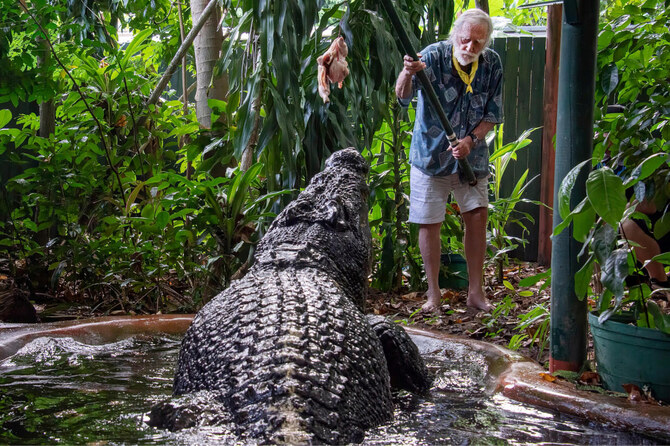
SYDNEY: A 5.48-meter (18 feet) Australian crocodile that held the world record as the largest crocodile in captivity has died, a wildlife sanctuary said on Saturday. He was thought to be more than 110 years old.
Cassius, weighing in at more than one tonne, had been in declining health since Oct. 15, Marineland Melanesia Crocodile Habitat said on Facebook.
“He was very old and believed to be living beyond the years of a wild Croc,” according to a post by the organization, based on Green Island near the Queensland tourist town of Cairns.
“Cassius will be deeply missed, but our love and memories of him will remain in our hearts forever.”
The group’s website said he had lived at the sanctuary since 1987 after being transported from the neighboring Northern Territory, where crocodiles are a key part of the region’s tourist industry.
Cassius, a saltwater crocodile, held the Guinness World Records title as the world’s largest crocodile in captivity.
He took the title after the 2013 death of Philippines crocodile Lolong, who measured 6.17m (20 feet 3 inches) long, according to Guinness.


World’s largest captive crocodile Cassius dies in Australia
https://arab.news/8h435
World’s largest captive crocodile Cassius dies in Australia

- Cassius, weighing in at more than one tonne, had been in declining health since October 15
- He took the title after the 2013 death of Philippines crocodile Lolong, who measured 6.17 meters


Trunk snapped off famed Bernini statue in Rome square
ROME, Feb 18 (Reuters) - A marble elephant designed by Baroque master Gian Lorenzo Bernini has been damaged, with its left tusk found snapped off and lying at the base of the monument in the heart of Rome, authorities said.
The damage was uncovered on Monday night and police said they would review video footage from Piazza della Minerva to determine whether the tusk was vandalised or simply fell off following weeks of unusually heavy rains.
Italy's Culture Minister Alessandro Giuli made clear he thought it was deliberate, saying the 17th statue, which supports an ancient Egyptian obelisk, was victim of an "absurd act of barbarity".
"It is unacceptable that once again the nation's artistic and cultural heritage must suffer such serious damage," he said in a statement.
It is not the first time the sculpture, popularly known as the Elefantino (little elephant), has been damaged.
In November 2016, the tip of the same tusk was similarly found broken off. The piece was reattached during restoration work.
The sculpture, created in 1667 by Ercole Ferrata based on a design by Bernini, stands a short distance from the Pantheon, one of most visited tourist sites in Rome. (Reporting by Francesca Piscioneri, editing by Crispian Balmer)