Pakistan announces drafting of transshipment policy to boost role in global trade

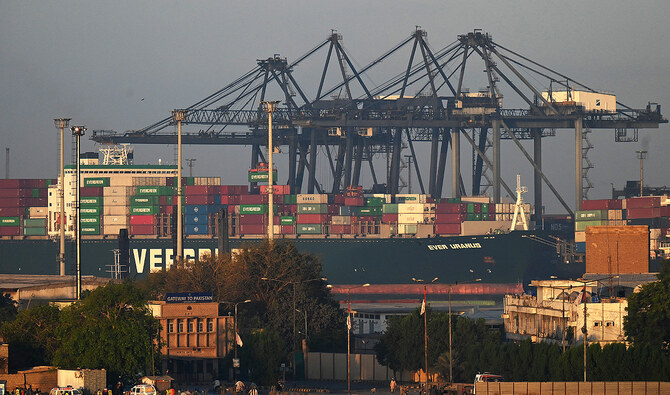
In this file photo, taken on April 6, 2023, shipping containers are seen stacked on a ship at a seaport in Karachi. (AFP/File)
Short Url
Updated 01 November 2024
Follow

Pakistan announces drafting of transshipment policy to boost role in global trade

  • International companies have shown interest in Pakistan’s maritime and transshipment potential
  • Abu Dhabi Ports has signed a deal to operate a Karachi container terminal, will invest $220 million

ISLAMABAD: Pakistan is formulating a transshipment policy aimed at enhancing its role in regional and international trade, state media reported on Friday, as the country seeks to gain financial strength by embedding itself more firmly within the global economic system.
International transshipment nodes enable the transfer of cargo from one vessel to another, facilitating regional and international trade by efficiently directing its flow. The process can be lucrative for Pakistan, whose maritime minister announced the government’s decision to draft the policy during parliamentary proceedings.
Last year in June, Abu Dhabi Ports Group signed a 50-year concession agreement with Karachi Port Trust to operate a container terminal, committing to invest $220 million over the first decade.
Subsequently, APM Terminals, a subsidiary of Maersk, expressed interest in developing Pakistan’s first green transshipment terminal in Karachi earlier this year in May, reflecting growing international confidence in Pakistan’s maritime potential.
“Minister for Maritime Affairs Qaiser Ahmad Shaikh told the House during the Question Hour that this policy will provide clear guidelines and incentives for transshipment activities,” according to Radio Pakistan.
“He said it will also streamline transshipment operations at Pakistani ports, resulting in economic growth and job opportunities,” the report added.
Prime Minister Shehbaz Sharif has also actively promoted Pakistan’s ports to Central Asian nations, positioning them as conduits to global markets.
During his visit to Tajikistan in July, he emphasized his government’s commitment to enhancing regional connectivity and integration, highlighting the strategic importance of Pakistan’s ports for the region’s landlocked economies.
The maritime minister said a comprehensive transshipment policy was expected to further solidify Pakistan’s position as a pivotal trade and transit hub in South Asia.


World Bank president in Pakistan to discuss development projects, policy issues

Updated 6 sec ago
Follow

World Bank president in Pakistan to discuss development projects, policy issues

  • Pakistan, World Bank are currently gearing up to implement a 10-year partnership framework to grant $20 billion loans to the cash-strapped nation
  • World Bank President Ajay Banga will hold meetings with Pakistan Prime Minister Shehbaz Sharif and other senior officials during the high-level visit

ISLAMABAD: World Bank President Ajay Banga has arrived in Pakistan to hold talks with senior government officials on development projects and key policy issues, Pakistani state media reported on Sunday, as Islamabad seeks multilateral support to stabilize economy and accelerate growth.

The visit comes at a time when Pakistan and the World Bank are gearing up to implement a 10-year Country Partnership Framework (CPF) to grant $20 billion in loans to the cash-strapped nation.

The World Bank’s lending for Pakistan, due to start this year, will focus on education quality, child stunting, climate resilience, energy efficiency, inclusive development and private investment.

"World Bank President Ajay Banga arrives in Pakistan for a high-level visit," the state-run Pakistan TV Digital reported on Sunday. "During his stay, he will meet Prime Minister Shehbaz Sharif and other senior officials to discuss economic reforms, development projects, and key policy issues."

Pakistan, which nearly defaulted on its foreign debt obligations in 2023, is currently making efforts to stabilize its economy under a $7 billion International Monetary Fund (IMF) program.

Besides efforts to boost trade and foreign investment, Islamabad has been seeking support from multilateral financial institutions to ensure economic recovery.

“This partnership fosters a unified and focused vision for your county around six outcomes with clear, tangible and ambitious 10-year targets,” Martin Raiser, the World Bank vice president for South Asia, had said at the launch of the CPF in Jan. last year.

“We hope that the CPF will serve as an anchor for this engagement to keep us on the right track. Partnerships will equally be critical. More resources will be needed to have the impact at the scale that we wish to achieve and this will require close collaboration with all the development partners.”

In Dec., the World Bank said it had approved $700 million in ​financing for Pakistan under a multi-year initiative aimed at supporting the country's macroeconomic stability and service delivery.

It ‍followed a $47.9 ‍million World Bank grant ‍in August last year to improve primary education in Pakistan's most populous Punjab province.