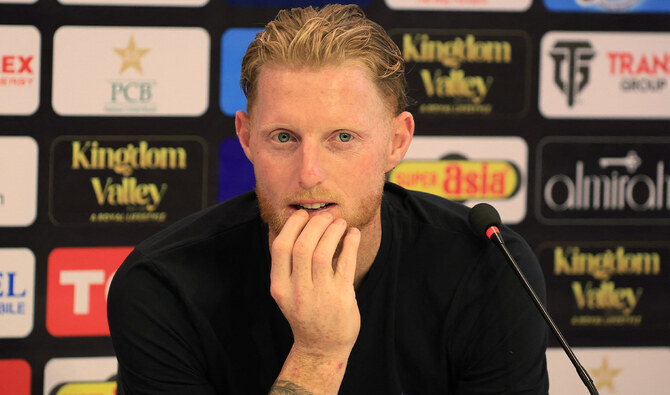
LONDON: A man has been arrested after England Test captain Ben Stokes’ home was burgled while he was on tour in Pakistan, police said Friday.
Stokes said his wife and two children were at home in County Durham, in northeast England, during the break-in by “masked” burglars on the evening of October 17, when valuables were taken.
Durham Police said a 32-year-old man had been arrested on suspicion of burglary. He has since been bailed.
Stokes was in Pakistan for a Test series when the incident occurred.
He said items stolen included a medal he received after he was recognized in the 2020 New Year Honours list, for helping England win the World Cup the year before.
Describing the break-in on his personal X account, Stokes posted images of the items taken from his home including a Christian Dior handbag, a gold ring with England cricket insignia and bracelets.
“By far the worst thing about this crime is that it was carried out whilst my wife and two young children were in the house,” the 33-year-old wrote.
“Thankfully, none of my family came to any physical harm. Understandably, however, the experience has had an impact on their emotional and mental state.
“All we can think about is how much worse this situation could have been.”
England lost their Test series in Pakistan 2-1.


Man arrested after Ben Stokes’ home raided by masked gang
https://arab.news/c8mq7
Man arrested after Ben Stokes’ home raided by masked gang

- England captain was in Pakistan for a Test series when the incident occurred
- Stolen items include a medal received after England won the 2019 World Cup

Saudi football leaders shift focus from big names at WFS
- Privatization and community building is focus of Saudi officials
- Al-Kholood’s success under Ben Harburg seen as benchmark
RIYADH: Saudi Arabia is recognized as one of football’s fastest-rising nations, but there was a noticeable shift in tone on the first day of the World Football Summit, which returns to Riyadh for the second consecutive year.
Instead of conversations about which global superstar would arrive next, speakers touched on the foundations of Saudi football — infrastructure, governance and sustainable growth.
WFS brings together leaders from around the world to explore how football can evolve, from ticketing systems to artificial intelligence models offering deeper player insights. Yet it was the future of Saudi football — particularly its trajectory in the lead-up to the 2034 FIFA World Cup — that dominated the main stage.
The event’s first panel, “Saudi Sport — A Changing Landscape with a Bright Future,” moderated by Ben Jacobs, featured Ibrahim Al-Moaiqel of the Ministry of Sport. He emphasized the Kingdom’s privatization program was not simply about selling clubs but “bringing partners with the know-how to develop them.”
Privatization has been a defining topic around the Saudi Pro League, especially after Ben Harburg’s acquisition of Al-Kholood, making him the first-ever foreign owner of a Saudi football club. Harburg’s impact has been immediate, with Al-Kholood making the King’s Cup final four for the first time in their history just six months into his tenure.
But while privatization dominated early discussion, it quickly shifted to whether the SPL could one day rival Europe’s top five leagues — particularly England’s Premier League. Al-Moaiqel downplayed the comparison, highlighting the long-term work still required to reach that level.
SPL CEO Omar Mugharbel expanded on the theme, stressing the importance of building communities and developing stadiums capable of supporting a broader football ecosystem.
The SPL has seen its revenues triple since 2023, but it didn’t stop Mugharbel saying things were just getting started. “How do we build something for Saudi that we can export to the world?” he asked.
This sentiment was also shared by club management. Al-Hilal CEO Esteve Calzada said that while their heroics at the 2025 FIFA Club World Cup highlighted the SPL’s rising competitiveness, the club’s priority moving forward was sustainable revenue generation.
“We want to put the best products possible in front of our fans,” he said, a statement that encapsulated the day’s theme: The future lies not solely in marquee signings, but in building clubs, communities and systems that endure.
This shift in rhetoric marks a defining moment for Saudi football as it approaches its next major milestone — the AFC Asian Cup 2027, the first of several flagship events on the Kingdom’s long-term football roadmap.
If Day 1 of the WFS made anything clear, it was that Saudi Arabia’s footballing ambitions are no longer measured by the stars they attract, but by the structures they build.


