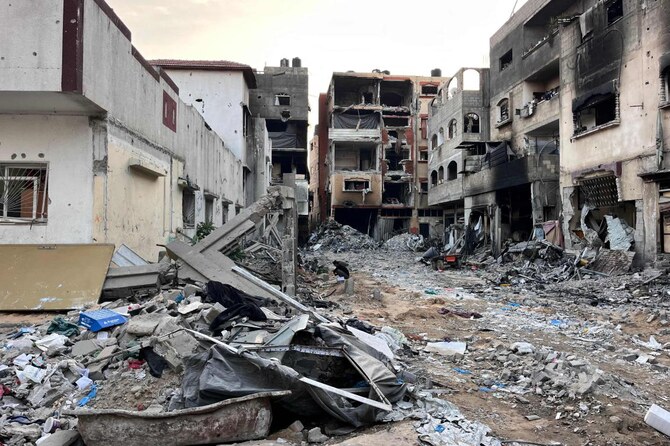
JERUSALEM: More than a year into a war that has ricocheted across the Middle East, Israeli troops are still battling Hamas in the most heavily destroyed and isolated part of the Gaza Strip.
In northern Gaza, Hamas militants carry out hit-and-run attacks from bombed-out buildings. Residents say Israeli forces have raided shelters for the displaced, forcing people out at gunpoint. First responders say they can barely operate because of the Israeli bombardment.
Since its Oct. 7 attack into Israel that sparked the war in Gaza, Hamas has taken heavy losses. The recent killing of its top leader, Yahya Sinwar, was viewed as a possible turning point, yet the two sides do not appear any closer to a ceasefire, and Hamas, which still holds scores of hostages, remains the dominant power in Gaza.
The conflict has drawn in militants from Lebanon to Yemen, and their key sponsor, Iran, has inched closer to all-out war with Israel. But in northern Gaza, the war seems stuck in a loop of devastating Israeli offensives, followed by Hamas fighters regrouping.
Israel is once again ordering mass evacuations, severely restricting aid despite global outrage and raiding hospitals it says are used by militants.
In the northern border town of Beit Lahiya — one of the first targets of last year’s ground invasion — two Israeli strikes this week killed at least 88 Palestinians, including dozens of women and children. The military said its target was a spotter on the roof.
As the war grinds on, Israel is resorting to ever more draconian measures. There is even talk of adopting a surrender-or-starve strategy proposed by former generals.
On Monday, Israel passed legislation that could severely restrict the UN agency that is the largest aid provider in Gaza despite protests by the United States and other close allies. It accuses the agency of allowing itself to be infiltrated by Hamas, allegations denied by the UN
Another offensive, as Hamas keeps filling the void
Israel launched its latest offensive in northern Gaza in early October, focusing on Jabaliya, a crowded, decades-old urban refugee camp where it says Hamas had regrouped.
Hamas-led militants killed some 1,200 people, mostly civilians, and abducted another 250 that day. Israel’s offensive has killed over 43,000 Palestinians, according to Gaza health authorities, who do not say how many were combatants but say more than half were women and children.
Israel says it has killed over 17,000 fighters, without providing evidence, and the United States says Hamas is no longer capable of mounting an Oct. 7-style attack.
But Israeli forces have repeatedly returned to areas where they had battled before — only to face renewed attacks. At least 16 Israeli soldiers have been killed in northern Gaza since the latest operation began, including a 41-year-old colonel.
Israel has yet to lay out a plan for postwar Gaza and has rejected a US push for the Western-backed Palestinian Authority to return and govern with Arab support. Plainclothes Hamas security men still patrol most areas.
“It’s endless war,” said Michael Milshtein, a former Israeli military intelligence officer who now leads a Palestinian studies program at Tel Aviv University.
He says Israel has only two options to break the cycle: Either completely reoccupy Gaza, which would require several thousand troops to be stationed there indefinitely. Or secure a ceasefire with Hamas that involves the release of its hostages in exchange for Palestinians in Israeli jails, and a full Israeli withdrawal — the kind of deal that has long eluded US and Arab mediators.
“We are in Jabaliya for the fourth time, and maybe in the next month we will find ourselves there for the fifth and the sixth.” he said.
‘Leave now’ if you care about the lives of your children
Around a million people fled the north, including Gaza City, when Israel ordered its wholesale evacuation at the start of the war. They have not been allowed to return.
Some 400,000 have remained, even as Israel has encircled the area and obliterated entire neighborhoods and critical infrastructure.
The UN says at least 60,000 people have fled to Gaza City in recent weeks from Jabaliya and the northern border towns of Beit Hanoun and Beit Lahiya.
Residents who remain describe being stuck in their homes for days at a time because of the fighting, with bodies rotting in the streets and rescue teams unable to venture out.
Amna Mustafa and her children were asleep before dawn in a crowded school-turned-shelter in Beit Lahiya last week when an Israeli drone hovering overhead ordered everyone to evacuate. “If you care about your life and the lives of your children, leave now,” it said.
She said men were ordered to strip down and taken away in trucks. The military says it makes every effort to avoid harming civilians, and that such procedures are used to search and detain militants who it says hide among civilians.
Women and children were ordered to walk to a nearby hospital, where Israeli soldiers searched them before allowing most to walk onward to Gaza City, several miles (kilometers) to the south. Mustafa said she spent two nights in the open before moving into a new tent camp in a soccer field.
“There is no food, no water, no blankets, no diapers and no milk for the children,” she said. “We are here waiting for God’s mercy.”
The Israeli military shared drone footage of a similar exodus, showing thousands of people walking down a plowed up road past tanks. It said Hamas had prevented them from leaving before its forces arrived, without providing evidence.
The UN human rights office warned earlier this month that Israel “may be causing the destruction of the Palestinian population in Gaza’s northernmost governate through death and displacement.”
Israel restricts aid despite US warnings
Israel has severely restricted aid to Gaza in October, allowing in only about a third of the humanitarian assistance that entered the previous month.
Alia Zaki, a spokesperson for the World Food Program, said Israel has not allowed UN agencies to deliver aid to the north outside of Gaza City since the latest offensive began.
Col. Elad Goren, a spokesperson for COGAT, the Israeli military body in charge of civilian affairs in Gaza, attributed the lack of aid in the first half of the month to Jewish holiday closures and troop movements.
At a briefing last week, he said there was no need for aid deliveries in Beit Hanoun and Beit Lahiya because there was “no population” left in either town. That was before this week’s strikes on Beit Lahiya killed scores of people.
The Biden administration has told Israel to increase the supply of aid entering Gaza, warning it of US laws that could require it to reduce its crucial military support.
Does Israel plan to empty the north?
Palestinians fear Israel is carrying out a strategy proposed by former generals in which aid to the north would be cut off, civilians would be ordered to leave and anyone remaining would be branded a militant. Rights groups say the plan would violate international law.
US Secretary of State Antony Blinken, who visited the region last week for the 11th time since the start of the war, said Prime Minister Benjamin Netanyahu told him that Israel had not adopted the plan. The military has denied receiving such orders.
But the Israeli government has not publicly repudiated the plan, even after Blinken’s visit.
Milshtein says the fact that Israel is even considering it is “a post-traumatic phenomenon” born of desperation.
“Many people in the (Israeli military) know it’s a bad idea... But they say: ‘OK, we don’t have any other plan, so let’s try it.”


![]()
Israel fights a seemingly endless war in Gaza’s most devastated region

Short Url
https://arab.news/m4aqq
Israel fights a seemingly endless war in Gaza’s most devastated region
- Since its Oct. 7 attack into Israel that sparked the war in Gaza, Hamas has taken heavy losses
- esidents say Israeli forces raid shelters for the displaced, forcing people out at gunpoint


Latest updates





© 2026 SAUDI RESEARCH & PUBLISHING COMPANY, All Rights Reserved And subject to Terms of Use Agreement.