

47 Palestinians killed overnight in Israeli strikes in central Gaza, Palestinian news agency says

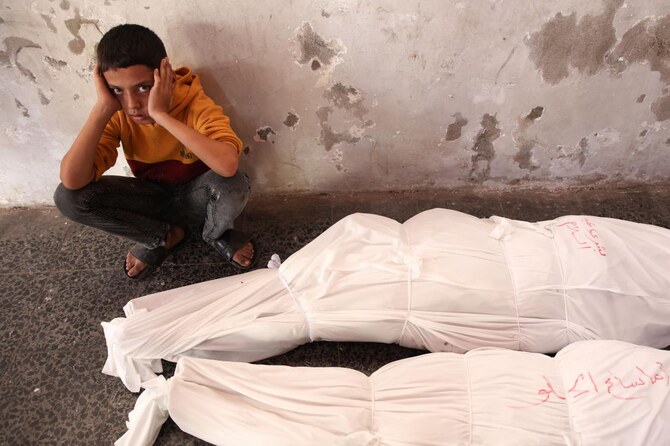
A Palestinian child sits next to the shrouded bodies of people killed in an Israeli strike. (AFP)
Short Url
Updated 01 November 2024
Follow

47 Palestinians killed overnight in Israeli strikes in central Gaza, Palestinian news agency says

  • Israel’s assault on Gaza has killed more than 43,000 Palestinians and reduced most of the enclave to rubble

GAZA: Forty seven Palestinians were killed and dozens injured, most of them children and women, in overnight Israeli bombardment of the city of Deir Al-Balah, the Nuseirat camp and the town of Al-Zawayda in the central Gaza Strip, the Palestinian news agency WAFA reported on Friday.

The Gaza war began after Hamas-led militants attacked Israel on Oct. 7, 2023, killing some 1,200 people and taking 251 hostages back to Gaza, according to Israeli tallies.

Israel’s subsequent assault on Gaza has killed more than 43,000 Palestinians and reduced most of the enclave to rubble, Palestinian authorities say.

At least 46 Palestinians were killed in Israeli military strikes across the Gaza Strip on Thursday, mostly in the north where one attack hit a hospital, torching medical supplies and disrupting operations, the enclave’s health officials said.

Israel’s military has accused the Palestinian militant group Hamas of using Kamal Adwan Hospital in Beit Lahiya for military purposes and said “dozens of terrorists” have been hiding there. Health officials and Hamas deny the assertion.

The health ministry in the Gaza Strip called for all international bodies “to protect hospitals and medical staff from the brutality of the (Israeli) occupation.”

Medical charity Médecins Sans Frontières (MSF) said on Thursday that one of its doctors at the hospital, Mohammed Obeid, had been detained last Saturday by Israeli forces. It called for the protection of him and all medical staff who “are facing horrific violence as they try to provide care.”


Efforts to heal Syria’s ‘deep divisions’ arduous but ‘not insurmountable,’ UN chief says on anniversary of Assad’s fall

Updated 5 sec ago
Follow

Efforts to heal Syria’s ‘deep divisions’ arduous but ‘not insurmountable,’ UN chief says on anniversary of Assad’s fall

  • Antonio Guterres hails ‘end of a decades-old system of repression,’ Syrians’ ‘resilience and courage’— Transition offers opportunity to ‘forge a nation where every Syrian can live securely, equally, and with dignity’

NEW YORK: Efforts to heal Syria’s “deep divisions” will be long and arduous but the challenges ahead are “not insurmountable,” UN Secretary-General Antonio Guterres said on Sunday as he marked the first anniversary of the fall of the Assad regime.

A surprise offensive by a coalition of rebel forces led by Hayat Tahrir al-Sham and allied militias rapidly swept through regime-held areas in late November 2024. Within days, they seized key cities and ultimately captured the capital Damascus.

On Dec. 8 last year, as regime defenses collapsed almost overnight, then-President Bashar Assad fled the Syrian Arab Republic, ending more than 50 years of brutal rule by his family.

“Today marks one year since the fall of the Assad government and the end of a decades-old system of repression,” Guterres said, praising the “resilience and courage” of Syrians “who never stopped nurturing hope despite enduring unimaginable hardship.”

He added that the anniversary was both a moment of reflection on the sacrifices made in pursuit of “historic change,” and a reminder of the difficult path ahead for the country.

“What lies ahead is far more than a political transition; it is the chance to rebuild shattered communities and heal deep divisions,” he said, adding that the transition offers an opportunity to “forge a nation where every Syrian — regardless of ethnicity, religion, gender or political affiliation — can live securely, equally, and with dignity.”

Guterres stressed that the UN will continue supporting Syrians as they shape new political and civic institutions.

“The challenges are significant, but not insurmountable,” he said. “The past year has shown that meaningful change is possible when Syrians are empowered and supported in driving their own transition.”

He added that communities across the country are building new governance structures, and that “Syrian women continue to lead the charge for their rights, justice, and equality.”

Though humanitarian needs remain “immense,” he pointed to progress in restoring services, widening aid access, and creating conditions for the return of refugees and displaced people.

Transitional justice efforts are under way, he added, alongside broader civic engagement. Guterres urged governments to stand firmly behind a “Syrian-led, Syrian-owned transition,” saying support must include respect for sovereignty, removal of barriers to reconstruction, and robust funding for humanitarian and economic recovery.

“On this anniversary, we stand united in purpose — to build a foundation of peace and prosperity and renew our pledge to a free, sovereign, united, and inclusive Syria,” he added.