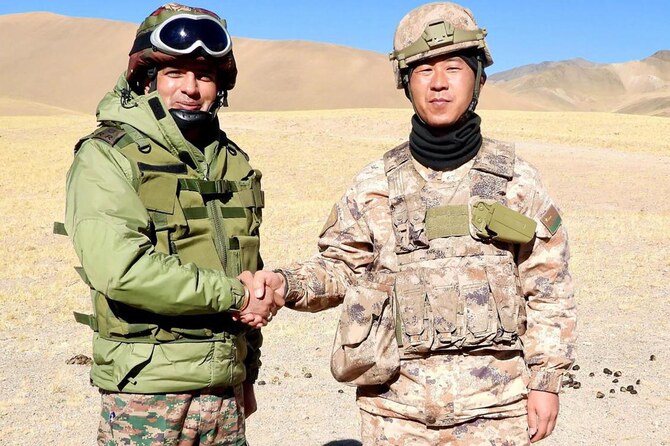
NEW DELHI: India and China have moved most of their frontline troops further from their disputed border in a remote region in the northern Himalayas, India’s defense minister said Thursday, some 10 days after the two countries reached a new pact on military patrols that aims to end a four-year standoff that’s strained relations.
Rajnath Singh said the “process of disengagement” of Indian and Chinese troops near the Line of Actual Control in Ladakh is “almost complete.”
The Line of Actual Control separates Chinese and Indian-held territories from Ladakh in the west to India’s eastern state of Arunachal Pradesh, which China claims in its entirety. India and China fought a deadly war over the border in 1962.
Ties between the two countries deteriorated in July 2020 after a military clash killed at least 20 Indian soldiers and four Chinese. That turned into a long-running standoff in the rugged mountainous area, as each side stationed tens of thousands of military personnel backed by artillery, tanks and fighter jets in close confrontation positions.
Earlier this month the two neighbors announced a border accord aimed at ending the standoff, followed by a meeting between India’s Prime Minister Narendra Modi and China’s President Xi Jinping on the sidelines of the recent BRICS summit in Russia, their first bilateral meeting in five years.
It’s not clear how far back the troops were moved, or whether the pact will lead to an overall reduction in the number of soldiers deployed along the border.
“Our efforts will be to take the matter beyond disengagement; but for that, we will have to wait a little longer,” Singh said.
Chinese Defense Ministry spokesperson Zhang Xiaogang said Thursday that the frontline troops were “making progress in implementing the resolutions in an orderly manner.”
The pact called for Indian and Chinese troops to pull back from the last two areas of the border where they were in close positions. After the deadly confrontation in 2020, soldiers were placed in what commanders called “eyeball to eyeball” positions at least six sites. Most were resolved after previous rounds of military and diplomatic talks as the two nations agreed to the creation of buffer zones.
However, disagreements over pulling back from in the Depsang and Demchok areas lasted until the Oct. 21 pact.
“It is a positive move,” said Lt. Gen. D.S. Hooda, who from 2014 to 2016 headed Indian military’s Northern Command, which controls Kashmir region, including Ladakh. “Given how deep mistrust has been between the two countries and how all confidence building measures collapsed, it is quite a positive beginning,” he said.
However, Hooda added, it will take time for both countries to return to their pre-2020 positions. “It does not mean everything is going to as normal as it existed earlier. We have to re-establish traditional patrolling and also the buffer zones need to be sorted out,” he said.
The border standoff also damaged business ties between the two nations, as India halted investments from Chinese firms and major projects banned.


![]()


India says frontier disengagement with China along their disputed border is ‘almost complete’
Short Url
https://arab.news/2x83t
India says frontier disengagement with China along their disputed border is ‘almost complete’
- The two countries reached a new pact on military patrols that aims to end a four-year standoff that hss strained relations
- Ties between the two countries deteriorated in July 2020 after a military clash killed at least 20 Indian soldiers and four Chinese


Taiwan says Chinese drone made ‘provocative’ flight over South China Sea island
TAIPEI: A Chinese reconnaissance drone briefly flew over the Taiwan-controlled Pratas Islands at the top end of the South China Sea on Saturday, in what Taiwan’s defense ministry called a “provocative and irresponsible” move.
Democratically governed Taiwan, which China claims as its own territory, reports Chinese military activity around it on an almost daily basis, including drones though they very rarely enter Taiwanese airspace.
Taiwan’s defense ministry said the Chinese reconnaissance drone was detected around dawn on Saturday approaching the Pratas Islands and flew in its airspace for eight minutes at an altitude outside the range of anti-aircraft weapons.
“After our side broadcast warnings on international channels, it departed at 0548,” it said in a statement.
“Such highly provocative and irresponsible actions by the People’s Liberation Army seriously undermine regional peace and stability, violated international legal norms, and will inevitably be condemned,” it added.
Taiwan’s armed forces will continue to maintain strict vigilance and monitoring, and will respond in accordance with the routine combat readiness rules, the ministry said.
Calls to China’s defense ministry outside of office hours on a weekend went unanswered.
In 2022, Taiwan’s military for the first time shot down an unidentified civilian drone that entered its airspace near an islet off the Chinese coast controlled by Taiwan.
Lying roughly between southern Taiwan and Hong Kong, the Pratas are seen by some security experts as vulnerable to Chinese attack due to their distance — more than 400 km (250 miles) — from mainland Taiwan.
The Pratas, an atoll which is also a Taiwanese national park, are only lightly defended by Taiwan’s military, but lie at a highly strategic location at the top end of the disputed South China Sea.
China also views the Pratas as its own territory.
Taiwan’s government rejects Beijing’s sovereignty claims.
Democratically governed Taiwan, which China claims as its own territory, reports Chinese military activity around it on an almost daily basis, including drones though they very rarely enter Taiwanese airspace.
Taiwan’s defense ministry said the Chinese reconnaissance drone was detected around dawn on Saturday approaching the Pratas Islands and flew in its airspace for eight minutes at an altitude outside the range of anti-aircraft weapons.
“After our side broadcast warnings on international channels, it departed at 0548,” it said in a statement.
“Such highly provocative and irresponsible actions by the People’s Liberation Army seriously undermine regional peace and stability, violated international legal norms, and will inevitably be condemned,” it added.
Taiwan’s armed forces will continue to maintain strict vigilance and monitoring, and will respond in accordance with the routine combat readiness rules, the ministry said.
Calls to China’s defense ministry outside of office hours on a weekend went unanswered.
In 2022, Taiwan’s military for the first time shot down an unidentified civilian drone that entered its airspace near an islet off the Chinese coast controlled by Taiwan.
Lying roughly between southern Taiwan and Hong Kong, the Pratas are seen by some security experts as vulnerable to Chinese attack due to their distance — more than 400 km (250 miles) — from mainland Taiwan.
The Pratas, an atoll which is also a Taiwanese national park, are only lightly defended by Taiwan’s military, but lie at a highly strategic location at the top end of the disputed South China Sea.
China also views the Pratas as its own territory.
Taiwan’s government rejects Beijing’s sovereignty claims.
Latest updates





© 2026 SAUDI RESEARCH & PUBLISHING COMPANY, All Rights Reserved And subject to Terms of Use Agreement.