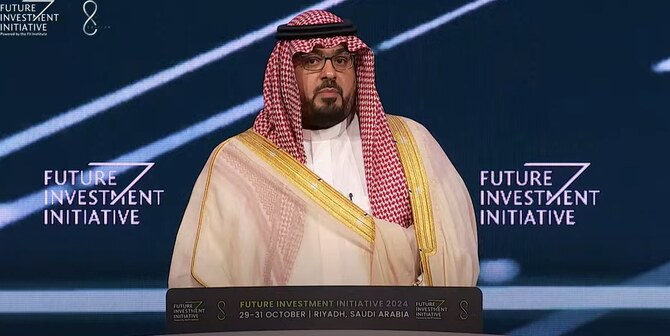

RIYADH: The ongoing energy transition, the rise of artificial intelligence, and geopolitical tensions are reshaping the global investment landscape, according to a top minister.
Speaking during the Future Investment Initiative in Riyadh on Oct. 31, Saudi Arabia’s Minister of Economy and Planning, Faisal Al-Ibrahim, said that the world needs efficiency-seeking investments to boost productivity and future growth.
“Megatrends of the energy transition, artificial intelligence, and geoeconomic fragmentation are fundamentally reshaping the investment landscape. We can and must fulfill our shared responsibility to invest in the future and capture opportunities that come with these paradigm shifts,” said Al-Ibrahim.
He added: “Today’s world calls for efficiency-seeking investments that can boost productivity and help the world to correct the low-growth, high-debt path that we as a global economy are currently sleepwalking alone.”
According to the Saudi minister, mere investments do not materialize future growth, but the proper channelization of funds will bring better outputs.
Al-Ibrahim also underscored the vitality of public-private partnerships to meet the investment demands for the future.
“The public and the private sectors must evolve in parallel and together to become more aligned with the demands of our times. Investment alone does not drive growth. It is the starting point of prosperity and a catalyst for progress. But what matters is how and where we direct our investments,” said the minister.
During his speech, Al-Ibrahim also highlighted Saudi Arabia’s achievements since the launch of Vision 2030 and added that the Kingdom’s non-oil sector is currently a significant contributor to economic development.
“Since the launch of Saudi Vision 2030, our economy without oil has grown 20 percent. At the same time, we have witnessed a 70 percent increase in private investments in our non-oil sectors. For the first time in history, non-oil activities now make up 53 percent of our real gross domestic product,” he said.
According to the minister, the Kingdom has opened the door to investments that infuse technology and innovation, and it has helped the nation to emerge as an investment powerhouse in the Middle East and North Africa region.
Al-Ibrahim added that Saudi Arabia had implemented several regulatory reforms that have turned the Kingdom into a friendly investment destination for international entities.
“What sets Saudi Arabia apart is not just we are the biggest economy in the Middle East. The world looks to Saudi Arabia for global solutions because we have long been a trusted and reliable partner. We have created a business environment that integrates innovation, provides more regulatory clarity, and offers practical solutions,” said the minister.
He added: “Investors deploy their capital in Saudi Arabia with the confidence that they will get the results and returns. In the first half of 2024 alone, 184 global companies relocated their headquarters in the Kingdom. Investment licenses have risen by nearly 50 percent.”
Speaking at FII8 on Oct. 29, Saudi Arabia’s Minister of Investment, Khalid Al-Falih, said the Kingdom 540 international companies have established their regional headquarters in Riyadh, meaning a 2030 target of 500 has already been surpassed.
Some prominent firms that opened their regional headquarters in the Kingdom include Northern Trust, Bechtel, and PepsiCo, as well as IHG Hotels and Resorts, PwC, and Deloitte.
Through the regional HQ program, Saudi Arabia introduced new tax incentives for multinational companies moving their regional headquarters to the Kingdom. These incentives include a 30-year exemption on corporate income tax and withholding tax related to headquarters activities, alongside discounts and support services.
In a separate panel discussion, Mohammed El-Kuwaiz, chairman of Saudi Arabia’s Capital Market Authority, said that the Kingdom is witnessing simultaneous growth in both the public market and private market, which includes venture capital firms.
El-Kuwaiz added that Saudi Arabia seeks to attract $3 trillion of investments over the next few years to accomplish the Vision 2030 goals.
“I imagine that the biggest wave of growth in Saudi Arabia is likely to come from the required pipeline of investments and financing needs. If you look at the quantum of investments required in Saudi from now to Vision 2030, estimates reach about $3 trillion. And that requires a lot of capital, both public and private capital at the same time,” said El-Kuwaiz.
The CMA chief also highlighted that Saudi Arabia’s capital markets are becoming increasingly attractive to international investors.
“In our case, the big story of the capital markets is both increase in the size as well as opening it up to international investment. International investment has moved from virtually nothing — five to six years ago to now slightly over SR400 billion ($106.50 billion), he added.