Riyadh Air plans wide-body jet order next year: official

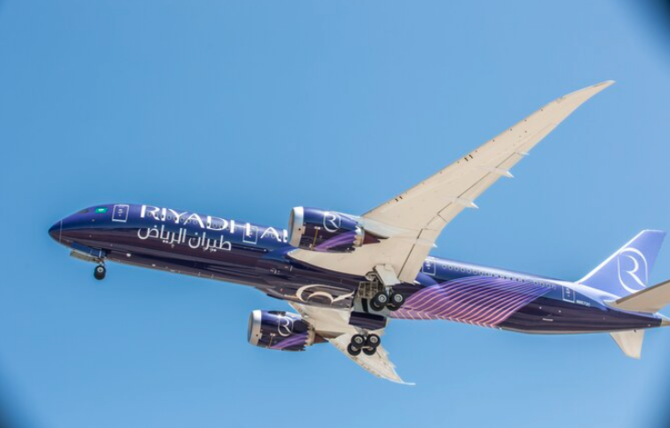
Riyadh Air expects to serve 100 routes by 2030 and more than 120 by 2035. File
Short Url
Updated 31 October 2024
Follow

Riyadh Air plans wide-body jet order next year: official

RIYADH: Saudi Arabia’s new national airline, Riyadh Air, plans next year to order wide-body aircraft capable of seating more than 300 passengers, its chief financial officer told AFP on Thursday.

The order would be the third for the airline, which was created last year and plans to operate its first flights in the summer of 2025.

“We will do our third RFP (request for proposal) for an ultimate ultra wide body, which has in excess of 300 seats as well, but that will be next year,” Adam Boukadida said on the sidelines of the Future Investment Initiative investor forum in Riyadh, referring to the request for proposal procurement document.

“It could be Boeing, it could be Airbus. At the moment, we’re very happy having the relationship with both of these key suppliers.”

On Wednesday, Riyadh Air announced a multi-billion dollar deal to purchase 60 narrow-body Airbus A321neo aircraft from Airbus.

That brought the firm’s total aircraft orders to 132 after a deal inked last year with Boeing for 39 wide-body Dreamliner 787-9s, which seat just under 300 passengers, with options for 33 more jets.

Saudi Crown Prince Mohammed bin Salman sees aviation as a key component of his Vision 2030 reform agenda to remake the petroleum-dominated country, aiming to more than triple annual traffic to 330 million passengers by the end of the decade.

Riyadh Air expects to serve 100 routes by 2030 and more than 120 by 2035. 

Deliveries of the Airbus planes “will start from the second half of 2026 all the way out to 2030,” Boukadida said.

“This will bring us in excess of 130 aircraft before 2030, so we’re still on track for the second half of next year to commence operations to over 100 destinations by 2030.”

Also on Thursday, Riyadh Air announced the establishment of its first revolving credit facility of up to SR5 billion ($1.3 billion) involving eight financial institutions from Saudi Arabia and the Gulf region.

“This would help us fund our growth, but also provide a platform for us to grow up until 2030 to be an international player,” Boukadida said.


Jordan’s industry fuels 39% of Q2 GDP growth

Updated 31 December 2025
Follow

Jordan’s industry fuels 39% of Q2 GDP growth

JEDDAH: Jordan’s industrial sector emerged as a major contributor to economic performance in 2025, accounting for 39 percent of gross domestic product growth in the second quarter and 92 percent of national exports.

Manufactured exports increased 8.9 percent year on year during the first nine months of 2025, reaching 6.4 billion Jordanian dinars ($9 billion), driven by stronger external demand. The expansion aligns with the country’s Economic Modernization Vision, which aims to position the country as a regional hub for high-value industrial exports, the Jordan News Agency, known as Petra, quoted the Jordan Chamber of Industry President Fathi Jaghbir as saying.

Export growth was broad-based, with eight of 10 industrial subsectors posting gains. Food manufacturing, construction materials, packaging, and engineering industries led performance, supported by expanded market access across Europe, Arab countries, and Africa.

In 2025, Jordanian industrial products reached more than 144 export destinations, including emerging Asian and African markets such as Ethiopia, Djibouti, Thailand, the Philippines, and Pakistan. Arab countries accounted for 42 percent of industrial exports, with Saudi Arabia remaining the largest market at 955 million dinars.

Exports to Syria rose sharply to nearly 174 million dinars, while shipments to Iraq and Lebanon totaled approximately 745 million dinars. Demand from advanced markets also strengthened, with exports to India reaching 859 million dinars and Italy about 141 million dinars.

Industrial output also showed steady improvement. The industrial production index rose 1.47 percent during the first nine months of 2025, led by construction industries at 2.7 percent, packaging at 2.3 percent, and food and livestock-related industries at 1.7 percent.

Employment gains accompanied the sector’s expansion, with more than 6,000 net new manufacturing jobs created during the period, lifting total industrial employment to approximately 270,000 workers. Nearly half of the new jobs were generated in food manufacturing, reflecting export-driven growth.

Jaghbir said industrial exports remain among the economy’s highest value-added activities, noting that every dinar invested generates an estimated 2.17 dinars through employment, logistics, finance, and supply-chain linkages. The sector also plays a critical role in narrowing the trade deficit and supporting macroeconomic stability.

Investment activity accelerated across several subsectors in 2025, including food processing, chemicals, pharmaceuticals, mining, textiles, and leather, as manufacturers expanded capacity and upgraded production lines to meet rising demand.

Jaghbir attributed part of the sector’s momentum to government measures aimed at strengthening competitiveness and improving the business environment. Key steps included freezing reductions in customs duties for selected industries, maintaining exemptions for production inputs, reinstating tariffs on goods with local alternatives, and imposing a 16 percent customs duty on postal parcels to support domestic producers.

Additional incentives in industrial cities and broader structural reforms were also cited as improving the investment climate, reducing operational burdens, and balancing consumer needs with protection of local industries.