

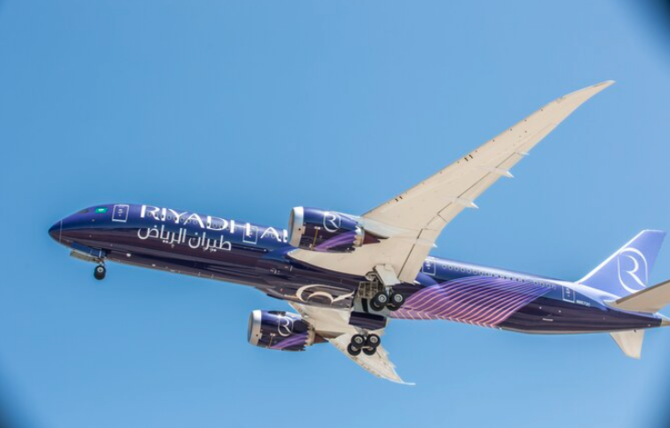
Riyadh Air plans wide-body jet order next year: official

Riyadh Air expects to serve 100 routes by 2030 and more than 120 by 2035. File
Short Url
Updated 31 October 2024
Follow

Riyadh Air plans wide-body jet order next year: official

RIYADH: Saudi Arabia’s new national airline, Riyadh Air, plans next year to order wide-body aircraft capable of seating more than 300 passengers, its chief financial officer told AFP on Thursday.

The order would be the third for the airline, which was created last year and plans to operate its first flights in the summer of 2025.

“We will do our third RFP (request for proposal) for an ultimate ultra wide body, which has in excess of 300 seats as well, but that will be next year,” Adam Boukadida said on the sidelines of the Future Investment Initiative investor forum in Riyadh, referring to the request for proposal procurement document.

“It could be Boeing, it could be Airbus. At the moment, we’re very happy having the relationship with both of these key suppliers.”

On Wednesday, Riyadh Air announced a multi-billion dollar deal to purchase 60 narrow-body Airbus A321neo aircraft from Airbus.

That brought the firm’s total aircraft orders to 132 after a deal inked last year with Boeing for 39 wide-body Dreamliner 787-9s, which seat just under 300 passengers, with options for 33 more jets.

Saudi Crown Prince Mohammed bin Salman sees aviation as a key component of his Vision 2030 reform agenda to remake the petroleum-dominated country, aiming to more than triple annual traffic to 330 million passengers by the end of the decade.

Riyadh Air expects to serve 100 routes by 2030 and more than 120 by 2035. 

Deliveries of the Airbus planes “will start from the second half of 2026 all the way out to 2030,” Boukadida said.

“This will bring us in excess of 130 aircraft before 2030, so we’re still on track for the second half of next year to commence operations to over 100 destinations by 2030.”

Also on Thursday, Riyadh Air announced the establishment of its first revolving credit facility of up to SR5 billion ($1.3 billion) involving eight financial institutions from Saudi Arabia and the Gulf region.

“This would help us fund our growth, but also provide a platform for us to grow up until 2030 to be an international player,” Boukadida said.


Saudi Maaden reports 156% profit surge to $2bn on strong commodity prices, record production

Updated 05 March 2026
Follow

Saudi Maaden reports 156% profit surge to $2bn on strong commodity prices, record production

RIYADH: Saudi mining and metals company Maaden has reported a 156 percent jump in its net profit attributable to shareholders for 2025, driven by higher commodity prices, record production volumes, and a one-off bargain purchase gain.

The state-backed giant posted a net profit of SR7.35 billion ($1.95 billion) for the full year 2025, an increase from SR2.87 billion in the previous year. The firm’s revenue surged by 19 percent to SR38.58 billion, up from SR32.55 billion in 2024.

This comes as Saudi Arabia steps up efforts to expand its mining sector as a pillar of economic diversification, encouraging international participation and private investment to unlock the Kingdom’s estimated $2.5 trillion in untapped mineral resources under Vision 2030.    

In a statement on Tadawul, the company said: “Performance was led by record phosphate production, near record aluminum production, an increase in all three of Maaden’s main output commodity prices.”

The performance was also fueled by a 60 percent increase in gross profit, which reached SR14.79 billion. In its annual results announcement, Maaden attributed the top-line growth to “higher commodity market prices for phosphate, aluminum and gold business units,” as well as increased sales volumes in its phosphate and aluminum segments. This was partially offset by slightly lower sales volume in the gold unit.

Maaden’s CEO, Bob Wilt, hailed 2025 as a transformative year for the company, marked by strategic growth and operational excellence. “This was a great year for Maaden’s strategic growth. We delivered strong financial results and sustained operational excellence across the business,” he said in a statement.

“This was driven by growth in production across all businesses, including record-breaking DAP (di-ammonium phosphatevolumes), disciplined cost control across and a clear commitment to our role as a cornerstone of the Saudi economy,” Wilt added.

Profitability was further bolstered by an increased share of net profit from joint ventures and an associate. This included a one-off bargain purchase gain of SR768 million related to Maaden’s investment in Aluminium Bahrain B.S.C. The company also benefited from lower finance costs.

The fourth quarter of 2025 was strong, with Maaden swinging to a net profit of SR1.67 billion, compared to a loss of SR106 million in the same period of the prior year. Quarterly revenue rose 7 percent to SR10.64 billion.

The firm achieved record production of di-ammonium phosphate, reaching 6.72 million tonnes for the year, a 9 percent increase. Aluminum production remained near-record levels, while the company added a net 7.8 million ounces to its reportable gold mineral resources through discovery and resource development.

The phosphate division saw sales jump 17 percent to SR20.77 billion, with the earnings before interest, taxes, depreciation, and amortization margin expanding to 47 percent. The aluminum business reported a 9 percent increase in sales to SR10.99 billion, with EBITDA more than doubling in the fourth quarter.

Looking ahead, Wilt emphasized that the pace of growth will accelerate as the company advances key initiatives, including the Phosphate 3 Phase 1 and Ar Rjum projects, which remain on budget and schedule. Maaden has also secured a gas supply for its future Phosphate 4 project.

“This pace of growth will only accelerate. Not only as we advance projects and increase the scale of our exploration program, but as we continue to grow production and implement technology that will further modernize, streamline and unlock value,” Wilt added.

Earnings per share for the year rose sharply to SR1.91, up from SR0.78 in 2024. Total shareholders’ equity increased by 18.7 percent to SR61.59 billion.