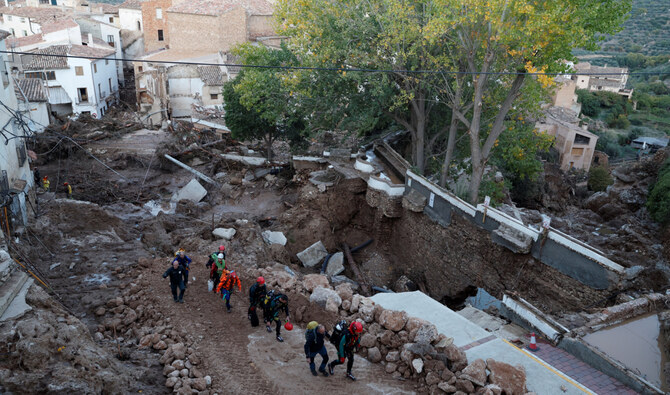

SEDAVI, Spain: Spain braced for a heavier human toll on Wednesday after 95 people died in flash floods that launched muddy waters through towns, tossed cars and wreaked transport havoc.
Rescuers were expected to find more bodies in the European country’s deadliest flood in more than 50 years and three days of official mourning were due to start on Thursday.
Heavy downpours and fierce winds have lashed Spain since the beginning of the week after a storm formed over the Mediterranean Sea, with up to a year’s worth of rain falling in just hours in some areas.
The body coordinating emergency services in the eastern Valencia region announced a provisional death toll of 92, adding that bodies were still being recovered and identified.
Two people died in neighboring Castilla-La Mancha and another victim was reported in Andalusia in the south, both regions’ leaders told journalists.
The toll is likely to rise because “there are many missing people,” government minister Angel Victor Torres told public broadcaster TVE.
The head of the Valencia region, Carlos Mazon, told reporters there were no longer people to save from roofs or terraces through aerial means.
Emergency services carried out 200 rescues on the ground and 70 aerial evacuations throughout the day, he said.
A sea of piled-up cars and mud swamped streets in Sedavi, a suburb of the Mediterranean coastal city of Valencia, AFP journalists saw.
Stunned residents attempted to clean the sludge and grabbed buckets to bail out water from their homes ahead of a long night without water or electricity.
In Ribarroja del Turia on the outskirts of Valencia city, town councillor Esther Gomez said workers were stuck overnight in an industrial estate “without a chance of rescuing them” as streams overflowed.
“It had been a long time since this happened and we’re scared,” she told AFP.
According to Spain’s weather service AEMET, the town of Chiva, west of Valencia, recorded 491 mm of rain in just eight hours on Tuesday — almost equalling a year’s worth.
“All of Spain weeps with all of you... We won’t abandon you,” Prime Minister Pedro Sanchez told victims and their families in a televised address.
The disaster could not be considered over and “we will deploy all the necessary resources for as long as necessary so that we can recover from this tragedy,” he added.
King Felipe VI said he was “devastated” by the news on X and offered “heartfelt condolences” to families of the victims, thanking emergency services for their “titanic” response.

Damage to telephone networks and flooded roads were hampering efforts to reach stricken communities in the Valencia region, but rescuers’ access to all urban hubs was restored by Wednesday evening, Mazon said.
Some 155,000 homes were without electricity in Valencia region due to the storm, energy company Iberdrola said, adding that it had dispatched 500 workers to restore power there.
Defense Minister Margarita Robles told reporters more than 1,000 troops backed by helicopters were being deployed in the face of “an unprecedented phenomenon.”
The European Union activated its Copernicus satellite system to help coordinate Spanish rescue teams, commission chief Ursula von der Leyen told a news conference in Brussels.
The bloc has also offered to use its civil protection mechanism to send further reinforcements, she said.
Officials in the Valencia region announced survivors were being sheltered in temporary accommodation such as fire stations.
Rail and air transport remained severely disrupted. The high-speed line between Valencia and Madrid will be suspended over the next four days at least, rail infrastructure authority Adif announced.
Some downpours are expected to continue, but AEMET removed all remaining red alerts in the evening.
The flood toll is Spain’s deadliest since 1973 when at least 150 people were estimated to have died in the southeastern provinces of Granada, Murcia and Almeria.
Meteorologists have said the latest storm was caused by cold air moving over Mediterranean’s warm waters, which produced intense rain clouds, a phenomenon common for the time of year.
Scientists warn extreme weather events such as storms are becoming more intense, last longer and occur more frequently as a result of human-induced climate change.
Such extremes “can overwhelm the ability of existing defenses and contingency plans to cope, even in a relatively wealthy country like Spain,” said Leslie Mabon, senior lecturer in environmental systems at Britain’s Open University.
The heavy death toll came after warnings for extreme rainfall, suggesting Valencia’s flood alert system failed, said Hannah Cloke, hydrology professor at the University of Reading.