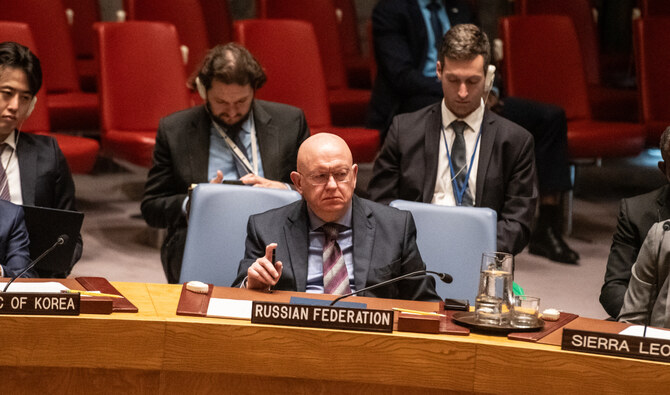
UNITED NATIONS: Russia’s ambassador to the United Nations on Wednesday denied reports that North Korean troops were present at its front lines in the war against Ukraine, calling them “barefaced lies.”
Vassily Nebenzia accused Washington and London of “disinformation” and insisted that Moscow’s interaction with North Korea has followed international law.
“These statements about the North Korean soldiers in our front should not surprise no one, because they’re all barefaced lies,” he told the Security Council.
Nebenzia spoke after the United States alleged that up to 10,000 North Korean soldiers had been deployed to Russia, which invaded Ukraine in February 2022, for possible action against Ukrainian forces.
On Tuesday the Pentagon said it had indications that a “small number” of North Korean troops had been deployed to Russia’s Kursk region, on the border with Ukraine.
Russia and North Korea have deepened their political and military alliance as the Ukraine war has dragged on, but sending Pyongyang’s troops into combat against Kyiv’s forces would mark a significant escalation that has sparked widespread international concern.
Even if the US allegations were true, Nebenzia said, “why is it that the United States and allies are trying to impose on everyone the flawed logic that they have the right to help the Zelensky regime... and Russian allies have no right” to do the same.
Nebenzia said Russia’s interaction with North Korea “in the military and other areas is in line with international law and is not a violation of it.”
However, other members of the Security Council expressed concern.
British ambassador Barbara Woodward warned of the benefits Pyongyang could derive from Moscow, in particular military assistance, which “risks further raising tensions on the Korean peninsula” and undermining security in the Indo-Pacific region.
If North Korean troops are indeed deployed in Russia, it would be seen as “a hostile act with direct consequences for European security, international peace and security, and would only increase the suffering of the Ukrainian people,” French ambassador Nicolas de Riviere said.
The United Nations said it had followed the allegations with “serious concern.”
“The United Nations does not have any additional details on these developments and is not in a position to verify or confirm claims or reports made,” said Miroslav Jenca, UN Under-Secretary-General for Europe.


![]()

Reports on North Korean troops ‘barefaced lies’: Russian UN envoy
Short Url
https://arab.news/6hjut
Reports on North Korean troops ‘barefaced lies’: Russian UN envoy


Latest updates


© 2026 SAUDI RESEARCH & PUBLISHING COMPANY, All Rights Reserved And subject to Terms of Use Agreement.