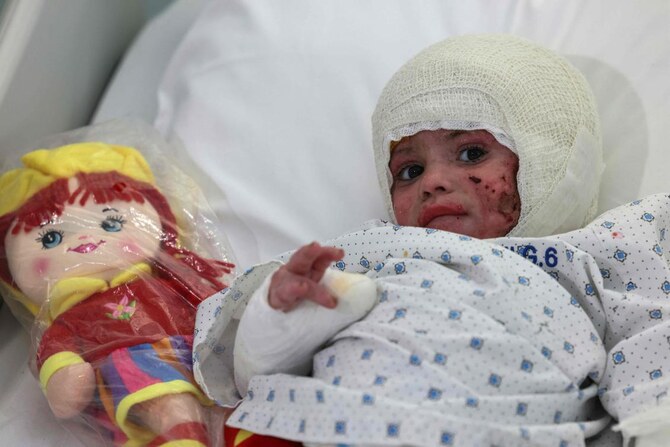
BEIRUT: Wrapped in gauze from her head to her tiny toes, toddler Ivana Skayki lies nearly motionless in a hospital bed much too big for her. For weeks, she has been treated for severe burns sustained in Israeli strikes on her hometown in southern Lebanon.
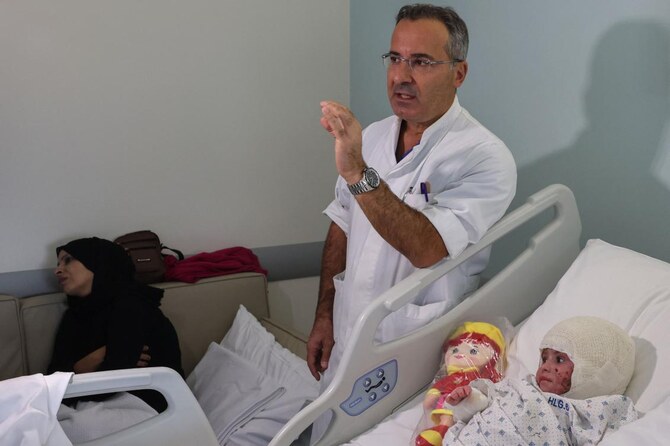
Skayki, who turns two next month, sustained burns to nearly 40 percent of her body, including half of her face, her chest and both upper limbs, according to Ziad Sleiman, plastic surgeon at the specialist burn unit in Beirut’s Geitaoui Hospital.
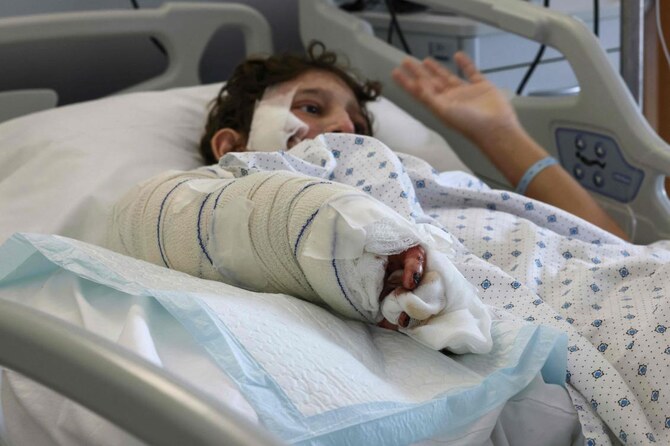
The unit is the only one across Lebanon equipped to deal with burns. Its hallways echo with the screams of children as anxious parents await news from doctors.
Ivana’s father Mohammad told Reuters his daughter was burned in Israeli strikes as they prepared to flee their hometown of Al-Aliyah on Sept. 23, the day that Israel dramatically ramped up its strikes on Lebanon.
More than 550 people were killed that day alone, according to Lebanon’s health ministry.
“There was a hit, the house shook — everything was breaking, the windows, the roof, everything, the blast was in my house,” Skayki recalled. “I thought to myself, ‘this could be it, this could be the end.’“
Israel says it makes all possible efforts to avoid civilian casualties and accuses Hezbollah of deliberately basing its fighters in residential areas and using civilians as human shields. Hezbollah has denied the accusation.
The family managed to flee to the southern port city of Tyre, where Ivana got initial treatment. They moved again to another hospital, but with no department there for burns, Ivana only got partial treatment before they could reach Beirut.
Sleiman said Ivana had received skin-graft operations and could be released within days. She still has deep red marks on her face, where some of her skin is peeling.
The hospital has admitted eight children with third-degree burns to half their bodies. It has had to be selective compared to other patients, Sleiman said, because it is short of space.
Geitaoui Hospital’s burn unit has a typical capacity of nine beds, but has managed to increase to 25 with help from the health ministry to cope with the influx of patients, said the hospital’s medical director Naji Abi Rached.
Most patients stay for up to six weeks because of their critical condition.
“Sometimes the outcome is not positive, due to the extent of the burns,” Abi Rached said.


![]()
![]()
![]()

Lebanon’s only burn unit treats toddlers after Israeli strikes
Short Url
https://arab.news/jp43w
Lebanon’s only burn unit treats toddlers after Israeli strikes
- The unit is the only one across Lebanon equipped to deal with burns and its hallways echo with the screams of children


Latest updates


© 2026 SAUDI RESEARCH & PUBLISHING COMPANY, All Rights Reserved And subject to Terms of Use Agreement.