

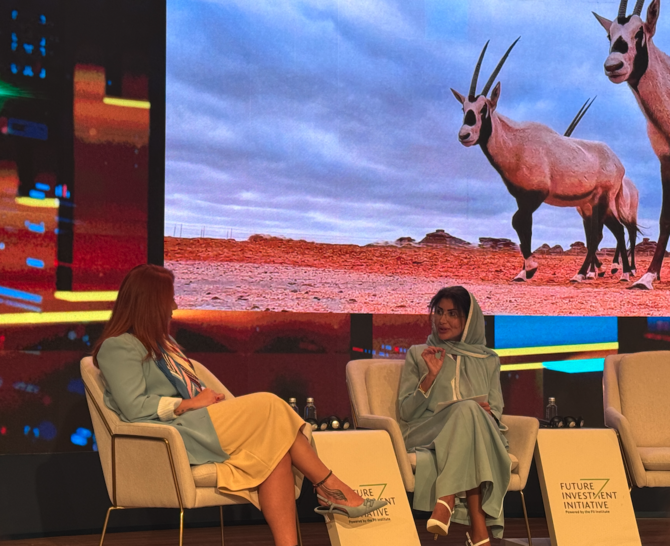

RIYADH: The Royal Commission for AlUla is reshaping the city’s economy, with non-tourism sectors contributing around SR7 billion ($1.86 billion) to Saudi Arabia’s gross domestic product, a senior official said.
During a panel session at the Future Investment Initiative in Riyadh, Abeer Al-Akel, acting CEO of RCU, highlighted that this figure nearly matches AlUla’s tourism contribution to the Kingdom’s gross domestic product at around SR9.5 billion.
Al-Akel said that the commission is working to diversify the city’s economic foundation and provide the local community with inclusive growth opportunities.
She added: “People might not know that the contribution of non-tourism sectors in AlUla is basically around SR7 billion, which is a very close amount to the tourism, right?

“We are basically working with the local community in ensuring that we provide the local community with opportunities for them to participate in what we do in AlUla.”
As part of RCU’s diversification strategy, agriculture ranks as the second-largest sector in AlUla after tourism.
The commission has committed to improving farming practices and enhancing the entire agricultural value chain — from production and packaging to buyer connectivity.
“We’re aiming to empower our farming community and introduce local produce to a broader market,” Al-Akel said, underscoring RCU’s goals of fortifying AlUla’s food ecosystem and increasing local producers’ market reach.
She continued: “We’re really doing this for three main reasons. One is to ensure that we create and advance the food ecosystem in AlUla and expand it, but we’re also doing this to empower our farming community.
Al-Akel added: “Finally, is to mainly do that because of introducing local produce to a bigger networking market.”
Furthermore, RCU’s efforts to establish AlUla as a regional film hub are underway, with recent successes including the blockbuster movie Kandahar featuring Gerard Butler.
She explained that AlUla now boasts a world-class, 30,000 sq. meter production facility, positioning it as a major destination for international film production.
With 700 production days already recorded, the sector is set to contribute to the economy and foster local creative talent both in front of and behind the camera.
AlUla’s historic role as an ancient crossroad of civilizations is being revitalized through strategic international partnerships.

RCU collaborates with leading global organizations such as UNESCO and the World Bank, working toward shared goals of cultural conservation, environmental preservation, and sustainable economic growth.
AlUla’s comprehensive eco-friendly approach, guided by its 12-point Sustainability Charter, places environmental and cultural preservation at the forefront of all initiatives.
As Al-Akel emphasized, the RCU’s mandate is to “strike a delicate balance between development and ecosystem progress,” ensuring that AlUla’s unique natural and cultural landscape is protected while fostering economic growth.
“We are on the right track, and we have achieved a lot in the past years; we have basically introduced and released over 2,300 animals into the wild,” Al-Akel said.
She continued to say that 50 percent of the lands are “basically protected,” adding: “We have recruited more than 150 Rangers that are now patrolling and monitoring those reserves.”


