Pakistani rescue service says 90 percent of Koh-e-Sulaiman forest blaze controlled 

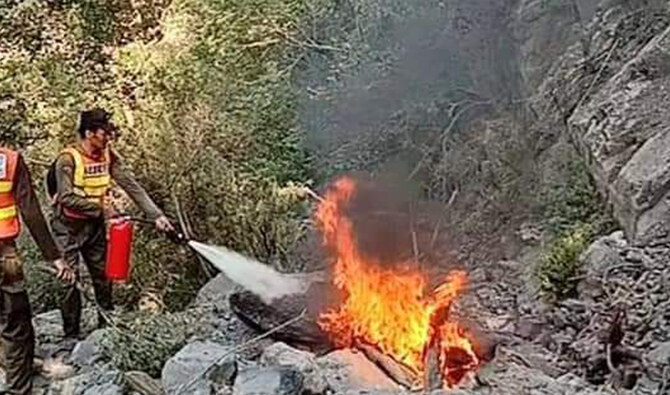
Firefighters try to extinguish a fire that erupted in the pine nut forests of the Koh-e-Sulaiman range in the Darazinda subdivision, Khyber Pakhtunkhwa on October 30, 2024. (Photo courtesy: Rescue 1122)
Short Url
Updated 30 October 2024
Follow

Pakistani rescue service says 90 percent of Koh-e-Sulaiman forest blaze controlled 

  • Pakistani rescue service says operation halted due to limited visibility, will resume early Thursday morning 
  • Two years ago, a significant fire broke out in the same mountain range in Balochistan that lasted for two weeks

DERA ISMAIL KHAN: Pakistani firefighters have controlled 90 percent of a blaze in the pine nut forests of the Koh-e-Sulaiman range in the Darazinda subdivision, Rescue 1122 emergency service said on Wednesday, with the operation halted temporarily due to limited visibility. 

Pakistan dispatched a 16-member team to the affected area after the fire broke out on Wednesday morning, who battled the flames with the provincial wildlife department throughout the day. 

“After working hard all day on the difficult paths of the mountain range, 90 percent of the fire has been controlled,” the statement said. 

“The current operation has been stopped due to limited visibility because of darkness in the mountain range,” it added. “However, the Rescue 1122 team is currently at the scene.” 

The emergency response service said firefighters will resume the operation to douse the flames early Thursday morning. 


Firefighters try to extinguish a fire that erupted in the pine nut forests of the Koh-e-Sulaiman range in the Darazinda subdivision, Khyber Pakhtunkhwa on October 30, 2024. (Photo courtesy: Rescue 1122)

In an earlier statement, Rescue 1122 said its team is equipped with all necessary firefighting gear, including fire extinguishers, personal protective equipment and other essential items required for working in mountainous areas.

“In such emergencies, methods like smoldering and starvation are employed to extinguish the fire, which involves cutting off the fire’s access to oxygen and fuel,” it explained. 


Firefighters try to extinguish a fire that erupted in the pine nut forests of the Koh-e-Sulaiman range in the Darazinda subdivision, Khyber Pakhtunkhwa on October 30, 2024. (Photo courtesy: Rescue 1122)

This is not the first such incident in the region’s pine nut forests. A significant fire broke out in the Sherani district, part of the same range that straddles Pakistan’s western provinces of Balochistan and Khyber Pakhtunkhwa, in May 2022.

The blaze lasted over two weeks, destroying a large portion of the ancient pine nut trees, with reports suggesting over 100,000 trees were burned, causing significant damage to the local ecosystem.

The 2022 fire in the Sherani district in Balochistan prompted Pakistan to seek assistance from Iran, which sent an air tanker to help extinguish the flames.

Such recurrent fires highlight the vulnerability of the region, where pine nut forests are not only ecologically valuable but also provide a livelihood for many locals.


Three Afghan migrants die crossing into Iran as UN warns of new displacement toward Pakistan

Updated 9 sec ago
Follow

Three Afghan migrants die crossing into Iran as UN warns of new displacement toward Pakistan

  • UNHCR says 1.8 million Afghans were forced to return from Iran this year, straining Afghanistan’s resources
  • Rights groups warn forced refugee returns risk harm as Afghanistan faces food shortages and climate shocks

KABUL: Three Afghans died from exposure in freezing temperatures in the western province of Herat while trying to illegally enter Iran, a local army official said on Saturday.

“Three people who wanted to illegally cross the Iran-Afghanistan border have died because of the cold weather,” the Afghan army official told AFP on condition of anonymity.

He added that a shepherd was also found dead in the mountainous area of Kohsan from the cold.

The migrants were part of a group that attempted to cross into Iran on Wednesday and was stopped by Afghan border forces.

“Searches took place on Wednesday night, but the bodies were only found on Thursday,” the army official said.

More than 1.8 million Afghans were forced to return to Afghanistan by the Iranian authorities between January and the end of November 2025, according to the latest figures from the United Nations refugee agency (UNHCR), which said that the majority were “forced and coerced returns.”

“These mass returns in adverse circumstances have strained Afghanistan’s already overstretched resources and services” which leads to “risks of onward and new displacement, including return movements back into Pakistan and Iran and onward,” UNHCR posted on its site dedicated to Afghanistan’s situation.

This week, Amnesty International called on countries to stop forcibly returning people to Afghanistan, citing a “real risk of serious harm for returnees.”

Hit by two major earthquakes in recent months and highly vulnerable to climate change, Afghanistan faces multiple challenges.

It is subject to international sanctions particularly due to the exclusion of women from many jobs and public places, described by the UN as “gender apartheid.”

More than 17 million people in the country are facing acute food insecurity, the UN World Food Program said Tuesday.