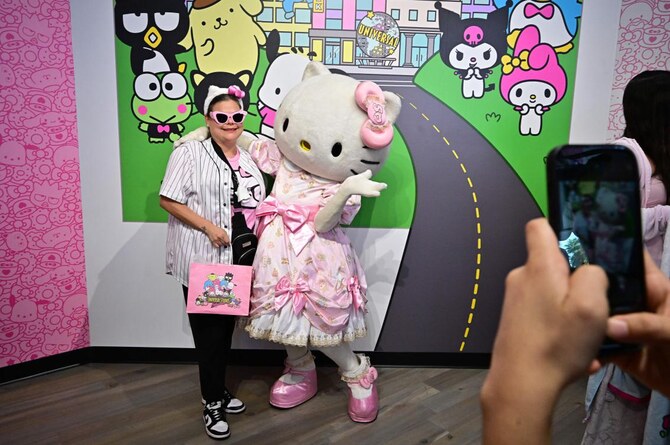
TOKYO: Hello Kitty, the cute, enigmatic character that adorns everything from handbags to rice cookers, turns 50 on Friday – still making millions for her Japanese creators.
The simple design of the character – who is not a cat, but a little girl from London according to Sanrio, the company behind Kitty – has mileage as a money-spinner for years to come, experts say.
One woman in the US state of California has amassed so much Hello Kitty merchandise that her husband built her a pink so-called “she-shed” to keep it in.
Stuffed inside are thousands of toys and other items featuring Kitty and her eye-catching red bow, including rows of sunglasses, a swivel chair and novelty gumball dispensers.
“People my age, you know, we are told many times, ‘Hello Kitty is for little kids,’ and I laugh at that,” said Helen from Riverside County, conceding she is “50 plus.”
Helen, who drives a Hello Kitty-decorated SUV and runs the local fan club “Hello Kitty SoCal Babes,” has been “obsessed” with the character since its 1970s US debut.
Her vast collection of Hello Kitty plushies “make me feel warm,” she said, describing spending hours among the soft toys, many of them rare, on a regular basis.
“Something in my inner child gets healed,” she said.
Hello Kitty started life as an illustration on a vinyl coin purse.
It has since appeared on tens of thousands of products – official and unofficial – including tie-ups with Adidas, Balenciaga and other top brands.
The phenomenon shows no sign of slowing, with a Warner Bros movie in the pipeline and a new Hello Kitty theme park due to open next year on China’s tropical Hainan island.
Sanrio’s share price has soared more than seven-fold, pushing its market cap over one trillion yen ($6.8 billion), since young CEO Tomokuni Tsuji took over from his grandfather in 2020.
“We’d be foolishly cynical to say that we don’t need these soft, fluffy, pink things,” Christine R. Yano of the University of Hawaii said.
In fact, “given the fraught nature of our contemporary lives, perhaps we need it now more than ever,” said Yano, author of the book “Pink Globalization” about Hello Kitty.
“This is not a phenomenon that has died or is going to die, at least soon.”
Unlike other Japanese cultural exports such as Pokemon or Dragon Ball, there is minimal narrative around the character, whose full name is Kitty White.
She has a twin sister Mimmy, a boyfriend called Dear Daniel, and a pet cat of her own, Sanrio says. She loves her mother’s apple pie and dreams of becoming a pianist or poet.
The rest is left to fans’ imaginations – just like her “abstract, bare design that can speak with a kind of simplicity and elegance to more people,” Yano said.
“I call her a ‘pure product’,” the researcher added.
Some feminists say Hello Kitty’s lack of mouth is a symbol of disempowerment, but Yano counters that by not depicting it, “she has a greater range of expression.”
Famous Hello Kitty fans include Lady Gaga, Nicki Minaj and Katy Perry, and her appeal extends to royalty: Britain’s King Charles wished her a happy birthday this year.
And on Hello Kitty’s TikTok account – whose bio is “CEO of supercute” – sardonic memes and footage from “Hello Kitty Day” at US baseball games delight 3.5 million followers.
Hello Kitty is the epitome of Japan’s “kawaii” – cute – soft power, and she is the mascot of a campaign promoting good tourist etiquette in Tokyo.
Posters celebrating the 50th anniversary are on display at Sanrio Puroland theme park, where businesswoman Kim Lu from Manila had brought her four-year-old niece on their holiday.
“This really is our priority here in Tokyo,” she said.
“To be honest, we really don’t know” the reason for Hello Kitty’s ineffable popularity, said Lu, 36.
“I think it’s the kawaii charm.”
Sanrio owns the copyright to hundreds of other popular characters, and Hello Kitty now accounts for 30 percent of profits, down from 75 percent a decade ago.
But Kitty is still a favorite of 23-year-old Rio Ueno, who took an overnight bus from Japan’s northern Niigata region to visit the park with a friend.
“I’ve had Kitty goods around me since I was a small child,” said Ueno, dressed in a fluffy Hello Kitty sweater, sporting a Kitty bag, and clutching a Kitty doll.
“She is someone who is always close to me, and I want it to stay that way.”


![]()

Hello Kitty – the cute, enigmatic character – turns 50 on Friday
Short Url
https://arab.news/9bqqp
Hello Kitty – the cute, enigmatic character – turns 50 on Friday
- The simple design of the character – who is not a cat, but a little girl from London according to Sanrio – has mileage as a money-spinner for years to come, experts say

Latest updates





© 2026 SAUDI RESEARCH & PUBLISHING COMPANY, All Rights Reserved And subject to Terms of Use Agreement.