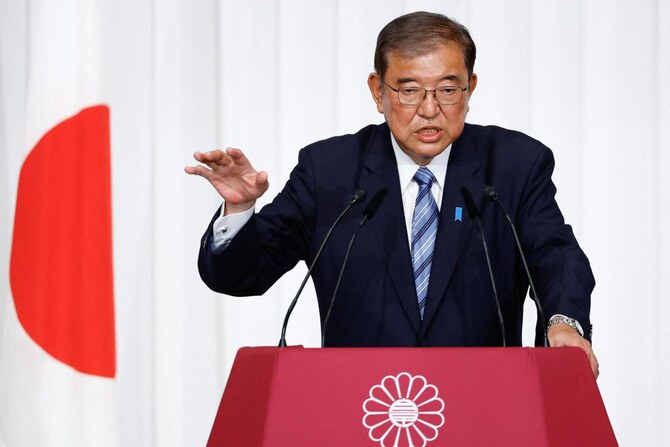
TOKYO: Support has sunk further for Japan’s embattled ruling coalition, a new poll showed Wednesday, after Prime Minister Shigeru Ishiba’s party suffered its worst election result in 15 years.
Backing for the government nosedived to 34 percent, while its disapproval rating came to 51 percent, according to the survey by the Yomiuri Shimbun daily.
In Ishiba’s short honeymoon period after taking office on October 1, the same survey found 51 percent supported his cabinet against 32 percent who didn’t.
A separate poll by Kyodo News released Tuesday had 53 percent saying they did not want the ruling coalition of the Liberal Democratic Party (LDP) and Komeito to stay in power.
Sunday’s snap election left the coalition short of a majority for the first time since 2009 — when it was booted out of power for three years — 18 seats short of the 233 needed.
Ishiba has already indicated he will seek to govern a minority administration and seek approval from other parties to get legislation through parliament.
That expectation was reinforced late Tuesday when the head of potential kingmaker the Democratic Party for the People (DPP), which has 28 seats, ruled out joining the LDP in a coalition government.
“We will give all of our strength to achieve our policies and we will not join the coalition,” DPP chief Yuichiro Tamaki said at a press conference.
However, Ishiba is still courting other parties including the centrist DPP to secure parliamentary approval to remain prime minister in a vote reportedly slated for November 11.
To win their support, analysts said that Ishiba may agree to tax cuts and stimulus spending that the DPP campaigned on in the snap election.
Also likely seeking to become premier will be Yoshihiko Noda, head of the Constitutional Democratic Party (CDP), whose seat tally rose from 96 in the last election to 148.
In a likely run-off vote, unseen in the past three decades, whoever wins the most votes will become the next leader, even if the person does not have a majority.
“The DPP is in an extremely strong position and holds a ‘casting vote’ that can decide the direction of political momentum,” Takahide Kiuchi, executive economist at Nomura Research Institute, said in a memo.

Support sinks for Japan coalition after election blow
Short Url
https://arab.news/zu5k2
Support sinks for Japan coalition after election blow
- Sunday’s snap election left the ruling coalition short of a majority for the first time since 2009
- Shigeru Ishiba has already indicated he will seek to govern a minority administration
European leaders expected to cement support for Ukraine amid Washington pressure to accept deal
BERLIN (AP) — European leaders are expected to cement support for Ukraine Monday as it faces Washington’s pressure to swiftly accept a U.S.-brokered peace deal.
After Sunday’s talks in Berlin between U.S. envoys and Ukrainian President Volodymyr Zelenskyy, Ukrainian and European officials are set to continue a series of meetings in an effort to secure the continent’s peace and security in the face of an increasingly assertive Russia.
Zelenskyy sat down Sunday with U.S. President Donald Trump’s special envoy Steve Witkoff and Trump’s son-in-law Jared Kushner in the German federal chancellery in the hopes of bringing the nearly four-year war to a close.
Washington has tried for months to navigate the demands of each side as Trump presses for a swift end to Russia’s war and grows increasingly exasperated by delays. The search for possible compromises has run into major obstacles, including control of Ukraine’s eastern Donetsk region, which is mostly occupied by Russian forces.
Zelenskyy on Sunday voiced readiness to drop his country’s bid to join NATO if the U.S. and other Western nations give Kyiv security guarantees similar to those offered to NATO members. But Ukraine continued to reject the U.S. push for ceding territory to Russia.
Putin wants Ukraine to withdraw its forces from the part of the Donetsk region still under its control among the key conditions for peace.
The Russian president also has cast Ukraine’s bid to join NATO as a major threat to Moscow’s security and a reason for launching the full-scale invasion in February 2022. The Kremlin has demanded that Ukraine renounce the bid for alliance membership as part of any prospective peace settlement.
Zelenskyy emphasized that any Western security assurances would need to be legally binding and supported by the U.S. Congress.
‘Pax Americana’ is over
German Chancellor Friedrich Merz, who has spearheaded European efforts to support Ukraine alongside French President Emmanuel Macron and U.K. Prime Minister Keir Starmer, said Saturday that “the decades of the ‘Pax Americana’ are largely over for us in Europe and for us in Germany as well.”
He warned that Putin’s aim is “a fundamental change to the borders in Europe, the restoration of the old Soviet Union within its borders.”
“If Ukraine falls, he won’t stop,” Merz warned during a party conference in Munich.
Macron, meanwhile, vowed Sunday on social platform X that “France is, and will remain, at Ukraine’s side to build a robust and lasting peace — one that can guarantee Ukraine’s security and sovereignty, and that of Europe, over the long term.”
Putin has denied plans to attack any European allies.
After Sunday’s talks in Berlin between U.S. envoys and Ukrainian President Volodymyr Zelenskyy, Ukrainian and European officials are set to continue a series of meetings in an effort to secure the continent’s peace and security in the face of an increasingly assertive Russia.
Zelenskyy sat down Sunday with U.S. President Donald Trump’s special envoy Steve Witkoff and Trump’s son-in-law Jared Kushner in the German federal chancellery in the hopes of bringing the nearly four-year war to a close.
Washington has tried for months to navigate the demands of each side as Trump presses for a swift end to Russia’s war and grows increasingly exasperated by delays. The search for possible compromises has run into major obstacles, including control of Ukraine’s eastern Donetsk region, which is mostly occupied by Russian forces.
Zelenskyy on Sunday voiced readiness to drop his country’s bid to join NATO if the U.S. and other Western nations give Kyiv security guarantees similar to those offered to NATO members. But Ukraine continued to reject the U.S. push for ceding territory to Russia.
Putin wants Ukraine to withdraw its forces from the part of the Donetsk region still under its control among the key conditions for peace.
The Russian president also has cast Ukraine’s bid to join NATO as a major threat to Moscow’s security and a reason for launching the full-scale invasion in February 2022. The Kremlin has demanded that Ukraine renounce the bid for alliance membership as part of any prospective peace settlement.
Zelenskyy emphasized that any Western security assurances would need to be legally binding and supported by the U.S. Congress.
‘Pax Americana’ is over
German Chancellor Friedrich Merz, who has spearheaded European efforts to support Ukraine alongside French President Emmanuel Macron and U.K. Prime Minister Keir Starmer, said Saturday that “the decades of the ‘Pax Americana’ are largely over for us in Europe and for us in Germany as well.”
He warned that Putin’s aim is “a fundamental change to the borders in Europe, the restoration of the old Soviet Union within its borders.”
“If Ukraine falls, he won’t stop,” Merz warned during a party conference in Munich.
Macron, meanwhile, vowed Sunday on social platform X that “France is, and will remain, at Ukraine’s side to build a robust and lasting peace — one that can guarantee Ukraine’s security and sovereignty, and that of Europe, over the long term.”
Putin has denied plans to attack any European allies.
© 2025 SAUDI RESEARCH & PUBLISHING COMPANY, All Rights Reserved And subject to Terms of Use Agreement.


