

Germany recalls envoy to Iran over execution of dual national

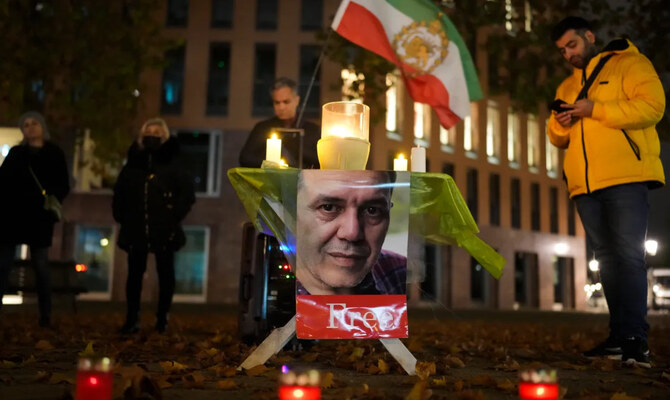
People commemorate Iranian-German Jamshid Sharmahd during a protest following his execution in Iran, near the Foreign Ministry in Berlin, Germany, Oct. 28, 2024. (AP)
Short Url
Updated 29 October 2024
Follow

Germany recalls envoy to Iran over execution of dual national

  • Sharmahd, who also holds US residency, was sentenced to death in 2023 on charges of “corruption on earth,” a capital offense under Iran’s Islamic laws

BERLIN: Germany has recalled its ambassador to Iran over the execution of German Iranian national Jamshid Sharmahd and summoned the Iranian charge d’affaires to voice Berlin’s protest, the German foreign office said on Tuesday.

“We have sent our strongest protest against the actions of the Iranian regime & reserve the right to take further action,” the Foreign Ministry said in a post on X.

Germany’s ambassador in Tehran protested in the strongest possible terms against the killing of Sharmahd, the post said, adding that German Foreign Minister Annalena Baerbock had recalled the ambassador to Berlin for consultations. Iranian state media said on Monday Sharmahd was put to death after he was convicted of carrying out terrorist attacks. “No terrorist enjoys impunity in Iran. Even if supported by Germany,” Iran’s Foreign Minister Abbas Araqchi said on X.

“Iranian national Jamshid Sharmahd openly and unashamedly led a terrorist attack on a mosque that killed 14 innocent people.”

Iranian state media reported on Tuesday that the German ambassador was summoned by the Foreign Ministry over “interventionist comments” made by German officials against the Iranian judiciary’s decision.

“Support for Sharmahd contradicts the German government’s claims in regards to the rule of law, the protection of human rights, and the fight against terrorism,” the Foreign Ministry said according to state media.

Sharmahd, who also holds US residency, was sentenced to death in 2023 on charges of “corruption on earth,” a capital offense under Iran’s Islamic laws.

He was accused by Iran of heading a pro-monarchist group accused of a deadly 2008 bombing and planning other attacks.

His daughter Gazelle Sharmahd, also on X, demanded proof of his execution and called for the immediate return of her father.


Greek coast guard search for 15 after migrant boat found adrift

Updated 4 sec ago
Follow

Greek coast guard search for 15 after migrant boat found adrift

  • The two survivors reported that the vessel had become unstable due to bad weather and there was no means of getting shelter, food or water

ATHENS: Greek coast guard were on Monday searching for 15 people who fell into the water from a migrant boat that was found drifting off the coast of Crete with 17 bodies on board.
The 17 fatalities, all of them men, were discovered on Saturday on the craft, which was taking on water and partially deflated, some 26 nautical miles (48 kilometers) southwest of the island.
Post-mortem examinations were being carried out to determine how they died but Greek public television channel ERT suggested they may have suffered from hypothermia or dehydration.
A Greek coast guard spokeswoman told AFP that two survivors reported that “15 people fell in the water” after the motor cut out on Thursday, then the vessel drifted for two days.
At the time, Crete and much of the rest of Greece was battered by heavy rain and storms.
The two survivors reported that the vessel had become unstable due to bad weather and there was no means of getting shelter, food or water.
The vessel had 34 people on board and had left the Libyan port of Tobruk on Wednesday, the Greek port authorities said. Most of those who died came from Sudan and Egypt.
It was initially spotted by a Turkish-flagged cargo ship on Saturday, triggering a search that included ships and aircraft from the Greek coast guard and the European Union border agency Frontex.
Migrants have been trying to reach Crete from Libya for the last year, as a way of entering the European Union. But the Mediterranean crossing is perilous.
In Brussels, the EU’s 27 members on Monday backed a significant tightening of immigration policy, including the concept of returning failed asylum-seekers to “return hubs” outside the bloc.
The UN refugee agency said more than 16,770 asylum seekers in the EU have arrived on Crete since the start of the year — more than any other island in the Aegean Sea.
Greece’s conservative government has also toughened its migration policy, suspending asylum claims for three months, particularly those coming to Crete from Libya.