

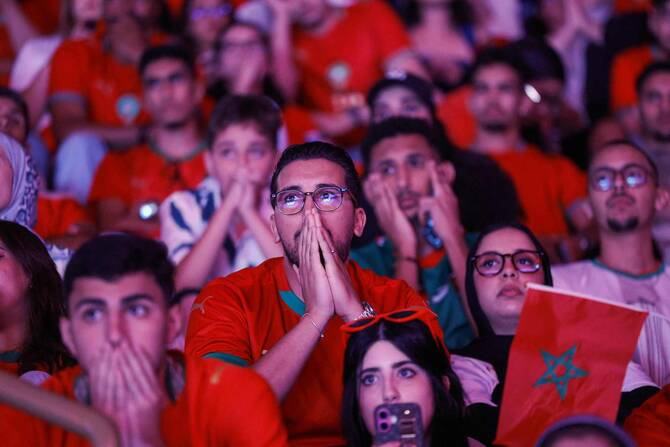

DUBAI: Morocco’s 2-0 quarterfinal defeat by France ended another memorable FIFA World Cup campaign, but perhaps the biggest takeaway from the Atlas Lions’ exit was not the result — it was what followed.
Four years after becoming the first Arab and African nation to reach a World Cup semifinal, Morocco no longer measures success simply by how far its team progresses. Expectations have changed. And that was evident in the reaction following the loss to France.
“We can’t just say we are happy and proud with our achievements here. We need to move forward, be self-critical and assess the situation,” said head coach Mohamed Ouahbi.
Those words capture the evolution of Moroccan football.
Not long ago, reaching the knockout stages of a World Cup would have been celebrated as a remarkable achievement. Today, a place in the quarterfinals and a competitive campaign against one of the current tournament favorites leaves a sense more was possible. That is not disappointment born of unrealistic expectations — it is the mindset of a team that now believes it belongs among the world’s elite.
France deserved their victory, again demonstrating the quality that has made them a dominant force in international football, Morocco, meanwhile, struggled to create opportunities and missed the presence of Ismael Saibari, whose three goals made him their leading scorer before he was ruled out of the quarterfinal by a hamstring injury. His absence highlighted the importance of attacking depth at the highest level, an area Morocco will continue to strengthen.
Yet the reasons for optimism extend well beyond the current squad.
Morocco’s investment in football over the past decade is producing results at every level of the game. The country’s success is no longer built around one outstanding generation but is increasingly supported by a production line of young talent capable of sustaining that progress.
The clearest evidence came in 2025, when Morocco won both the FIFA U-20 and U-17 World Cups. Those triumphs reflected years of investment in player development, coaching and infrastructure, and offered further proof that the country’s future is built on far more than the achievements of its current senior team.
Many of those young players are expected to challenge for places in the senior squad over the next four years, creating increased competition and giving Morocco greater depth across the pitch. For a team that has now reached the latter stages of successive World Cups, that depth could prove as important as individual talent.
Attention will now turn to 2030, when Morocco will be one of the World Cup’s host nations alongside Spain and Portugal. By then, many of today’s senior internationals will be entering the prime of their careers, while the U-20 and U-17 world champions will be knocking on the door of the national team.
The opportunity is significant. Home support, tournament experience and a new generation of emerging talent could give Morocco its strongest World Cup squad yet.
The defeat by France was disappointing, but it also demonstrated how much Moroccan football has evolved.
The ambition is no longer to reach the knockout rounds. It is to compete for the biggest prize in football.
With a championship mindset, an experienced core and one of the world’s most promising youth pipelines, Morocco will head into the 2030 World Cup not simply as a host nation, but as a country with genuine reason to believe it can challenge for the title.


