

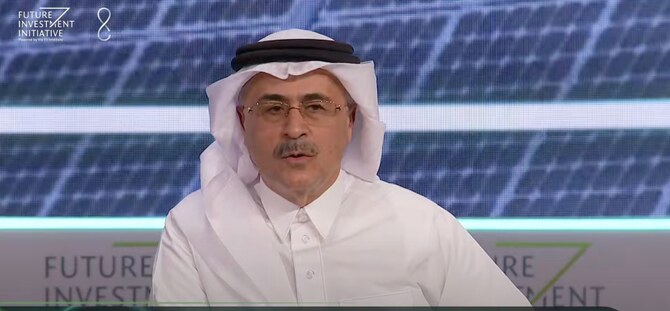

RIYADH: The global oil market remains stable, with Saudi Aramco forecasting an average demand of 104.5 million barrels per day for this year, according to CEO Amin Nasser.
Speaking at the Future Investment Initiative conference in Riyadh, Nasser addressed the current dynamics affecting oil prices and consumption, particularly the implications of interest rate changes and economic conditions in China.
“I think the market is currently balanced today. Definitely the increase in interest rates, what happened in China, had an impact, but it is balanced in terms of demand-supply fundamentals,” Nasser said.
“We are looking at 104.5 (million barrels per day) an average for this year, the fourth quarter we are looking close to 106 million barrels,” he added.
However, declining oil demand from China, the world’s largest crude oil importer, has posed challenges to global oil consumption and prices.
Nasser acknowledged that while there is a “small impact” on gasoline due to the rise of electric vehicles and current economic conditions, growth still exists in China.
“When people talk about China, they are always trying to maximize the downside and ignoring the upside,” he said.
In addition to addressing market conditions, Nasser highlighted Saudi Aramco’s commitment to sustainability, reiterating plans to launch a carbon capture, utilization, and storage project by 2027, aimed at capturing 9 million tonnes of carbon dioxide annually.
Speaking on a panel titled “Future of Energy: What Will Accelerate the Energy Transition Curve?” on the first day of FII*, Nasser explained that this initiative will create a hub serving not only Aramco but the entire Kingdom.
The move aligns with the oil giant’s broader strategy to achieve zero Scope 1 and 2 emissions across its wholly-owned assets by 2050, with an interim target of a 1.5 percent reduction by 2035 compared to 2021. The company also aims to reduce Scope 1 and 2 emissions intensity by 15 percent by 2035.
“We’re building one of the biggest projects at 9 million tonnes by the end of 2027 or early 2028. We have been working for a number of years to identify the aquifers that will create the hub required to facilitate not only the 9 million tonnes but other emissions, like CO2, that might come from the rest of the industries in the Kingdom,” Nasser said.
He added: “We are creating a hub that will cater not only for Aramco but for the rest of the Kingdom. We identified the aquifers and the storage capacity through exploration and drilling in the pilot wells that will be sufficient to satisfy the Kingdom’s requirements by 2060.”
Nasser emphasized that both Aramco and Saudi Arabia are making significant investments in renewables, hydrogen, and carbon capture and storage technologies.
“So, we are for the transition, but at the same time, we are making sure that we are growing our oil and gas activities and petrochemicals,” he said.
“If you look at our emissions of methane and CO2, it is the lowest. So, we are not really against the transition; actually, we are for the transition, especially with the Kingdom’s Green Initiative and all of that,” Nasser added.


