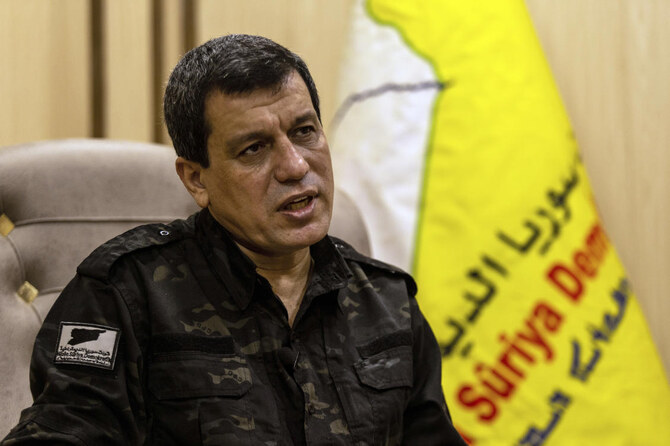
QAMISHLI: The leader of the US-backed Kurdish forces in northeast Syria in an interview with The Associated Press called for international mediators to push for diplomatic solutions to the complex web of conflicts in Syria, including the escalating Turkish bombardment of Kurdish areas.
Turkiye has intensified its airstrikes in northern Iraq and northeastern Syria following an Oct. 23 attack on a defense company in Ankara that killed five people and wounded more than 20. Turkish airstrikes targeted dozens of sites believed to be linked to or affiliated with the Kurdistan’s Worker’s Party (PKK), which claimed responsibility for the attack.
Mazloum Abdi, commander-in-chief of the Syrian Democratic Forces (SDF), said that the attack in Ankara served as an excuse for a long-planned Turkish operation in Syria.
“The Turks claim that these attacks are a response to the recent activity in Ankara. But that is not the reason, because the type and continuity of the attacks now entering their sixth day show that this is not a mere response. The Ankara incident was just an excuse,” Abdi told AP in an interview Tuesday evening.
He alleged that the Turkish strikes, which have damaged electricity and oil facilities and bakeries, have had severe consequences for civilians and are part of a broader strategy by Turkiye to force a demographic shift by pushing Kurdish residents out of the area.
The strikes have killed at least 18 people, mostly civilians, with injured more than 60. Abdi said in some cases Turkish strikes had targeted emergency teams responding to the initial strike.
The Turkish bombardment hinders the fight against the Daesh group
Still, he said, “We are open to dialogue with all parties, including Turkiye, even though their attacks persist.”
He appealed to the US-led coalition formed to fight the Islamic State militant group and to other mediators to push for diplomatic solutions.
The PKK is considered a terror organization by Turkiye’s Western allies, including the United States. Turkiye and the US, however, disagree on the status of the Syrian Kurdish groups, which have been allied with Washington in the fight against the IS group in Syria.
The escalation in northern Syria comes as the United States has agreed to a gradual troop reduction in Iraq, part of a larger drawdown expected to conclude by end of 2026.
While the withdrawal applies solely to Iraq, with no immediate plans to exit Syria, Abdi expressed concern over how the coalition’s diminishing presence in the region could affect operations in Syria.
“We, along with coalition forces, conduct daily activities to neutralize Daesh cells, and if the coalition withdraws, the threat level would rise across the region,” Abdi said.
He added that Turkish bombardment has hindered the SDF’s ability to conduct anti-IS operations, delaying two planned campaigns against cells in Syria.
US officials have yet to announce any specific timeline for troop reductions in Syria, though discussions continue amid rising tensions.
Analysts have said that a US departure could lead to increased pressure on the SDF from both Turkish and Syrian government forces, exacerbating the region’s security vacuum and the conflict’s toll on civilians.
Talks ongoing between the SDF and Assad’s government
Abdi said that dialogue between the SDF and the government of Bashar Assad in Damascus has been ongoing since the early years of the 13-year-old Syrian uprising-turned-civil-war, though these discussions have yielded limited progress.
“We have made numerous attempts to reach an agreement with the Syrian regime, but they have yet to produce results,” he said. The main sticking point, he said, has been the Syrian government’s reluctance to recognize the SDF’s administrative and military autonomy in the region. The Kurdish forces have called for a constitutional change that that formalizes the SDF’s role in security and governance after more than a decade of self-administration.
“For us, there are some red lines,” Abdi said.
The prospect of reconciliation between Turkiye and the Syrian government presents additional challenges. There have been several attempts at a rapprochement between Damascus and Ankara that so far have not progressed to an agreement.
According to Abdi, Turkiye is pushing for a deal that would dismantle the existing self-administration in northeastern Syria.
“The Turkish government said clearly that they would reconcile with the Syrian regime on the basis of eliminating the existing status of this region, which makes us their target,” he said.
The proposed reactivation of the 1998 Adana Agreement between Turkiye and Syria, aimed at addressing security concerns along their shared border, could have serious ramifications for the Kurdish region.


![]()

Kurdish leader in Syria calls for diplomatic solutions to conflict with Turkiye
Short Url
https://arab.news/565q5
Kurdish leader in Syria calls for diplomatic solutions to conflict with Turkiye
- Turkiye has intensified its airstrikes in northern Iraq and northeastern Syria following an Oct. 23 attack on a defense company in Ankara
Latest updates




© 2026 SAUDI RESEARCH & PUBLISHING COMPANY, All Rights Reserved And subject to Terms of Use Agreement.