DUBAI: Israel’s attack on Iran likely damaged a base run by the paramilitary Revolutionary Guard that builds ballistic missiles and launches rockets as part of its own space program, satellite images analyzed by The Associated Press on Tuesday showed.
The damage at the base in Shahroud raises new questions about Israel’s attack early Saturday, particularly as it took place in an area previously unacknowledged by Tehran and involved the Guard, a powerful force within Iran’s theocracy that so far has remained silent about any possible damage it suffered from the assault. Iran only has identified Israeli attacks as taking place in Ilam, Khuzestan and Tehran provinces — not in rural Semnan province where the base is located.
It also potentially further restrains the Guard’s ability to manufacture the solid-fuel ballistic missiles it needs to stockpile as a deterrent against Israel. Tehran long has relied on that arsenal as it cannot purchase the advanced Western weapons that Israel and Tehran’s Gulf Arab neighbors have armed themselves with over the years, particularly from the United States.
Satellite photos earlier analyzed by the AP of two military bases near Tehran also targeted by Israel shows sites there Iran uses in its ballistic missile manufacturing have been destroyed, further squeezing its program.
“We don’t know if Iranian production has been crippled as some people are saying or just damaged,” said Fabian Hinz, a missile expert and research fellow at the International Institute for Strategic Studies who studies Iran. “We’ve seen enough imagery to show there’s an impact.”
Iran’s mission to the United Nations did not immediately respond to a request for comment, nor did the Israeli military.
Images show major building at Shahroud base destroyed
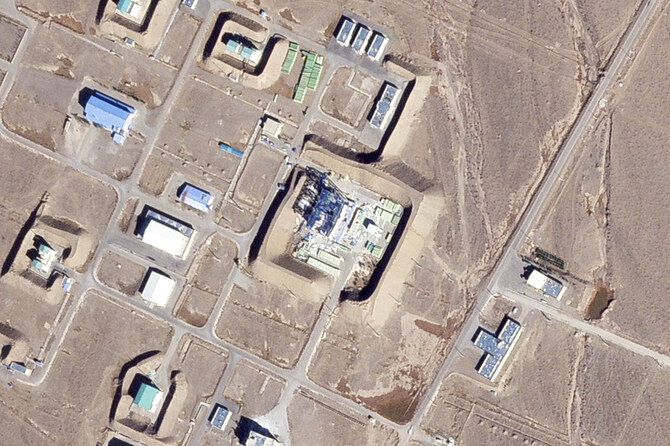
High-resolution satellite images from Planet Labs PBC taken for and analyzed by the AP showed the damage at the Guard’s Shahroud Space Center in Semnan, some 370 kilometers (230 miles) northeast of the Iranian capital, Tehran. Semnan also hosts the Imam Khomeini Space Center, which is used by Iran’s civilian space program.
The images showed a central, major building at the Shahroud Space Center had been destroyed, the shadow of its still-standing frame seen in the image taken Tuesday morning. Vehicles could be seen gathered around the site, likely from officials inspecting the damage, with more cars than normal parked at the site’s main gate nearby.
Three small buildings just to the south of the main structure also appeared to be damaged. Iran has been constructing new buildings at the base in recent months. Another hangar to the northeast of the main building also appeared to have been damaged.
Iran has not acknowledged any attack at Shahroud. However, given the damage done to multiple structures, it suggested the Israeli attack included pinpoint strikes on the base. Low-resolution images since the attack showed signs of damage at the site not seen before the assault — further pointing to Israeli missile strikes as being the culprit.
“We can’t 100 percent exclude the possibility it’s something else, but it’s almost certain this building got damaged because of an Israeli attack,” Hinz said.
Given that the large building had been surrounded by earthen berms, that suggests it handled high explosives, said Hinz, who long has studied the site. That central site likely deals with solid propellant mixing and casting operations, he added.
Large boxes next to the building likely are missile motor crates as well, Hinz said. Their sizes suggest they could be used for Iran’s Kheibar Shekan ballistic missile and the Fattah 1, a missile that Iran has claimed is able to reach Mach 15 — which is 15 times the speed of sound. Both have been used in Iran’s attacks on Israel during the Israel-Hamas war and the later ground invasion of Lebanon.
The strike at Shahroud, coupled with others across the country, likely have put more pressure on Iran’s theocracy, particularly as it assesses the damage to its main weapon arsenal and tries to downplay the attack.
“Due to preparedness and vigilance of the Islamic Republic of Iran’s armed forces, and timely reaction by the country’s air defense, limited damage was caused to some of the points hit,” Iranian Foreign Minister Abbas Araghchi claimed in a meeting with foreign diplomats Tuesday in Tehran. “Necessary measures were taken immediately to restore the damaged equipment to operational state.”
US worries Guard’s space program a cover for missile research
A short distance from the destroyed buildings sits a concrete launch pad used by the Guard, which has conducted a series of successful missions putting satellites into space using mobile launchers. The Guard, which answers only to 85-year-old Supreme Leader Ayatollah Ali Khamenei, revealed its secret space program back in 2020.
The US intelligence community’s 2024 worldwide threat assessment said Iran’s continued development of satellite launch vehicles “would shorten the timeline to produce” an intercontinental ballistic missile because it uses similar technology.
Intercontinental ballistic missiles can be used to deliver nuclear weapons. Iran is now producing uranium close to weapons-grade levels after the collapse of its nuclear deal with world powers. Tehran has enough enriched uranium for “several” nuclear weapons, if it chooses to produce them, the head of the International Atomic Energy Agency repeatedly has warned.
Iran has always denied seeking nuclear weapons and says its space program, like its nuclear activities, is for purely civilian purposes. However, US intelligence agencies and the IAEA say Iran had an organized military nuclear program up until 2003. Parchin, one of the two military bases near Tehran targeted by Israel, saw a building linked to that program destroyed.
“Like with Iran’s nuclear program, you don’t build the system itself, you build all the technology under cover of a civilian program,” Hinz said.
Then, Iran could make the decision to pursue the weapon — or use its knowledge as a bargaining chip with the West over international sanctions.
But for now, the satellite photos suggest Iran is still trying to assess the aftermath of Israel’s attack.
“The picture that is emerging is one of significant damage to Iranian air defenses as well as missile launch facilities, both of which would be intended to show the Iranians that they are vulnerable to further strikes if they attempt retaliation,” an analysis published Monday by two experts at Britain’s Royal United Services Institute said.


![]()

Satellite photos show Israeli strike likely hit important Iran Revolutionary Guard missile base
Short Url
https://arab.news/54fps
Satellite photos show Israeli strike likely hit important Iran Revolutionary Guard missile base
- The damage at the base in Shahroud raises new questions about Israel’s attack early Saturday
- Attack potentially further restrains the Guard’s ability to manufacture the solid-fuel ballistic missiles


Latest updates


© 2026 SAUDI RESEARCH & PUBLISHING COMPANY, All Rights Reserved And subject to Terms of Use Agreement.