

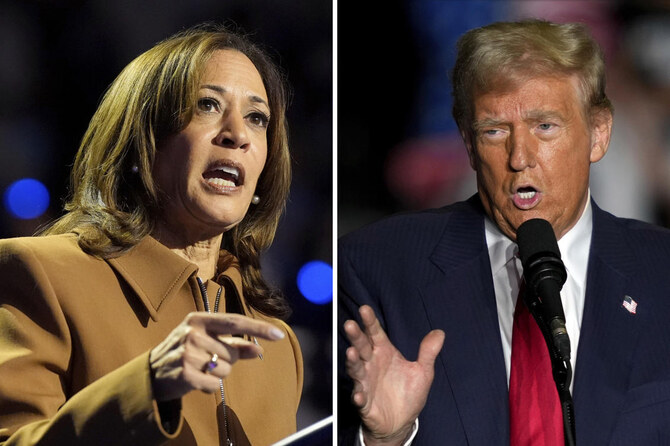

ACCRA: Sporting a scarf emblazoned with an image of Kamala Harris, shop owner Jimmie Thorne watched US election coverage on TV from his printing shop in Ghana’s capital Accra.
As US election day draws near, the 70-year-old is among a unique set of African American voters closely following the presidential race from the other side of the Atlantic.
In 2019, Ghana launched a program encouraging members of the African diaspora to relocate to the West African country and reconnect with their roots.
Since the so-called “Year of Return,” which commemorated 400 years since the arrival of the first enslaved Africans in Virginia, many African Americans have moved to Ghana and found a sense of belonging.
Launched by Ghana’s President Nana Akufo-Addo, the program also attracted high-profile visitors such as television presenter Steve Harvey, actor Samuel L. Jackson and rapper Usher, boosting Ghana’s image as a global tourism destination.
But those who have made the move permanent often feel they have a dual identity. Many still vote in US elections despite the distance, with some even influencing their peers back home through advocacy and social media.
It is no secret that Thorne is one such voter.
He spoke to AFP wearing a stars-and-stripes shirt, surrounded by Democratic Party paraphernalia.
“I’m voting for Kamala Harris because democracy is at stake,” he said. “She is the better of the two choices for sure. I have absolutely no doubt.”
Thorne expressed concern about the consequences of a win for Republican Donald Trump, for the United States and Africa.
“If Donald Trump is elected, it’s not good for Africa — he’s called us ‘shithole countries’, and that’s how he sees us.”
Other African American voters in Ghana said they were throwing their weight behind Harris too.
Delia Gillis, an emeritus professor of Africana Studies who moved from the United States to Ghana in 2019, said she was thrilled by Harris’s candidacy, especially as a woman of color.
“It’s exciting to see someone who looks like me running for the highest office,” Gillis told AFP.
“African American women in particular... have been stalwarts in the election process,” she said. “Now we have an opportunity to elect someone presidential in demeanour.”
Not everyone supports Harris, of course.
“I believe Trump deserves another chance,” said Marcus Wright, an African American visitor to Ghana weighing up whether to make the move permanent.
“His economic policies during his administration helped create jobs and gave the US a much-needed economic boost. I think he could do it again.”
Some African Americans in Ghana think their attention is wasted on US politics.
“I don’t care about the US elections,” said Durah Davies, 65, who has lived in Ghana for 15 years.
“The United States has committed unspeakable atrocities, and its policies have historically oppressed Africans globally.
“My focus is on Africa and the well-being of our people here.”
Ghana’s political future
For Thorne and Gillis, Ghana’s political future is as important as the US polls.
Ghana is preparing for its own elections in December, and the contest between Vice President Mahamudu Bawumia of the New Patriotic Party (NPP) and opposition leader John Mahama is intensifying.
Gillis believes whoever wins in Ghana must focus on youth empowerment.
“The continent’s future lies in the hands of its young people,” she said.
Having gained citizenship two years ago, Thorne will vote in Ghana for the first time in December.
“I feel like a real citizen now,” he said. “My voice counts, and I’m excited to contribute to the future of my new home.”


