

Ghana’s VP and former president among 13 candidates for election

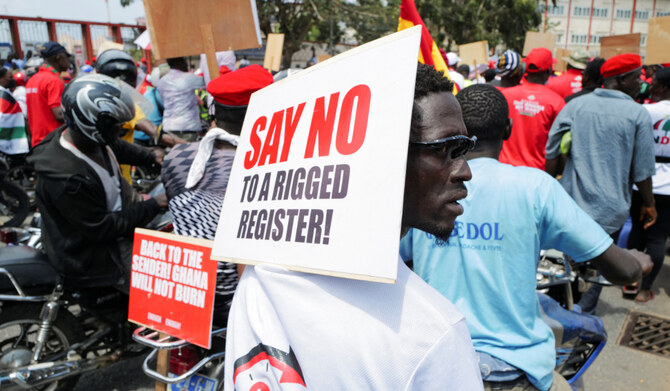
Ghana’s opposition supporters take part in a protest in Accra. (Reuters)
Short Url
Updated 20 September 2024
Follow

Ghana’s VP and former president among 13 candidates for election

  • No party has won more than two consecutive terms in government in Ghana’s democratic history

ACCRA: Ghana’s Vice President Mahamudu Bawumia and ex-President John Dramani Mahama are among 13 candidates approved for the 2024 presidential poll, the electoral commission said on Friday.
Voters in the West African gold- and cocoa-producing nation head to the polls on Dec. 7 to elect a successor to President Nana Akufo-Addo, who will step down in January after serving the constitutionally mandated eight years.
Former President Mahama, 65, represents the main opposition National Democratic Congress, or NDC, party. Bawumia, a 60-year-old economist and former central banker, was picked by Akufo-Addo’s ruling New Patriotic Party as its candidate.
No party has won more than two consecutive terms in government in Ghana’s democratic history.
The commission said it had also accepted the candidacies of Alan John Kwadwo Kyerematen, a former trade and industry minister who resigned from the ruling party to stand as an independent, Nana Kwame Bediako, a businessman competing for the first time for the top job, and Nana Akosua Frimpomaa, one of two women in the race.
On Tuesday, Mahama’s NDC party held nationwide protests against alleged irregularities, saying the electoral commission had illegally transferred voters to different voting stations without their knowledge.
The electoral commission said it would review a petition submitted by the party at the end of the demonstrations and provide a response in the coming days.
The allegations dent the electoral authority’s image when public confidence is low.
A July survey by pan-African research group Afrobarometer showed trust in Ghana’s electoral commission at a historic low since confidence polls started in 1999.


UN’s top court opens Myanmar Rohingya genocide case

Updated 12 January 2026
Follow

UN’s top court opens Myanmar Rohingya genocide case

  • The Gambia filed a case against Myanmar at the UN’s top court in 2019
  • Verdict expected to impact Israel’s genocide case over war on Gaza

DHAKA: The International Court of Justice on Monday opened a landmark case accusing Myanmar of genocide against its mostly Muslim Rohingya minority.

The Gambia filed a case against Myanmar at the UN’s top court in 2019, two years after a military offensive forced hundreds of thousands of Rohingya from their homes into neighboring Bangladesh.

The hearings will last three weeks and conclude on Jan. 29.

“The ICJ must secure justice for the persecuted Rohingya. This process should not take much longer, as we all know that justice delayed is justice denied,” said Asma Begum, who has been living in the Kutupalong refugee camp in Bangladesh’s Cox’s Bazar district since 2017.

A mostly Muslim ethnic minority, the Rohingya have lived for centuries in Myanmar’s western Rakhine state but were stripped of their citizenship in the 1980s and have faced systemic persecution ever since.

In 2017 alone, some 750,000 of them fled military atrocities and crossed to Bangladesh, in what the UN has called a textbook case of ethnic cleansing by Myanmar.

Today, about 1.3 million Rohingya shelter in 33 camps in Cox’s Bazar, turning the coastal district into the world’s largest refugee settlement.

“We experienced horrific acts such as arson, killings and rape in 2017, and fled to Bangladesh,” Begum told Arab News.

“I believe the ICJ verdict will pave the way for our repatriation to our homeland. The world should not forget us.”

A UN fact-finding mission has concluded that the Myanmar 2017 offensive included “genocidal acts” — an accusation rejected by Myanmar, which said it was a “clearance operation” against militants.

Now, there is hope for justice and a new future for those who have been displaced for years.

“We also have the right to live with dignity. I want to return to my homeland and live the rest of my life in my ancestral land. My children will reconnect with their roots and be able to build their own future,” said Syed Ahmed, who fled Myanmar in 2017 and has since been raising his four children in the Kutupalong camp.

“Despite the delay, I am optimistic that the perpetrators will be held accountable through the ICJ verdict. It will set a strong precedent for the world.”

The Myanmar trial is the first genocide case in more than a decade to be taken up by the ICJ. The outcome will also impact the genocide case that Israel is facing over its war on Gaza.

“The momentum of this case at the ICJ will send a strong message to all those (places) around the world where crimes against humanity have been committed,” Nur Khan, a Bangladeshi lawyer and human rights activist, told Arab News.

“The ICJ will play a significant role in ensuring justice regarding accusations of genocide in other parts of the world, such as the genocide and crimes against humanity committed by Israel against the people of Gaza.”