Russia wishes to enhance ties with Pakistan in diverse fields — Pakistani state media

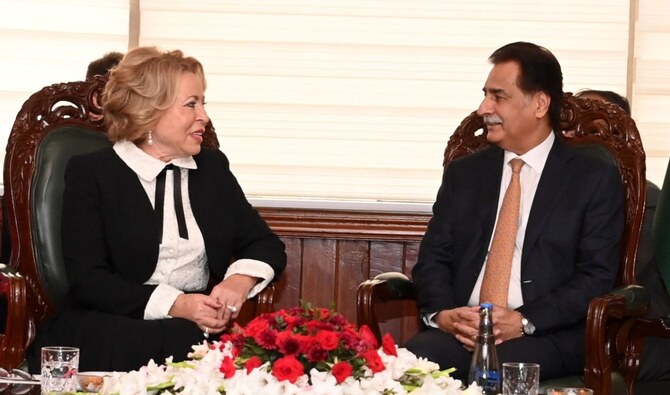
Speaker of the Federation Council of Russian Federal Assembly Valentina Matviyenko meeting with Speaker Pakistan National Assembly, Sardar Ayaz Sadiq, at Parliament House in Islmabad, Pakistan on October 28, 2024. (National Assembly/ website).
Short Url
Updated 28 October 2024
Follow

Russia wishes to enhance ties with Pakistan in diverse fields — Pakistani state media

  • The statement comes after a senior Russian official calls on Senate Chairman Yousuf Raza Gilani in Islamabad
  • Former Cold War rivals Pakistan, Russia have warmed up to each other in recent years through regular interactions

ISLAMABAD: Russia intends to enhance its bilateral relations with Pakistan in diverse fields, Pakistani state media reported on Monday, citing a top Russian official.
The statement came after a meeting of Speaker of the Federation Council of Russian Federal Assembly Valentina Matviyenko with Pakistan Senate Chairman Yousuf Raza Gilani in Islamabad.
The two figures discussed in detail matters relating to the promotion of diplomatic, economic, commercial and parliamentary relations between the two countries, the Radio Pakistan broadcaster reported.
“Russia says it will enhance bilateral cooperation with Pakistan in diverse fields including trade, investment and diplomacy,” Matviyenko was quoted as saying by the broadcaster.
Pakistan and Russia, once Cold War rivals, have warmed up to each other in recent years through regular business and trade interactions.
Islamabad’s ties with Russia also saw a significant improvement in 2023 after Pakistan started purchasing Russian crude oil at a discount rate. The development came after geopolitical tensions almost doubled the fuel prices in Pakistan, forcing the South Asian country to opt for cheaper sources of fuel.
Gilani told the Russian Federal Assembly speaker that her visit to Pakistan would boost bilateral ties and promote regional peace, development and prosperity, according to the report. He appreciated Russia’s support to Pakistan for improvements in infrastructural development as well as oil and gas sectors.
The Senate chairman underscored the need to find new opportunities to promote investment and increase the current trade volume between the two countries.
Pakistan is currently pushing for enhanced regional connectivity with Central Asian countries and Russia in its bid to unlock mutual economic opportunities, particularly in energy, trade and infrastructure.
The South Asian country hopes it can use its strategic geographical location to improve trade and cooperation with Russia and other states as it fights to ward off a prolonged economic crisis.
Earlier this month, Pakistan’s President Asif Ali Zardari met his Russian counterpart, Vladimir Putin, on the sidelines of a two-day international forum, titled ‘Interrelation of Times and Civilizations — Basis for Peace and Development,’ in Ashgabat, Turkmenistan where they pledged to further strengthen bilateral ties.
In September, Russia’s Deputy Prime Minister Alexei Overchuk also arrived in Islamabad on a brief visit, seeking to expand trade and investment ties with Pakistan. During his meeting with Overchuk, Prime Minister Shehbaz Sharif had also expressed the desire for direct flights between Pakistan and Russia to enhance connectivity between the two states.


Pakistan terms climate change, demographic pressures as ‘pressing existential risks’

Updated 06 December 2025
Follow

Pakistan terms climate change, demographic pressures as ‘pressing existential risks’

  • Pakistan has suffered frequent climate change-induced disasters, including floods this year that killed over 1,000
  • Pakistan finmin highlights stabilization measures at Doha Forum, discusses economic cooperation with Qatar 

ISLAMABAD: Pakistan’s Finance Minister Muhammad Aurangzeb on Saturday described climate change and demographic pressures as “pressing existential risks” facing the country, calling for urgent climate financing. 

The finance minister was speaking as a member of a high-level panel at the 23rd edition of the Doha Forum, which is being held from Dec. 6–7 in the Qatari capital. Aurangzeb was invited as a speaker on the discussion titled: ‘Global Trade Tensions: Economic Impact and Policy Responses in MENA.’

“He reaffirmed that while Pakistan remained vigilant in the face of geopolitical uncertainty, the more pressing existential risks were climate change and demographic pressures,” the Finance Division said. 

Pakistan has suffered repeated climate disasters in recent years, most notably the 2022 super-floods that submerged one-third of the country, displaced millions and caused an estimated $30 billion in losses. 

This year’s floods killed over 1,000 people and caused at least $2.9 billion in damages to agriculture and infrastructure. Scientists say Pakistan remains among the world’s most climate-vulnerable nations despite contributing less than 1 percent of global greenhouse-gas emissions.

Aurangzeb has previously said climate change and Pakistan’s fast-rising population are the only two factors that can hinder the South Asian country’s efforts to become a $3 trillion economy in the future. 

The finance minister noted that this year’s floods in Pakistan had shaved at least 0.5 percent off GDP growth, calling for urgent climate financing and investment in resilient infrastructure. 

When asked about Pakistan’s fiscal resilience and capability to absorb external shocks, Aurangzeb said Islamabad had rebuilt fiscal buffers. He pointed out that both the primary fiscal balance and current account had returned to surplus, supported significantly by strong remittance inflows of $18–20 billion annually from the Middle East and North Africa (MENA) and Gulf Cooperation Council (GCC) regions. 

Separately, Aurangzeb met his Qatari counterpart Ali Bin Ahmed Al Kuwari to discuss bilateral cooperation. 

“Both sides reaffirmed their commitment to strengthening economic ties, particularly by maximizing opportunities created through the newly concluded GCC–Pakistan Free Trade Agreement, expanding trade flows, and deepening energy cooperation, including long-term LNG collaboration,” the finance ministry said. 

The two also discussed collaboration on digital infrastructure, skills development and regulatory reform. They agreed to establish structured mechanisms to continue joint work in trade diversification, technology, climate resilience, and investment facilitation, the finance ministry said.