

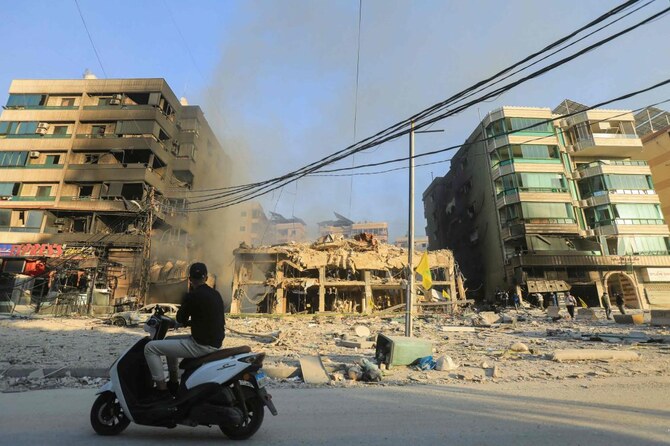

BEIRUT: Israeli attacks on targets in southern Lebanon escalated on Monday, with the Lebanese army, paramedics and civilians among those caught in the firing line.
Clouds of smoke hung over the coastal city of Tyre. It was subjected to the fiercest aerial bombardment, which destroyed or damaged large numbers of residential, commercial and educational buildings, including dozens of properties along the seafront.
On Monday morning, Avichay Adraee, a spokesperson for the Israeli military, displayed a map indicating large parts of the city he said would be targeted and warned residents to leave immediately. It coincided with a call from Israeli authorities to the Union of Tyre Municipalities demanding that some parts of the city be evacuated. Civil Defense officials immediately issued warnings over loudspeakers urging people in those areas to leave.
Minutes later, Israeli warplanes carried out initial raids ahead of the main strikes, including one that targeted the Raml neighborhood in the heart of Tyre, in which an entire family, the Muslimanis, was reportedly killed.
The Ministry of Health said five people were killed and 10 injured on Monday. The total death toll from Israeli attacks on the country now exceeds 2,670, and 12,490 people have been injured. Few villages in southern Lebanon have been spared from Israeli airstrikes on homes and civilian infrastructure.
The Lebanese Army Command said an army bulldozer was fired upon while it was being used to help clear and reopen the Borj Qalaouiye to Kfar Dounine road. A soldier was injured in the attack.
Israeli artillery targeted members of the Lebanese Civil Defense while they were fighting a fire in olive groves in the town of Burj Al-Malouk, forcing them to abandon their attempts and withdraw.
The Israeli army also reportedly attacked ambulances and fire engines to prevent them from accessing certain areas, on the grounds that they might be “carrying Hezbollah members or weapons.”
Political observers in Lebanon interpreted the latest Israeli escalation as a tool for leverage in negotiations with Lebanese authorities. It coincided with a visit by US special envoy Amos Hochstein to Tel Aviv for talks on a ceasefire proposal he discussed in Beirut last week with Nabih Berri, the speaker of the Lebanese parliament, and Najib Mikati, the caretaker prime minister. Hezbollah authorized Berri to lead the negotiations.
No part of southern Lebanon has escaped the Israeli aerial onslaught. Fighter jets twice targeted the outskirts of the town of Qatrani in the Jezzine district. The bodies of five people were found in the rubble of houses in the town of Shaqra, which was hit by airstrikes in the past week. Seven people were killed and 24 injured in an assault on the town of Ain Baal, including a nurse and three paramedics.
Attacks on the Kfar Jouz region of Nabatieh using concussion missiles caused significant damage to numerous buildings and shops. The Nabih Berri Governmental Hospital and the Lebanese Popular Secure Hospital, close to the targeted zone, also suffered considerable damage. Civil defense and medical teams continued to search the rubble for survivors on Sunday, despite the ongoing risk of further Israeli strikes.
There was a lull in the airstrikes on the southern suburbs of Beirut on Sunday night, and some residents took the opportunity to return to their homes there on Monday morning to salvage what they could of their possessions. Several people spoke of “smells of death emanating from the rubble.”
A young man named Hussein, who was checking his family’s home, said: “It is the scent of corpses.”
A building in Beirut damaged by airstrikes collapsed on Monday. Residents of targeted neighborhoods said they fear other buildings will fall, particularly as winter approaches, due to “the extent of the damage inflicted on the buildings from the bombardment.”
Elsewhere, an Israeli drone targeted a vehicle on the Aria Road with a missile. The driver survived. Remote villages in the Bekaa region were hit by airstrikes that killed two people and injured four in the town of Al-Halaniya. Also on Monday, an air raid on the periphery of the town of Chmestar killed resident Ali Samaha and injured three children.
Hezbollah again warned residents to evacuate settlements in northern Israel, and fired rockets at Israeli forces around the settlements of Manara, Margaliot and Kiryat Shmona. Confrontations were also reported along the border to prevent Israeli incursions. Hezbollah also said it targeted an Israeli military gathering at Fatima Gate.
The Israeli army said 15 soldiers were killed and 88 injured over the past two days in southern Lebanon.
Attacks by Israel on media facilities and journalists in Hasbaya in southern Lebanon, and the Ouzai area of the southern suburbs of Beirut, prompted Lebanese authorities to register a formal complaint with the UN Security Council. Photographers Wissam Qassem and Ghassan Najar and technician Mohammed Reda were killed in the attacks, and several journalists and photographers were injured.
Fifty Lebanese MPs, representing various parliamentary blocs, gathered on Monday at the parliament to discuss the mass displacement of residents from southern regions, the Bekaa and southern suburbs of Beirut as a result of the conflict.
The meeting took place against a backdrop of political divisions over whether to continue the conflict or pursue a ceasefire. In a joint statement, the participating MPs highlighted the importance of recognizing “displacement as a national concern that affects everyone, necessitating an approach based on the principles and rules of national solidarity.”
They urged “security, military and municipal authorities to ensure the safety of displaced people and local populations and to enforce laws rigorously,” and called for action to be taken to prevent any armed presence, whether among displaced communities or residents, and discourage people from taking the law into their own hands.
The MPs emphasized “the necessity for all residents and displaced people to adhere to the law and public-order regulations, and to respect private properties and refrain from encroaching upon them or utilizing them without the consent of their owners.”
They called for “the registration of displaced people” and urged those wishing to engage in any form of commercial or professional activities “to obtain the necessary permits from the relevant authorities and the municipality.”


