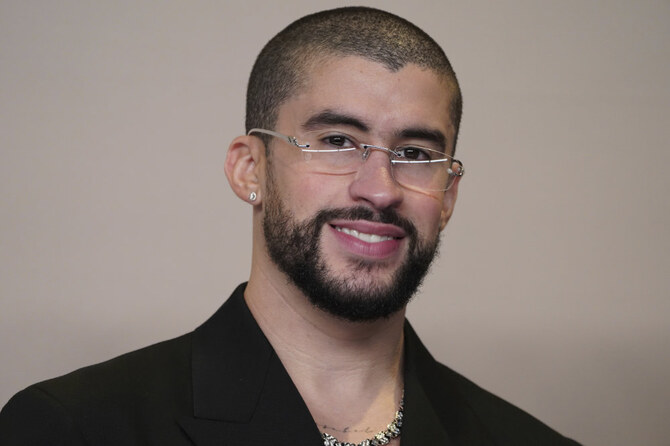
Bad Bunny is throwing his support behind Vice President Kamala Harris by sharing a video of the Democratic presidential nominee to his more than 45 million followers on Instagram.
Bad Bunny, whose official name is Benito Antonio Martínez Ocasio, is one of the most famous artists of the moment. His backing could be a boost for the Harris campaign as it tries to bolster its support with Latino voters, among whom Trump has been working to gain ground.
The 30-year-old Puerto Rican reggaeton artist, who has popular songs such as “Dakiti” and “Titi Me Preguntó,” has won three Grammy Awards. He was the most streamed artist on Spotify in 2020, 2021 and 2022, and was only surpassed by Taylor Swift in 2023. He was named Artist of the Year by Apple Music in 2022.
The video shared by Bad Bunny on Instagram shows Harris saying “there’s so much at stake in this election for Puerto Rican voters and for Puerto Rico.” A representative of the artist confirmed that Bad Bunny is supporting Harris.
The artist then shared several times another part of the clip where Harris says, “I will never forget what Donald Trump did and what he did not do when Puerto Rico needed a caring and a competent leader,” she says.
His endorsement came shortly after a comedian who spoke at the opening of Trump’s rally at Madison Square Garden on Sunday called Puerto Rico a “floating island of garbage.” The remarks by comedian Tony Hinchcliffe were immediately criticized by Harris’ campaign and were also criticized by Puerto Rican star Ricky Martin, who was among the first to support Harris as she launched her presidential bid in July.
“That’s what they think of us,” Ricky Martin shared on Instagram, and encouraged followers to vote for Harris.
The Puerto Rican vote is sizable in Pennsylvania, which is arguably the hardest fought of the swing states in the 2024 election. Other Puerto Rican singers such as Jennifer Lopez and Marc Anthony had already expressed support for Harris. Trump has also attracted support from other popular stars from the island such as Anuel AA and Nicky Jam.
Bad Bunny has been vocal about criticizing Puerto Rico’s electric system, which was razed by Hurricane Maria. In a 2022 music video for his song “El Apagon,” the artist called out the company Luma Energy, which handles transmission and distribution, for the constant power outages that plague the island.
One of his most recent songs, “Una Velita,” is also a protest against the government response following Hurricane Maria in Puerto Rico in 2017.
A year after the storm, public health experts estimated that nearly 3,000 perished because of the effects of Hurricane Maria. But Trump, whose efforts to help the island territory recover have been persistently criticized, repeatedly questioned that number saying it rose “like magic.”
His visit to the island after the hurricane elicited controversy such as when he tossed paper towels. His administration released $13 billion in assistance years later, just weeks before the 2020 presidential election. And a federal government watchdog found that officials hampered an investigation into delays in aid delivery.
Bad Bunny also shared a part of the clip showing Harris saying that Trump “abandoned the island, tried to block aid after back-to-back devastating hurricanes and offered nothing more than paper towels and insults.”
Harris visited a Puerto Rican restaurant in North Philadelphia earlier on Sunday and released her policy related to the island saying she wants to create a task force to attract investment to fix the electrical grid. And Trump is headed on Tuesday to Allentown, Pennsylvania, where more than half of its population is Hispanic and a majority of them from Puerto Rico.
In 2020, Bad Bunny allowed the Biden campaign to use one of his hits “Pero Ya No” in a TV ad.

Latin superstar Bad Bunny is supporting Harris for president
Short Url
https://arab.news/vwbwu
Latin superstar Bad Bunny is supporting Harris for president
- Bad Bunny has been vocal about criticizing Puerto Rico’s electric system, which was razed by Hurricane Maria
Japan reaffirms no-nukes pledge after senior official suggests acquiring weapons
- The unnamed official said Japan needed nuclear weapons because of a worsening security environment
- At a regular press briefing in Tokyo, Chief Cabinet Secretary Minoru Kihara said Japan’s nuclear policy had not changed
TOKYO: Japan reaffirmed its decades-old pledge never to possess nuclear weapons on Friday after local media reported that a senior security official suggested the country should acquire them to deter potential aggressors. The unnamed official said Japan needed nuclear weapons because of a worsening security environment but acknowledged that such a move would be politically difficult, public broadcaster NHK and other outlets reported, describing the official as being from Prime Minister Sanae Takaichi’s office.
At a regular press briefing in Tokyo, Chief Cabinet Secretary Minoru Kihara said Japan’s nuclear policy had not changed, but declined to comment on the remarks or to say whether the person would remain in government. There is a growing political and public willingness in Japan to loosen its three non-nuclear principles not to possess, develop or allow nuclear weapons, a Reuters investigation published in August found.
This is driven in part by doubts over the reliability of US security guarantees under President Donald Trump and growing threats from nuclear-armed China, Russia and North Korea.
Japan hosts the largest overseas concentration of US military forces and has maintained a security alliance with Washington for decades.
Some lawmakers within Takaichi’s ruling Liberal Democratic Party have said the United States should be allowed to bring nuclear weapons into Japan on submarines or other platforms to reinforce deterrence. Takaichi last month stirred debate on her own stance by declining to say whether there would be any changes to the three principles when her administration formulates a new defense strategy next year.
“Putting these trial balloons out creates an opportunity to start to build consensus around the direction to move on changes in security policy,” said Stephen Nagy, professor at the department of politics and international studies at the International Christian University in Tokyo.
Beijing’s assertiveness and growing missile cooperation between Moscow and Pyongyang are “creating the momentum to really change Japan’s thinking about security,” he added.
Discussions about acquiring or hosting nuclear weapons are highly sensitive in the only country to have suffered atomic bombings, and risk unsettling neighboring countries, including China.
Ties between Tokyo and Beijing worsened last month after Takaichi said a Chinese attack on Taiwan that also threatened Japan could constitute a “survival-threatening situation” and trigger a military response.
At a regular press briefing in Tokyo, Chief Cabinet Secretary Minoru Kihara said Japan’s nuclear policy had not changed, but declined to comment on the remarks or to say whether the person would remain in government. There is a growing political and public willingness in Japan to loosen its three non-nuclear principles not to possess, develop or allow nuclear weapons, a Reuters investigation published in August found.
This is driven in part by doubts over the reliability of US security guarantees under President Donald Trump and growing threats from nuclear-armed China, Russia and North Korea.
Japan hosts the largest overseas concentration of US military forces and has maintained a security alliance with Washington for decades.
Some lawmakers within Takaichi’s ruling Liberal Democratic Party have said the United States should be allowed to bring nuclear weapons into Japan on submarines or other platforms to reinforce deterrence. Takaichi last month stirred debate on her own stance by declining to say whether there would be any changes to the three principles when her administration formulates a new defense strategy next year.
“Putting these trial balloons out creates an opportunity to start to build consensus around the direction to move on changes in security policy,” said Stephen Nagy, professor at the department of politics and international studies at the International Christian University in Tokyo.
Beijing’s assertiveness and growing missile cooperation between Moscow and Pyongyang are “creating the momentum to really change Japan’s thinking about security,” he added.
Discussions about acquiring or hosting nuclear weapons are highly sensitive in the only country to have suffered atomic bombings, and risk unsettling neighboring countries, including China.
Ties between Tokyo and Beijing worsened last month after Takaichi said a Chinese attack on Taiwan that also threatened Japan could constitute a “survival-threatening situation” and trigger a military response.
© 2025 SAUDI RESEARCH & PUBLISHING COMPANY, All Rights Reserved And subject to Terms of Use Agreement.


