TBILISI, Georgia: Georgia’s president said Sunday she did not recognize the results of this weekend’s parliamentary vote, which election officials say was won by the ruling party, adding that the country fell victim to a “Russian special operation” aimed at moving it off a path toward Europe.
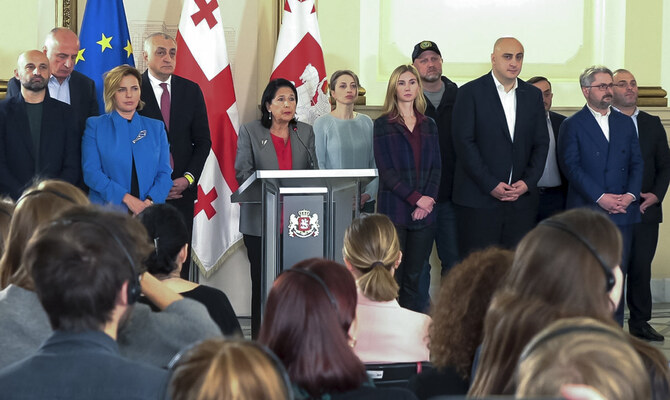
Standing alongside opposition leaders, President Salome Zourabichvili urged Georgians to rally Monday night on Tbilisi’s main street to protest what she called a “total falsification, a total stealing of your votes,” raising the prospect of further political turmoil in the South Caucasus nation.
She spoke the day after an election which could decide whether Georgia embraces Europe or falls under the sway of Russia.
“This election cannot be recognized, because it is the recognition of Russia’s intrusion here, Georgia’s subordination to Russia,” Zourabichvili said.
The Central Election Commission said Sunday that the ruling party, Georgian Dream, got 54.8 percent of Saturday’s vote with almost 100 percent of ballots counted.
Georgian Dream has become increasingly authoritarian over the past year, adopting laws similar to those used by Russia to crack down on freedom of speech. Brussels suspended Georgia’s EU membership process indefinitely because of a Russian-style “foreign influence law,” passed in June. Many Georgians viewed Saturday’s vote as a referendum on the opportunity to join the European Union.
The election campaign in the South Caucasus nation of 3.7 million people, which borders Russia, was dominated by foreign policy and marked by a bitter fight for votes and allegations of a smear campaign.
Zourabichvili suggested “Russian elections” were held in the country, and said “technology was used to whitewash counterfeiting. Such a thing has never happened before.”
European electoral observers said the election took place in a “divisive” environment marked by intimidation and instances of vote buying, double voting and physical violence.
During the campaign, Georgian Dream used “anti-Western and hostile rhetoric ... promoted Russian misinformation, manipulations, and conspiracy theories,” said Antonio López-Istúriz White, the head of the European Parliament monitoring delegation.
“Paradoxically, the government further claimed that it was continuing Georgia’s European integration,” he added.
The conduct of the polls, he said, is more evidence that points to the ruling party’s “democratic backsliding.”
President of the European Council Charles Michel said he called on Georgia’s officials to “swiftly, transparently and independently investigate” the electoral irregularities and called on the ruling party to demonstrate its “firm commitment” to the EU.
Prime Minister Irakli Kobakhidze, who is a member of Georgian Dream, on Sunday described his party’s victory as “impressive and obvious,” and said “any attempts to talk about election manipulation ... are doomed to failure.”
Hungary’s Victor Orbán was the first foreign leader to congratulate Georgian Dream and will be the first foreign leader to visit Georgia and meet the prime minister when he visits the capital for a visit Monday and Tuesday.
Georgian electoral observers, who were stationed across the country, also reported multiple violations and said the results do not reflect “the will of the Georgian people.”
In the capital Tbilisi, Tiko Gelashvili, 32, said, “The results that were published are just lies and rigged.”
Initial figures suggested turnout in the vote was the highest since Georgian Dream was first elected in 2012.
The United National Movement opposition party said its headquarters were attacked on Saturday while Georgian media reported two people were hospitalized after being attacked outside polling stations.
“The most important question is whether or not these elections will be recognized by the international community,” said Natia Seskuria, executive director of the Regional Institute for Security Studies in Tbilisi. Georgia’s “economic and political prospects” hinge on the election, she said.
Georgians have a complex relationship with Russia, which ruled it from Moscow until Georgia gained independence from the Soviet Union in 1991. Russia and Georgia fought a short war in 2008, and Moscow still occupies 20 percent of Georgia’s territory.
Despite that, Georgian Dream has adopted Russia-style laws and many Georgians fear the government is distancing the country from the West and into Moscow’s orbit.
The election observers said instances of intimidation and electoral violations were particularly noticeable in rural areas.
Georgian Dream scored its highest share of the vote — polling almost 90 percent — in the Javakheti region of southern Georgia, 135 kilometers (83 miles) west of the capital. In Tbilisi, it got no more than than 44 percent of the vote in any district.
Javakheti is predominantly agricultural and many people are ethnic Armenians who speak Armenian, Russian and limited Georgian. Before the election, the AP traveled to the region where voters suggested they were instructed how to vote by local officials. Several questioned why Georgia needed a relationship with Europe and suggested it would be better off allied with Moscow.


![]()

Georgian president won’t recognize parliamentary election result and calls public protests
Short Url
https://arab.news/6tbxd
Georgian president won’t recognize parliamentary election result and calls public protests
- “This election cannot be recognized, because it is the recognition of Russia’s intrusion here, Georgia’s subordination to Russia,” Zourabichvili said


Latest updates





Recommended


© 2026 SAUDI RESEARCH & PUBLISHING COMPANY, All Rights Reserved And subject to Terms of Use Agreement.