King Charles to resume foreign tours after cancer diagnosis

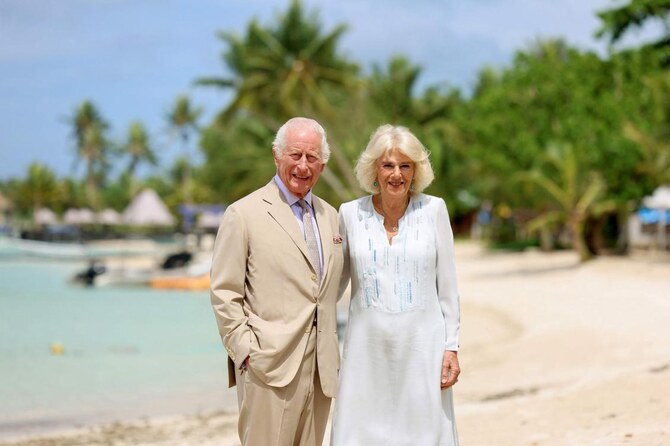
Charles and Queen Camilla left Samoa Saturday after the marathon 11-day tour that saw the king carry out more than 30 engagements. (File/AFP)
Short Url
Updated 27 October 2024
Follow

King Charles to resume foreign tours after cancer diagnosis

  • Doctors agreed King Charles could pause his treatment to allow him to travel to Australia and Samoa

LONDON: King Charles III’s cancer diagnosis will not prevent him flying abroad next year for foreign visits, a Buckingham Palace official said, as the monarch wrapped up a tour of Australia and Samoa.
“We’re now working on a pretty normal looking full overseas tour program for next year, which is a high for us to end on, to know that we can be thinking in those terms,” the official said late Saturday.
Charles was diagnosed with an undisclosed cancer earlier this year but doctors agreed he could pause his treatment to allow him to travel to Australia and Samoa.
The palace announced in April that he would make a limited return to public duties, as doctors were “very encouraged” by his progress.
The official added that the king had “thrived” on the tour’s program which had lifted “his spirits, his mood and his recovery.”
“In that sense, the tour, despite its demands, has been the perfect tonic,” he added.
The tour was Charles’ first to Australia, where he is also head of state, since he became king following the death of Queen Elizabeth II in September 2022.
Charles and Queen Camilla left Samoa Saturday after the marathon 11-day tour that saw the king carry out more than 30 engagements.
The royal couple visited Sydney, Canberra and the Samoan capital Apia, where Charles attended a meeting of Commonwealth nations.
The 56-nation bloc — made up mostly of British ex-colonies — had hoped to focus on a future threatened by climate change, but instead bickered over a troubled past marked by slavery and colonization.


US intercepts fifth sanctioned tanker as it exerts control over Venezuelan oil distribution

Updated 4 sec ago
Follow

US intercepts fifth sanctioned tanker as it exerts control over Venezuelan oil distribution

WASHINGTON: US forces boarded another oil tanker in the Caribbean Sea on Friday, the US military said, as the Trump administration targets sanctioned tankers traveling to and from Venezuela as part of a broader effort to take control of the South American country’s oil.
The predawn raid was carried out by Marines and Navy sailors launched from the aircraft carrier USS Gerald R. Ford, part of the extensive force the US has built up in the Caribbean in recent months, according to US Southern Command, which declared “there is no safe haven for criminals” as it announced the seizure of the tanker called the Olina. The Coast Guard then took control of the vessel, officials said.
Southern Command and Homeland Security Secretary Kristi Noem both posted unclassified footage on social media Friday morning of a US helicopter landing on the vessel and US personnel conducting a search of the deck and tossing what appeared to be an explosive device in front of a door leading to inside the ship.
In her post, Noem said the ship was “another ‘ghost fleet’ tanker ship suspected of carrying embargoed oil” and it had departed Venezuela “attempting to evade US forces.”
The Olina is the fifth tanker that has been seized by US forces as part of the effort by President Donald Trump’s administration to control the production, refining and global distribution of Venezuela’s oil products, and the third since the US ouster of Venezuela President Nicolás Maduro in a surprise nighttime raid.
In a post on his social media network later in the day, Trump said the seizure was conducted “in coordination with the Interim Authorities of Venezuela” but offered no elaboration.
The White House did not immediately respond to requests for more details.
Venezuela’s government acknowledged in a statement that it was working with US authorities to return the tanker, “which set sail without payment or authorization from the Venezuelan authorities,” to the South American nation.
“Thanks to this first successful joint operation, the ship is sailing back to Venezuelan waters for its protection and relevant actions,” according to the statement.
Samir Madani, co-founder of TankerTrackers.com, said his organization used satellite imagery and surface-level photos to document that at least 16 tankers left the Venezuelan coast in contravention of the quarantine US forces have set up to block sanctioned ships from conducting trade. The Olina was among that flotilla.
US government records show that the Olina was sanctioned for moving Russian oil under its prior name, Minerva M, and flagged in Panama.
While records show the Olina is now flying the flag of Timor-Leste, it is listed in the international shipping registry as having a false flag, meaning the registration it is claiming is not valid. In July, the owner and manager of the ship on its registration was changed to a company in Hong Kong.
According to ship tracking databases, the Olina last transmitted its location in November in the Caribbean, north of the Venezuelan coast. Since then, however, the ship has been running dark with its location beacon turned off.
While Noem and the military framed the seizure as part of an effort to enforce the law, other officials in the Trump administration have made clear they see it as a way to generate cash as they seek to rebuild Venezuela’s battered oil industry and restore its economy.
In an early morning social media post, Trump said the US and Venezuela “are working well together, especially as it pertains to rebuilding, in a much bigger, better, and more modern form, their oil and gas infrastructure.”
The administration said it expects to sell 30 million to 50 million barrels of sanctioned Venezuelan oil, with the proceeds to go to both the US and Venezuelan people. But the president expects the arrangement to continue indefinitely. He met Friday with executives from oil companies to discuss his goal of investing $100 billion in Venezuela to repair and upgrade its oil production and distribution.
Vice President JD Vance told Fox News this week that the US can “control” Venezuela’s “purse strings” by dictating where its oil can be sold.
Madani estimated that the Olina is loaded with 707,000 barrels of oil, which at the current market price of about $60 a barrel would be worth more than $42 million.