TEL AVIV: Israelis reacted with mixed emotions to the country’s strikes Saturday on arch-foe Iran. While some hoped for de-escalation, others expressed confidence in the military’s ability to defend them.
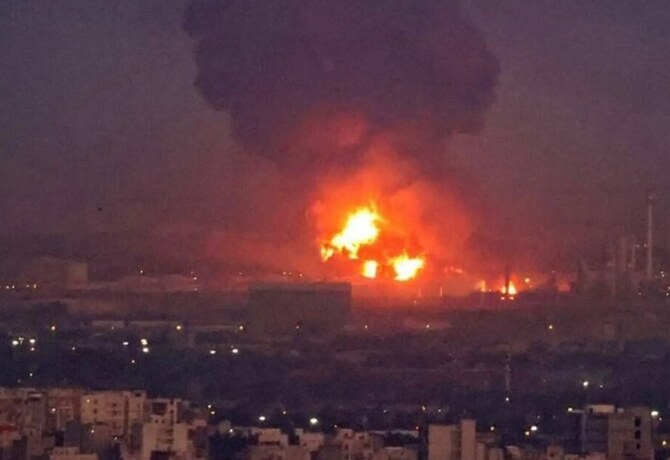
The army said its planes hit military bases, missile sites and other systems in several Iranian regions in retaliation for a missile barrage against Israel earlier this month. Iran said two soldiers were killed.
The strikes mark the latest phase in Israel’s ongoing fight on multiple fronts.
For over a year, it has battled Hamas in the Gaza Strip since the Iran-backed Palestinian militant group’s unprecedented October 7 attack on Israel.
Since last month, Israel has also been at war with the Iran-backed Hezbollah in Lebanon, targeting its leadership and launching incursions aimed at weakening the Hamas ally.
Despite air raid sirens and sporadic evacuations, life has gone on as usual for many Israelis.
“We should not be afraid of anything,” said Sagi Kawaz, 55, from Tel Aviv. “We have a good army and we will have a good response for every attack.”
The Israeli military said it launched the strikes “in response to months of continuous attacks” from Iran.
Since October 7, it added, Israel has faced aggression on “seven fronts,” including attacks from Iranian territory.
Saturday’s strikes follow Israel’s vow to avenge Iran’s October 1 missile attack.
Iran had previously said that barrage was in retaliation for an Israeli air raid that killed Hezbollah chief Hassan Nasrallah and a Revolutionary Guards general in Lebanon, as well as for the assassination in Tehran of Hamas political leader Ismail Haniyeh.
Some in Israel hope the tit-for-tat between the two countries has been settled for the time being.
“It won’t continue, the response was proportional, and things will move on,” said Yossi Yaish, 65, from Tel Aviv.
Yaish said his routine had gone on unchanged despite the strike on Iran.
“We heard in the morning about the attack and we continued as usual, as we do our bike ride every Saturday,” he added.
Israel and Iran continued a war of words on Saturday following the strikes.
The Israeli military warned the Islamic republic it would “pay a heavy price” if it begins a new round of escalation.
Iran’s foreign ministry fired back, saying the country “has the right and the duty to defend itself against foreign acts of aggression.”
For Tel Aviv resident Yaniv Chen, the latest escalation was “worrying” but “nothing more than that.”
“It’s hard to say what the future will bring,” Chen told AFP. “But I won’t agree to live in fear.”


![]()


’Things will move on’: Israelis press ahead after strikes on Iran
Short Url
https://arab.news/bfkph
’Things will move on’: Israelis press ahead after strikes on Iran
- The army said its planes hit military bases, missile sites and other systems in several Iranian regions
- The strikes mark the latest phase in Israel’s ongoing fight on multiple fronts


Egypt’s parliament approves cabinet reshuffle: state media
CAIRO: Egypt’s parliament approved a limited cabinet reshuffle on Tuesday, endorsing changes proposed by President Abdel Fattah El-Sisi, state media reported.
The reshuffle brings in 14 new ministers and creates a new post for a deputy prime minister in charge of economic affairs, according to the state-owned Al-Ahram newspaper.
The former head of parliament’s budget and planning committee, Hussein Issa, was appointed to that post.
Ahmed Rostom, a former specialist at the World Bank, was appointed minister of planning.
Mohamed Farid Saleh, who was executive chairman of Egypt’s Financial Regulatory Authority, was named minister of investment and foreign trade.
The changes also include the revival of the Ministry of Information, which will be headed by Diaa Rashwan, the current head of the State Information Service (SIS).
The ministry, tasked with overseeing media policy, had been dissolved several times following the 2011 uprising that toppled former president Hosni Mubarak, with its functions transferred later to media regulatory bodies.
As part of the reshuffle, the transport and industry ministries were separated.
Kamel Al-Wazir will continue as minister of transport only, having previously overseen both portfolios.
Planning was also separated from international cooperation, with Rania Al-Mashat remaining as minister of international cooperation.
Several key ministers retained their posts, including the ministers of finance, foreign affairs, defense, interior, petroleum and health.
The new government is expected to be sworn in on Wednesday, Egyptian media reported.
The reshuffle brings in 14 new ministers and creates a new post for a deputy prime minister in charge of economic affairs, according to the state-owned Al-Ahram newspaper.
The former head of parliament’s budget and planning committee, Hussein Issa, was appointed to that post.
Ahmed Rostom, a former specialist at the World Bank, was appointed minister of planning.
Mohamed Farid Saleh, who was executive chairman of Egypt’s Financial Regulatory Authority, was named minister of investment and foreign trade.
The changes also include the revival of the Ministry of Information, which will be headed by Diaa Rashwan, the current head of the State Information Service (SIS).
The ministry, tasked with overseeing media policy, had been dissolved several times following the 2011 uprising that toppled former president Hosni Mubarak, with its functions transferred later to media regulatory bodies.
As part of the reshuffle, the transport and industry ministries were separated.
Kamel Al-Wazir will continue as minister of transport only, having previously overseen both portfolios.
Planning was also separated from international cooperation, with Rania Al-Mashat remaining as minister of international cooperation.
Several key ministers retained their posts, including the ministers of finance, foreign affairs, defense, interior, petroleum and health.
The new government is expected to be sworn in on Wednesday, Egyptian media reported.
Latest updates


Recommended


© 2026 SAUDI RESEARCH & PUBLISHING COMPANY, All Rights Reserved And subject to Terms of Use Agreement.