WASHINGTON: G7 leaders have finalized details surrounding a $50 billion loan to aid Kyiv, backed by profits from Russian sovereign assets frozen after its invasion of Ukraine, according to a statement released Friday.
Leaders of the Group of Seven wealthy democracies said they “have reached a consensus on how to deliver” the loans of approximately $50 billion, with an aim to start disbursing funds by the end of this year.
“The loan proceeds will be disbursed through multiple channels to support Ukraine’s budgetary, military and reconstruction assistance,” G7 leaders added.
Their announcement came as world financial leaders gathered in Washington this week for meetings hosted by the International Monetary Fund and World Bank.
Finance ministers have “agreed on a technical solution ensuring consistency, coordination, fair distribution of lending, and solidarity among all G7 partners,” the statement said.
“We will not tire in our resolve to give Ukraine the support it needs to prevail,” the leaders added.
They called on Moscow to end its war and pay for damage caused to Ukraine.
This week, US President Joe Biden said that as part of the G7 package, the United States would provide $20 billion in loans to Ukraine, to be paid back by the interest earned from immobilized Russian sovereign assets.
This is aimed at supporting Ukraine now, “without burdening taxpayers.”
“Our efforts make it clear: tyrants will be responsible for the damages they cause,” Biden said.
US Treasury Secretary Janet Yellen signed a statement Wednesday with her Ukrainian counterpart Sergii Marchenko marking their intent to enter into the loan.
The move also committed that new United States or Ukrainian tax dollars would not be the source of repayment.
Economic concerns remain top-of-mind for US voters, with just over a week to go before the country’s presidential election on November 5.
Washington aims to provide at least $10 billion of the loans for economic support, with the other half expected to take the form of military aid.
But this will require additional authorization from Congress.
The remaining $30 billion in loans is set to come from a combination of G7 partners, including the European Union, United Kingdom, Canada and Japan, US officials said.
The EU, which has frozen roughly $235 billion of Russian central bank funds — the vast bulk of immobilized Russian assets worldwide — said it would contribute approximately EUR18 billion ($19.4 billion).
“Russia must end its illegal war of aggression and pay for the damage it has caused,” the 27-nation bloc’s chief, Ursula von der Leyen, said in a statement.
“We’re steadfast in our solidarity with Ukraine’s fight for freedom.”
Implementation of the G7 loan suffered from delays as the United States had sought guarantees from the EU that the Russian assets would remain frozen.
“We have once again made clear our unwavering commitment to stand by Ukraine for as long as it takes,” said the G7 statement on Friday.
“Time is not on President (Vladimir) Putin’s side.”

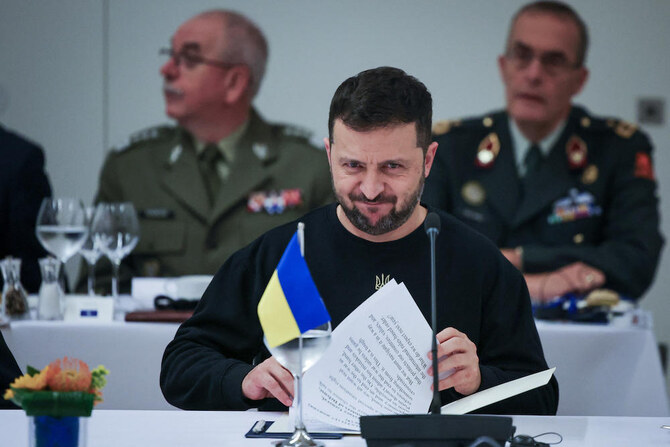
G7 finalize $50bn Ukraine loan backed by Russian assets profits
https://arab.news/6788m
G7 finalize $50bn Ukraine loan backed by Russian assets profits
- G7: ‘The loan proceeds will be disbursed through multiple channels to support Ukraine’s budgetary, military and reconstruction assistance’
- G7 finance ministers called on Moscow to end its war and pay for damage caused to Ukraine
’Only a miracle can end this nightmare’: Eritreans fear new Ethiopia war
- Now the fractious Horn of Africa rivals have begun trading barbs and accusations of war-mongering once more
- It is extremely difficult to gather testimonies from Eritrea, where dissidents often disappear to prison
ADDIS ABABA: Tewolde has fought multiple times for Eritrea, one of the most closed societies on Earth, and is now praying another war is not about to break out with neighboring Ethiopia.
“If the war starts, many people will go to the front and, as before, many children will lose their fathers, mothers will lose their husbands, parents will lose their children,” said Tewolde, who is in his 40s and lives in the Eritrean capital Asmara.
He fought first in the late 1990s during Eritrea’s horrific border war with Ethiopia, and more recently during clashes against rebels in the Ethiopian region of Tigray.
Now the fractious Horn of Africa rivals have begun trading barbs and accusations of war-mongering once more.
“We’ve already experienced this (before) and we know the losses are severe,” said Tewolde, who gave a false name to protect his identity in a country regularly described by rights groups as the North Korea of Africa.
It is extremely difficult to gather testimonies from Eritrea, where dissidents often disappear to prison. To obtain a few words from Tewolde, AFP had to pass questions and answers through an intermediary.
- ‘Incessant aggression’ -
Eritrea, a country of around 3.5 million, has been ruled by President Isaias Afwerki since independence from Ethiopia in 1993 and ranks near the bottom of every rights indicator.
Civilians are conscripted into the army for life or forced into a national service program that the United Nations has compared to slavery.
Ethiopian Prime Minister Abiy Ahmed won a Nobel Peace Prize in 2019 for signing a long-awaited peace deal with Eritrea shortly after coming to power and, in darkly ironic fashion, the two sides joined forces in the brutal war against the Tigrayans from 2020 to 2022.
Eritrea was not pleased that Ethiopia sued for peace without its input and has accused its landlocked neighbor of planning to seize its port at Assab.
For its part, Ethiopia has lately complained that Eritrea has been “actively preparing” for renewed conflict.
Ethiopian Foreign Minister Gedion Timothewos last month said that “Eritrean aggression and provocation is making further restraint more and more difficult.”
- ‘Fleeing en masse’ -
Mehari, an Eritrean in his 30s, fought in the Tigray war, where his army was accused of horrific war crimes.
“Young people are fleeing en masse to Ethiopia... and to Sudan to avoid a possible war,” he told AFP.
Another Eritrean, Luwan, left the country several years ago and now lives in an east African country, which she did not want to name for fear of reprisals against her family back home.
She says her family are terrified after a relative was summoned to a meeting and told to “prepare herself, her sons and daughters because she was told Abiy will start a war against her and the Eritrean people,” she said.
Some mothers at the meeting “still haven’t been informed about where their children are from the last war in Tigray, but still they are being asked to send their remaining children to the front,” Luwan added.
Eritrean Information Minister Yemane Ghebremeskel did not respond to a request for comment from AFP.
A former independence activist now in exile, researcher Mohamed Kheir Omer, said young people are split between their fear of conflict and of being overrun by Ethiopia, whose wartime atrocities are still in recent memory.
“We are torn between Isaias who does not care about his population, and Abiy who thinks only of his own legacy,” he said.
Luwan said she was desperate.
“Only a miracle can end this nightmare.”