EU chief cancels meeting with Serbian PM over Russia minister: ambassador

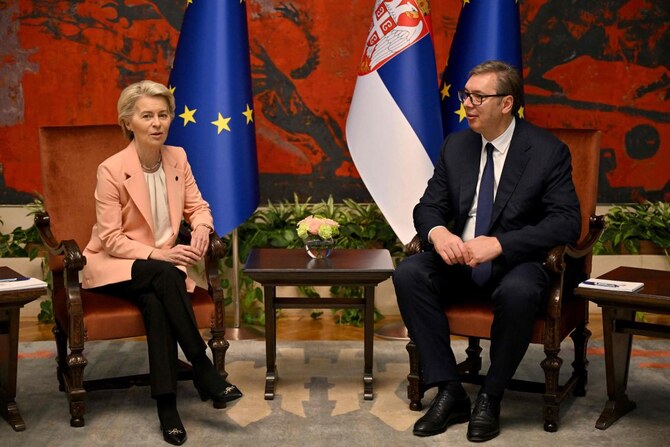
Serbia’s President Aleksandar Vucic (R) attends a meeting with President of the European Commission Ursula von der Leyen in Belgrade, on Oct. 25, 2024. (AFP)
Short Url
Updated 25 October 2024
Follow

EU chief cancels meeting with Serbian PM over Russia minister: ambassador

  • Vucevic had met earlier with Maxim Reshetnikov, Russia’s Minister of Economic Development.
  • The statement said that Vucevic spoke with Reshetnikov and a Russian delegation

BELGRADE: EU chief Ursula von der Leyen canceled talks with Serbia’s Prime Minister Milos Vucevic on Friday because of his earlier meeting with a Russian minister, the EU’s ambassador said.
“We canceled the meeting... following the prime minister meeting with the minister of economy of the Russian federation,” the EU’s ambassador in Belgrade, Emanuele Giaufret, told AFP.
Vucevic had met earlier with Maxim Reshetnikov, Russia’s Minister of Economic Development.
Giaufret said that according to a statement published on the Serbian government’s website, which he said was later removed, there was an “indication of Serbia’s intention to strengthen economic relations in other areas with the Russian Federation.”
“In that light the president of the Commission felt that there were no reasons to hold the meeting with the prime minister,” he added.
The statement, a copy of which was obtained by AFP, said that Vucevic spoke with Reshetnikov and a Russian delegation, about the “further strengthening of economic and overall cooperation between the two countries.”
Von der Leyen had arrived in Belgrade earlier Friday as part of a tour of six Balkan nations, and duly met with President Aleksandar Vucic.
The latter did not take part at this week’s summit of the BRICS group — an alliance of emerging economies — in Russia.
“My presence here today, in the context of my fourth trip to the Balkans since I took office, is a very clear sign that Serbia’s future is in the European Union,” von der Leyen told a joint press conference with Vucic.
“The partnership between the European Union and Serbia is getting stronger,” she added.
Serbia, which aspires to join the 27-nation bloc, has maintained friendly ties with Russia and has refused to sanction Moscow for its invasion of Ukraine.
On Friday, Vucic stressed his country’s commitment to joining the EU.
“We will continue on our European path,” he said, but added that Serbia will “try to preserve our friendship and partnership with all the others also.”
During her four-day Balkan tour, which started on Wednesday, von der Leyen pledged that membership expansion would be high on the Brussels agenda.
Discussions around EU enlargement in the Balkan region of almost 18 million people stretch back 20 years.
The six countries — Albania, Bosnia and Herzegovina, Kosovo, Montenegro, North Macedonia and Serbia — are in different stages on their path toward membership of the bloc.
The EU Commission chief will visit Montenegro and Kosovo on Saturday.


Ukraine president to meet European allies after Trump criticism

Updated 4 sec ago
Follow

Ukraine president to meet European allies after Trump criticism

  • Talks between Ukrainian and US officials in Miami ended on Saturday with no apparent breakthrough
  • President Donald Trump accuses Ukrainian leader of not reading the US proposal to end the war with Russia

LONDON: Ukrainian leader Volodymyr Zelensky was due to meet with European allies in London on Monday, after President Donald Trump accused him of not reading the US proposal to end the war with Russia.

It comes after days of talks between Ukrainian and US officials in Miami ended on Saturday with no apparent breakthrough, with Zelensky committing to further negotiations.

The Ukrainian president will be received in London by British Prime Minister Keir Starmer, along with the German chancellor and French president to discuss the negotiations.

British Foreign Secretary Yvette Cooper is meanwhile expected in Washington on Monday, where she will meet her American counterpart Marco Rubio.

“The UK and US will reaffirm their commitment to reaching a peace deal in Ukraine,” the Foreign Office in London said, announcing Cooper’s visit.

Moscow has meanwhile continued to strike its neighbor, wounding at least nine people overnight Sunday to Monday, according to Ukrainian officials.

‘Disappointed’

Zelensky said he joined his negotiators for a “very substantive and constructive” call with US envoys Steve Witkoff and Jared Kushner during the Miami negotiations.

“Ukraine is committed to continuing to work honestly with the American side to bring about real peace,” Zelensky said on Telegram, adding that the parties agreed “on the next steps and the format of the talks with America.”

But Trump criticized his Ukrainian counterpart on Sunday, telling reporters “I have to say that I’m a little bit disappointed that President Zelensky hasn’t yet read the proposal, that was as of a few hours ago.”

Witkoff and Kushner had met Russian President Vladimir Putin at the Kremlin last week, with Moscow rejecting parts of the US proposal.

French President Emmanuel Macron ahead of Monday’s talks slammed what he called Russia’s “escalatory path.”

“We will continue these efforts with the Americans to provide Ukraine with security guarantees, without which no robust and lasting peace will be possible,” Macron wrote on X.

He added: “We must continue to exert pressure on Russia to compel it to choose peace.”

Hot and cold

Washington’s initial plan to bring an end to the almost four-year war involved Ukraine surrendering land that Russia has not been able to win on the battlefield in return for security promises that fall short of Kyiv’s aspirations to join NATO.

But the nature of the security guarantees that Ukraine could get has so far been shrouded in uncertainty, beyond an initial plan saying that jets to defend Kyiv could be based in Poland.

Trump has blown hot and cold on Ukraine since returning to office in January, initially embracing Putin and chastising Zelensky for not being grateful for US support.

But he has also grown frustrated that his efforts to persuade Putin to end the war, including a summit in Alaska, have failed to produce results and he recently slapped sanctions on Russian oil firms.