STRASBOURG, France: Lawmakers at the European Parliament on Thursday re-elected Ursula von der Leyen to a second 5-year term as president of the European Union’s executive commission, giving her a comfortable majority and heading off a possible leadership vacuum.
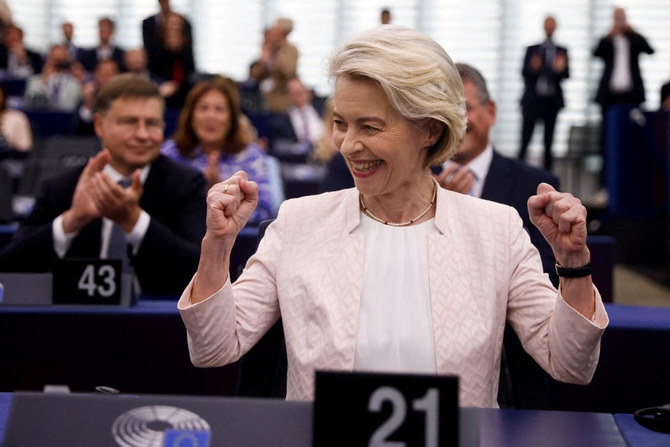
Von der Leyen raised both fists in victory as the Parliament President Roberta Metsola read out the result at the legislature.
“5 more years. I can’t begin to express how grateful I am for the trust of all MEPs that voted for me,” she said on the social media platform X.
The re-election ensures leadership continuity for the 27-nation bloc as it wrestles with crises ranging from the war in Ukraine to climate change, migration and housing shortages.
German Chancellor Olaf Scholz was quick to send his congratulations on X, calling von der Leyen’s re-election “a clear sign of our ability to act in the European Union, especially in difficult times. Europeans expect us to take Europe forward. Let’s do it!”
A majority in the 720-seat legislature voted for the German Christian Democrat after a speech in which she pledged to be a strong leader for Europe in a time of crisis and polarization.
Von der Leyen gained 401 of the 707 votes cast. There were 284 votes against her candidacy, 15 abstentions and seven void ballots.
The secret ballot came hot on the heels of strong gains by the far right in last month’s election for the European Parliament.
“I will never let the extreme polarization of our societies become accepted. I will never accept that demagogues and extremists destroy our European way of life. And I stand here today ready to lead the fight with all the Democratic forces in this house,” von der Leyen said in her final pitch.
If lawmakers had rejected her candidacy, it would leave leaders of the 27-nation bloc scrambling to find a replacement as Europe grapples with crises ranging from the war in Ukraine to climate change. Instead, the continent now has an experienced pair of hands at the helm.
In a speech that sought to shore up support from across the political spectrum, von der Leyen pledged to strengthen the EU economy, its police and border agencies, tackle migration and pursue policies tackling climate change while also helping farmers who have staged protests against what they call stifling EU bureaucracy and environmental rules.
She also vowed to tackle housing shortages across Europe and said she would appoint a commissioner for the Mediterranean region due to the multiple challenges it faces.
She also took a swipe at Hungarian Prime Minister Viktor Orbán and his recent visit to Russia shortly after his country took over the rotating six-month EU presidency.
“This so-called peace mission was nothing but an appeasement mission,” von der Leyen said as she vowed that Europe would remain shoulder-to-shoulder with Ukraine.
One radical right lawmaker, Diana Iovanovici-Sosoaca of Romania, was escorted out of the parliament’s chamber for heckling a speaker during the debate following von der Leyen’s speech. Iovanovici-Sosoaca briefly wore what appeared to be a muzzle and held up religious icons before being led out of the room.
Over the past five years, von der Leyen has steered the bloc through a series of crises, including Britain’s exit from the EU, the COVID-19 pandemic and Russia’s invasion of Ukraine. She has also pushed a Green Deal aiming to make the EU climate-neutral by 2050.
Von der Leyen’s election came as newly elected UK Prime Minister Keir Starmer was welcoming some 45 heads of government to discuss migration, energy security and the threat from Russia as he seeks to restore relations between the UK and its European neighbors.
EU leaders signed off on the conservative German von der Leyen at a summit meeting late last month. The 65-year-old von der Leyen’s bid was boosted when the European People’s Party, which includes von der Leyen’s Christian Democratic Union, remained the largest group at the EU Parliament after the elections.
The German politician has been praised for her leading role during the coronavirus crisis, when the EU bought vaccines collectively for its citizens. But she also found herself receiving sharp criticism for the opacity of the negotiations with vaccine makers.
The EU general court ruled Wednesday that the commission did not allow the public enough access to information about COVID-19 vaccine purchase agreements it secured with pharmaceutical companies during the pandemic.
Before voting got underway, a majority of lawmakers rejected a motion from a leftist bloc in parliament calling for the election to be delayed until September in light of the court ruling.
Following the elections for EU Parliament, European Union leaders agreed on the officials who will hold the key positions in the world’s biggest trading bloc in the coming years for issues ranging from antitrust investigations to foreign policy. At the side of von der Leyen will be two new faces: Antonio Costa of Portugal as European Council president and Estonia’s Kaja Kallas as the top diplomat of the world’s largest trading bloc.
While Costa’s nomination only needed the leaders’ approval, Kallas will also need to be approved by European lawmakers later this year. The Estonian prime minister is a staunch supporter of Ukraine and a fierce critic of Russia within the European Union and NATO.


![]()

Ursula von der Leyen re-elected to a second 5-year term as European Commission president
Short Url
https://arab.news/pdya2
Ursula von der Leyen re-elected to a second 5-year term as European Commission president


Latest updates


© 2026 SAUDI RESEARCH & PUBLISHING COMPANY, All Rights Reserved And subject to Terms of Use Agreement.