Lebanon says Israel’s killing of 3 journalists a ‘war crime’

1 / 2
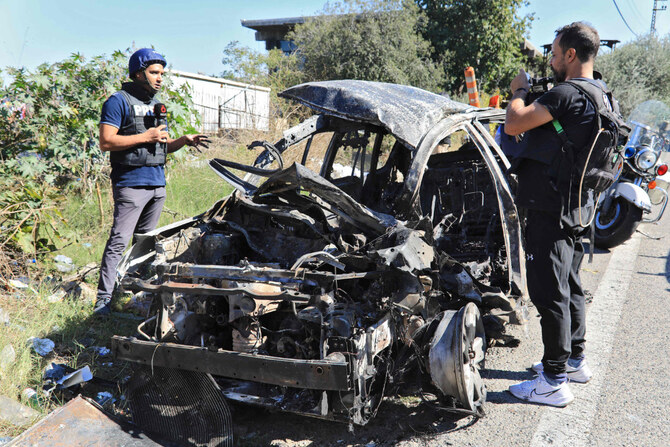
Journalists and security forces stand next to the wreckage of a car that was targeted in an Israeli drone attack on the Beirut-Damascus road in the area of Kahhale on October 24, 2024, amid the ongoing war between Israel and Hezbollah. (AFP)
2 / 2
Journalists and security forces stand next to the wreckage of a car that was targeted in an Israeli drone attack on the Beirut-Damascus road in the area of Kahhale on October 24, 2024, amid the ongoing war between Israel and Hezbollah. (AFP)
Short Url
Updated 25 October 2024
Follow

Lebanon says Israel’s killing of 3 journalists a ‘war crime’

  • ‘The Israeli enemy waited for the journalists’ nighttime break to betray them in their sleep’

BEIRUT:  Lebanon’s Information Minister Ziad Makary accused Israel on Friday of intentionally targeting journalists in a strike on the country’s south that killed three journalists, which he described as a “war crime.”

“The Israeli enemy waited for the journalists’ nighttime break to betray them in their sleep... This is an assassination, after monitoring and tracking, with prior planning and design, as there were 18 journalists there representing seven media institutions. This is a war crime,” Makary said in a post on X.

Lebanese state media said Friday that separate Israeli air strikes killed three journalists in eastern Lebanon and flattened buildings in southern suburbs of Beirut.

“Our correspondent in Zahle reported the death of three journalists in an Israeli raid on Hasbaya,” Lebanon’s official National News Agency (NNA) said, adding that Israeli military planes struck at 3:30 am (0030 GMT) near the Syrian border.

Local media reported that the air raid hit a hotel in Hasbaya, around 50 kilometers south of the Lebanese capital.

Separately, in Beirut’s southern Choueifat Al-Amrousieh area, Israeli warplanes “destroyed two buildings and ignited a large fire, and black smoke covered the area,” according to NNA.

“The raid that targeted the Saint Therese area also caused the collapse of two buildings near the Constitutional Council.”

The NNA report of the strikes on Beirut’s south on Thursday came about half an hour after Israel issued evacuation warnings for the Hezbollah bastion following intense assaults the night before.

“You are located near facilities and sites belonging to Hezbollah, which the Israeli Defense Forces will be targeting in the near future,” said the Israeli army’s Arabic-language spokesman Avichay Adraee in a post on X that included maps of the locations.

AFPTV footage showed plumes of smoke rising from Beirut’s south following the strikes and AFP correspondents in the capital heard loud bangs.

“Israeli warplanes launched a new strike a short while ago on the Choueifat” area of south Beirut, NNA said, adding later that Haret Hreik and Hadath were also targeted.

On Wednesday evening, Israeli strikes levelled six buildings in south Beirut, state media and AFP footage showed, with Israel’s army saying it had hit Hezbollah weapons production facilities “under and inside civilian buildings.”

On September 23, Israel launched an intense air campaign in Lebanon and later announced ground incursions, following a year of limited cross-border clashes with Iran-backed Hezbollah over the Gaza war.

Since then, Israeli strikes in Lebanon have killed at least 1,580 people, according to an AFP tally of Lebanese health ministry figures, though the real number is likely to be higher due to gaps in the data.

The Committee to Protect Journalists has documented at least 128 journalists and media workers killed in Gaza, the West Bank, Israel and Lebanon since the Israel-Hamas war began in October 2023.


Study finds nearly half of UK news stories on Muslims show signs of bias

Updated 09 March 2026
Follow

Study finds nearly half of UK news stories on Muslims show signs of bias

  • Centre for Media Monitoring finds 20,000 out of 40,913 articles from 30 major news outlets contain bias and 70% link Muslims to negative behaviors or themes
  • Findings reveal ‘deeply concerning evidence of structural bias’ in portrayal of Muslims by UK press and point to ‘systemic problem’ within the media, says center’s director

LONDON: Nearly half of news articles published in the UK in 2025 that referenced Muslims or Islam contained some degree of bias, according to a report issued on Monday by the Centre for Media Monitoring. It also found that about 70 percent of stories linked Muslims to negative behaviors or themes.

The nonprofit organization, which tracks the ways in which Muslims and Islam are portrayed in the media, examined 40,913 articles from 30 major news outlets and found that about 20,000 showed some form of bias.

The study looked at “structural patterns” in coverage that “shape public narratives” about Muslims amid rising hostility toward the community.

“As the largest study of its kind ever conducted in the UK, this report presents deeply concerning evidence of structural bias in how Muslims are portrayed in the UK press,” said Rizwana Hamid, the director of the organization.

It found that 70 percent of the articles it reviewed highlighted negative aspects related to Muslims, though not all of the stories were biased in themselves. The wider patterns were also troubling: 44 percent of the coverage omitted key context, 17 percent relied on generalizations, and 13 percent included outright misrepresentation.

Taken together, the monitoring center said, the findings amounted to evidence of an “information integrity crisis” that distorts public understanding, and “a deeply concerning trend” in reporting on Muslims.

The research points to a “systemic problem within our media ecosystem,” Hamid said.

“When entire communities are repeatedly framed through lenses of suspicion or threat, it inevitably shapes public attitudes, political debate and the everyday lives of British Muslims,” she added.

News brands targeting right-wing audiences were more likely to produce biased coverage, the report found.

The Spectator magazine and GB News were identified as having the highest proportion of “very biased” articles, and as the “worst across all five bias categories”: negative framing, generalizations, misrepresentation, lack of context, and problematic headlines.

Other outlets highlighted for displaying high levels of biased content about Muslims included The Telegraph, The Jewish Chronicle, Daily Express, The Sun, Daily Mail and The Times.

In contrast, the BBC, other broadcasters and left-leaning outlets recorded the lowest rates of bias in the study.

The research comes as British Muslims report rising levels of discrimination. Official figures published in October revealed that religious hate crimes against Muslims rose by 19 percent in the year to March 2025 compared with the previous 12 months.