
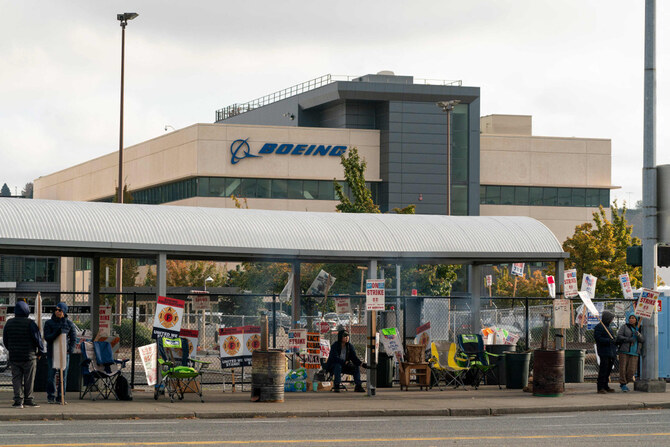
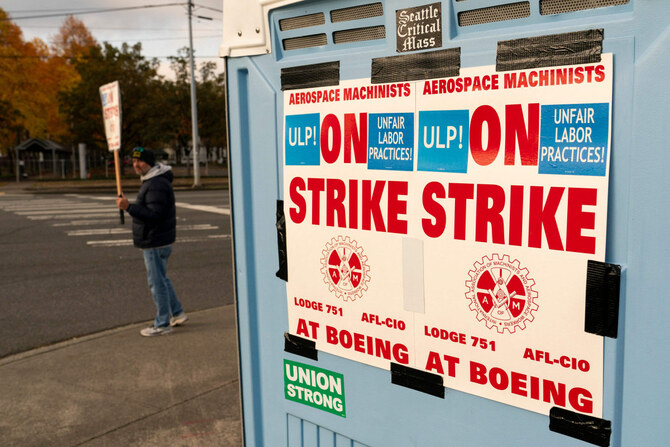

Since going on strike last month, Boeing factory workers have repeated one theme from their picket lines: They want their pensions back.
Boeing froze its traditional pension plan as part of concessions that union members narrowly voted to make a decade ago in exchange for keeping production of the company’s airline planes in the Seattle area.
Like other large employers, the aerospace giant argued back then that ballooning pension payments threatened Boeing’s long-term financial stability. But the decision nonetheless has come back to have fiscal repercussions for the company.
The International Association of Machinists and Aerospace Workers announced Wednesday night that 64 percent of its Boeing members voted to reject the company’s latest contract offer and remain on strike. The offer included a 35 percent increase in wage rates over four years for 33,000 striking machinists but no restoration of pension benefits.
The extension of the six-week-old strike plunges Boeing — which is already deeply in debt and lost another $6.2 billion in the third quarter — into more financial danger. The walkout has stopped production of the company’s 737, 767 and 777 jetliners, cutting off a key source of cash that Boeing receives when it delivers new planes.
The company indicated Thursday, however, that bringing pensions back remained a non-starter in future negotiations. Union members were just as adamant.
“I feel sorry for the young people,” Charles Fromong, a tool-repair technician who has spent 38 years at Boeing, said at a Seattle union hall after the vote. “I’ve spent my life here, and I’m getting ready to go, but they deserve a pension, and I deserve an increase.”
What are traditional pensions?
Pensions are plans in which retirees get a set amount of money each month for the rest of their lives. The payments are typically based on a worker’s years of service and former salary.
Over the past several decades, however, traditional pensions have been replaced in most workplaces by retirement-savings accounts such as 401(k) plans. Rather than a guaranteed monthly income stream in retirement, workers invest money that they and the company contribute.
In theory, investments such as stocks and bonds will grow in value over the workers’ careers and give them enough savings for retirement. However, the value of the accounts can vary based on the performance of financial markets and each employee’s investments.
Why did employers move away from pensions?
The shift began after 401(k) plans became available in the 1980s. With the stock market performing well over the next two decades, “people thought they were brilliant investors,” said Alicia Munnell, director of the Center for Retirement Research at Boston College. After the bursting of the dot-com bubble in the early 2000s took a toll on pension plan investments, employers “started freezing their plans and shutting them down,” she added.
In the 1980s, about 4 in 10 US workers in the private sector had pension plans, but today only 1 in 10 do, and they’re overwhelmingly concentrated in the financial sector, said Jake Rosenfeld, chairman of the sociology department at Washington University-St. Louis.
Companies realized that remaining on the hook to guarantee a certain percentage of workers’ salaries in retirement carried more risk and difficulty than defined contribution plans that “shift the risk of retirement onto the worker and the retiree,” Rosenfeld said.
“And so that became the major trend among firm after firm after firm,” he said.
Rosenfeld said he was surprised the pension plan “has remained a sticking point on the side of the rank and file” at Boeing. “These are the types of plans that have been in decline for decades now. And so you simply do not hear about a company reinstating or implementing from scratch a defined contribution plan.”
What happened to Boeing’s pension plan?
Boeing demanded in 2013 that machinists drop their pension plan as part of an agreement to build a new model of the 777 jetliner in Washington state. Union leaders were terrified by the prospect that Boeing would build the plane elsewhere, with nonunion workers.
After a bitter campaign, a bare 51 percent majority of machinists in January 2014 approved a contract extension that made union members hired after that ineligible for pensions and froze increases for existing employees starting in October 2016. In return, Boeing contributed a percentage of worker wages into retirement accounts and matched employee contributions to a certain point.
The company later froze pensions for 68,000 nonunion employees. Boeing’s top human-resources executive at the time said the move was about “assuring our competitiveness by curbing the unsustainable growth of our long-term pension liability.”
How realistic is the Boeing workers’ demand?
Boeing raised its wage offer twice after the strike started on Sept. 13 but has been steadfast in opposing the return of pensions.
“There is no scenario where the company reactivates a defined-benefit pension for this or any other population,” Boeing said in a statement Thursday. “They’re prohibitively expensive, and that’s why virtually all private employers have transitioned away from them to defined-contribution plans.”
Boeing says 42 percent of its machinists have been at the company long enough to be covered by the pension plan, although their benefits have been frozen for many years. In the contract that was rejected Wednesday, the company proposed to raise monthly payouts for those covered workers from $95 to $105 per year of service.
The company said in a securities filing that its accrued pension-plan liability was $6.1 billion on Sept. 30. Reinstating the pension could cost Boeing more than $1.6 billion per year, Bank of America analysts estimated.
Jon Holden, the president of IAM District 751, which represents the striking workers, said after the vote that if Boeing is unwilling to restore the pension plan, “we’ve got to get something that replaces it.”
Do companies ever restore pension plans?
It is unusual for a company to restore a pension plan once it was frozen, although a few have. IBM replaced its 401(k) match with a contribution to a defined-benefits plan earlier this year.
Pension plans have become a rarity in corporate America, so the move may help IBM attract talent, experts say. But IBM’s motivation may have been financial; the pension plan became significantly overfunded after the company froze it about two decades ago, according to actuarial firm Milliman.
“The IBM example is not really an indication that there was a movement toward defined benefit plans,” Boston College’s Munnell said.
Milliman analyzed 100 of the largest corporate defined benefits plans this year and found that 48 were fully funded or better, and 36 were frozen with surplus assets.
Can Boeing be pressured to change its mind?
Pressure to end the strike is growing on new CEO Kelly Ortberg. Since the walkout began, he announced about 17,000 layoffs and steps to raise more money from the sale of stock or debt.
Bank of America analysts estimate that Boeing is losing about $50 million a day during the strike. If it goes 58 days — the average of the last several strikes at Boeing — the cost could reach nearly $3 billion.
“We see more benefit to (Boeing) improving the deal further and reaching a faster resolution,” the analysts said. “In the long run, we see the benefits of making a generous offer and dealing with increased labor inputs outpacing the financial strain caused by prolonged disruptions.”