

Iran slams UN ineffectiveness to ‘extinguish’ regional crisis

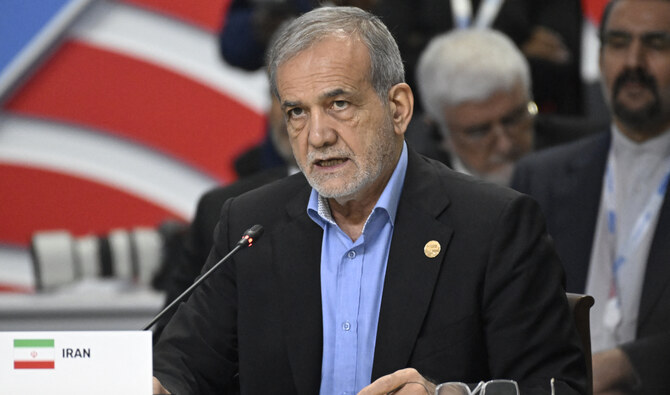
Iran's President Masoud Pezeshkian attends the extended format meeting of the BRICS summit in Kazan on October 23, 2024. (AFP)
Short Url
Updated 24 October 2024
Follow

Iran slams UN ineffectiveness to ‘extinguish’ regional crisis

  • Pezeshkian condemns Israel for violating ‘red lines,’ ‘producing new wave of violence, terror’

KAZAN: Iranian President Masoud Pezeshkian on Thursday condemned the 15-nation UN Security Council for failing to tackle the Middle East conflict.

“The fire of war is still raging in the Palestinian Gaza Strip and Lebanese cities,” Pezeshkian told leaders from emerging economies at the BRICS summit in Russia.

“And international institutions ... topped by the UN Security Council — who are drivers of international peace and security — lack the necessary efficiency to extinguish the fire of this crisis.”

Pezeshkian condemned Israel for violating “the red lines” of different states and “producing a new wave of violence and terror.”

Since the start of the war in Gaza, Iran has criticized the UN body for being inactive and ineffective in ending conflict in the Middle East.

Iran is engaged in an intense diplomatic campaign to establish ceasefires in both Gaza and Lebanon.

The efforts are also aimed at preventing the conflict from expanding across the region after Israel’s threat to retaliate to an attack by Iran on Oct. 1.

Tehran said the attack was in response to Israeli strikes in Lebanon, which killed an Iranian general and the head of the Lebanese Hezbollah movement, Hassan Nasrallah, late September.

For his part, Iran’s Foreign Ministry spokesman, Esmaeil Baghaei turned to social media to criticize the UN for turning “into a frustratingly dysfunctional platform.”

He said the UN was “sadly defeating its purpose” because the US “unconditional support for (the) occupying regime” — Israel — “has so emboldened the regime as to expand its aggressions and atrocities across the region,” he posted on X.

The US is one of the five permanent Security Council members with powers to block its decisions. Earlier, Iranian Foreign Minister Abbas Araghchi accused the US of obstructing the UN Security Council over the wars in Gaza and Lebanon.

“The inaction of the UN Security Council due to the obstruction of the US is a disaster,” he said.

Meanwhile, a Syria war monitor said Israeli strikes in the capital and in central Homs province killed two people, including a soldier.

The Syrian Observatory for Human Rights said the strikes in Damascus’s Kafr Sousa district targeted “the courtyard of a government building near a military fuel station.”

The Britain-based war monitor said: “One person whose identity is unknown” was killed and three others wounded.

In Homs province, which borders Lebanon where Israeli troops are fighting Hezbollah, the Israeli strikes “targeted a truck near a regime forces checkpoint on the road on the outskirts of Qusayr.”

That attack killed a soldier and wounded four others, the observatory said.

Syrian state news agency SANA said the Israeli army “launched an air attack ... targeting two sites” in the Kafr Sousa district of Damascus and a military site near Homs. 

It reported one soldier killed and seven others wounded.

Since the civil war erupted in 2011, Israel has carried out hundreds of strikes in Syria, mainly targeting the army and Iran-backed armed groups, including Hezbollah.


Israel PM holds coalition meeting after objecting to Gaza panel

Updated 18 January 2026
Follow

Israel PM holds coalition meeting after objecting to Gaza panel

  • Israeli Prime Minister Benjamin Netanyahu convened a meeting of his ruling coalition partners on Sunday after objecting to the composition of a Gaza advisory panel

JERUSALEM: Israeli Prime Minister Benjamin Netanyahu convened a meeting of his ruling coalition partners on Sunday after objecting to the composition of a Gaza advisory panel formed by the White House, according to an official and media reports.
The White House announced this week the setting up of a “Gaza Executive Board,” which would operate under a broader “Board of Peace” to be chaired by US President Donald Trump as part of his 20-point plan to end the war in Gaza.
The executive board, described as having an advisory role, includes Turkish Foreign Minister Hakan Fidan and Qatari diplomat Ali Al-Thawadi, alongside other regional and international officials.
Late on Saturday, Netanyahu’s office objected to the composition of the executive board.
“The announcement regarding the composition of the Gaza Executive Board, which is subordinate to the Board of Peace, was not coordinated with Israel and runs contrary to its policy,” the office of Netanyahu said.
“The Prime Minister has instructed the Foreign Affairs Minister to contact the US Secretary of State on this matter.”
It did not explain the reason for its objection, but Israel has previously objected strongly to any Turkish role in post-war Gaza, with relations between the two countries deteriorating sharply since the war began in October 2023.
In addition to naming Turkiye’s foreign minister to the executive board, Trump has also invited Turkish President Recep Tayyip Erdogan to join the overarching Board of Peace.
Media reports said that leaders of the country’s ruling coalition were scheduled to meet on Sunday to examine the composition of the executive board.
“There is a meeting scheduled of the coalition at 10:00 am (0800 GMT),” the spokesman of Netanyahu’s Likud Party told AFP, declining to provide further details.
Alongside Likud, the coalition includes the Religious Zionist Party led by far-right Finance Minister Bezalel Smotrich and Otzma Yehudit (Jewish Power) led by far-right National Security Minister Itamar Ben Gvir.
The White House said Trump’s plan would include three bodies: the Board of Peace, chaired by Trump; a Palestinian committee of technocrats tasked with governing Gaza; and the Gaza Executive Board, which would play an advisory role.
The Palestinian technocratic committee held its first meeting in Cairo on Saturday.
The diplomatic developments came as the United States said this week that the Gaza truce plan had entered a second phase, shifting from implementing a ceasefire to the disarmament of Hamas, whose October 7, 2023 attack on Israel triggered the Israeli offensive in Gaza.