ANKARA: Turkiye struck suspected Kurdish militant targets in Syria and Iraq for a second day on Thursday following an attack on the premises of a key defense company that killed at least five people, the state-run news agency reported.
The National Intelligence Organization targeted numerous “strategic locations” used by the Kurdistan Workers’ Party — the PKK — or by Syrian Kurdish militia that are affiliated with the militants, the Anadolu Agency reported. The targets included military, intelligence, energy and infrastructure facilities and ammunition depots, the report said. A security official said armed drones were used in Thursday’s strikes.
On Wednesday, Turkiye’s air force carried out airstrikes against similar targets in northern Syria and northern Iraq, hours after government officials blamed the deadly attack at the headquarters of the aerospace and defense company TUSAS, on the PKK.
Defense Minister Yasar Guler said Thursday that 47 alleged PKK targets were destroyed in Wednesday’s airstrikes — 29 in Iraq and 18 in Syria.
“Our noble nation should rest assured that we will continue with increasing determination our struggle to eliminate the evil forces that threaten the security and peace of our country and people until the last terrorist disappears from this geography,” Guler said.
The assailants — a man and a woman — arrived at the TUSAS premises on the outskirts of Ankara in a taxi they commandeered after killing its driver, reports said. Armed with assault rifles, they set off explosives and opened fire, killing four people at TUSAS, including a security guard and a mechanical engineer.
Security teams were dispatched as soon as the attack started at around 3:30 pm, the interior minister said. The two assailants were also killed and more than 20 people were injured in the attack.
Interior Minister Ali Yerlikaya named the assailants as Mine Sevjin Alcicek and Ali Orek and identified them as PKK members.
There was no immediate statement from the PKK on the attack or the Turkish airstrikes.
In Syria, the main US-backed force said Turkish strikes in the north of the country killed 12 civilians and wounded 25.
The Kurdish-led Syrian Democratic Forces said Turkish warplanes and drones struck bakeries, power stations, oil facilities and local police checkpoints.
Amir Samu, an administrator at the al Swediya oil refinery in Derik, northern Syria, said overnight strikes at the facility resulted in the deaths of seven workers and guards.
“They were all poor workers working in the refinery to make a living. It is a civil institution, not military or anything like that,” he said.
Samu stated that al Swediya was the only refinery “feeding” the area. “The damage will have effects on diesel, petrol and gas,” he said.
TUSAS designs, manufactures and assembles civilian and military aircraft, unmanned aerial vehicles and other defense industry and space systems. Its defense systems have been credited as key to Turkiye gaining an upper hand in its fight against Kurdish militants.
The attack occurred a day after the leader of Turkiye’s far-right nationalist party that’s allied with President Recep Tayyip Erdogan raised the possibility that the PKK’s imprisoned leader could be granted parole if he renounces violence and disbands his organization.
Abdullah Ocalan, who was captured in 1999, is serving a life sentence on a prison island off Istanbul.
In a related development, his nephew Omer Ocalan announced on the social platform X that on Wednesday family members were allowed to visit him for the first time since March 2020.
Omer Ocalan, a lawmaker from Turkiye’s pro-Kurdish Peoples’ Equality and Democracy Party, also conveyed a message from Abdullah Ocalan, saying he was being kept in isolation and offering to work to end the conflict “if the conditions are right.”
“I have the theoretical and practical power to (transform) this process from one grounded in conflict and violence to one that is grounded on law and politics,” Omer Ocalan quoted his uncle as saying.
The PKK has been fighting for autonomy in southeastern Turkiye in a conflict that has killed tens of thousands of people since the 1980s. It is considered a terrorist group by Turkiye and its Western allies.
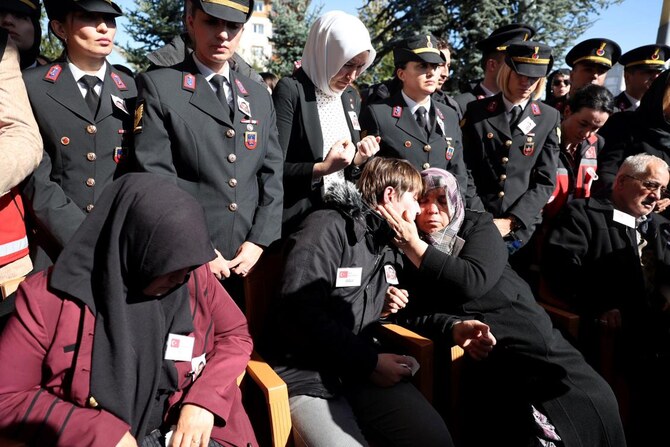
On Thursday, large crowds gathered in the courtyard of a mosque in Ankara to take part in the funeral prayers for three of the victims, including Zahide Guclu — an engineer who was part of a TUSAS helicopter project. She was killed by the assailants after she had gone to the entrance of the complex to collect flowers sent by her husband.


![]()

Turkiye strikes Kurdish militant targets in Syria and Iraq for a second day
Short Url
https://arab.news/bevyn
Turkiye strikes Kurdish militant targets in Syria and Iraq for a second day
- The National Intelligence Organization targeted numerous “strategic locations” used by the Kurdistan Workers’ Party
- Defense Minister Yasar Guler said Thursday that 47 alleged PKK targets were destroyed in Wednesday’s airstrikes — 29 in Iraq and 18 in Syria


Latest updates


© 2026 SAUDI RESEARCH & PUBLISHING COMPANY, All Rights Reserved And subject to Terms of Use Agreement.