

At SCO dinner gala, Pakistani chef crafted meatless menu for Indian delegates

The collage of images created on October 24, 2024, shows Chef Asad Monga posing for a picture with the flag of the Shanghai Cooperation Organization countries (left), and plates lined up for the guests of the summit at Serena Hotel in Islamabad, Pakistan. (Asad Monga)
Short Url
Updated 24 October 2024
Follow

At SCO dinner gala, Pakistani chef crafted meatless menu for Indian delegates

  • Asad Monga was asked to come to Islamabad to oversee the food served to foreign dignitaries
  • He says Pakistan should develop a service-based economy focusing on hospitality, culinary arts

KARACHI: A Karachi-based chef, specially flown to Islamabad to oversee meals for foreign dignitaries at the Shanghai Cooperation Organization (SCO) Summit, said this week his team ensured diversity in the menu to respect cultural sensitivities, recalling they avoided serving red meat to the Indian delegation.

The 23rd SCO Council of Heads of Government took place on October 15 and 16, bringing together political leaders from Russia, China, India, Kazakhstan, Tajikistan and other participating nations, including Pakistan.

Chef Asad Monga, 32, was invited to join the culinary experts at Islamabad’s popular Serena Hotel for the summit’s lunch and dinner services.

He informed the menu not only reflected international flavors but also highlighted local Pakistani dishes such as mutton chops and flatbread with minced meat filling. However, his team was also sensitive to the dietary preferences of the visiting delegates.

“[It was] just a good, well rounded mix of food to showcase our regional capabilities as people and as cooks, and also keeping in mind the diverse set of people that were coming to eat the food so that it registers with their palette also,” he told Arab News on Tuesday.

“We couldn’t serve red meat to the Indian delegates, so we had a vegetarian and chicken-based menu for that,” he added.
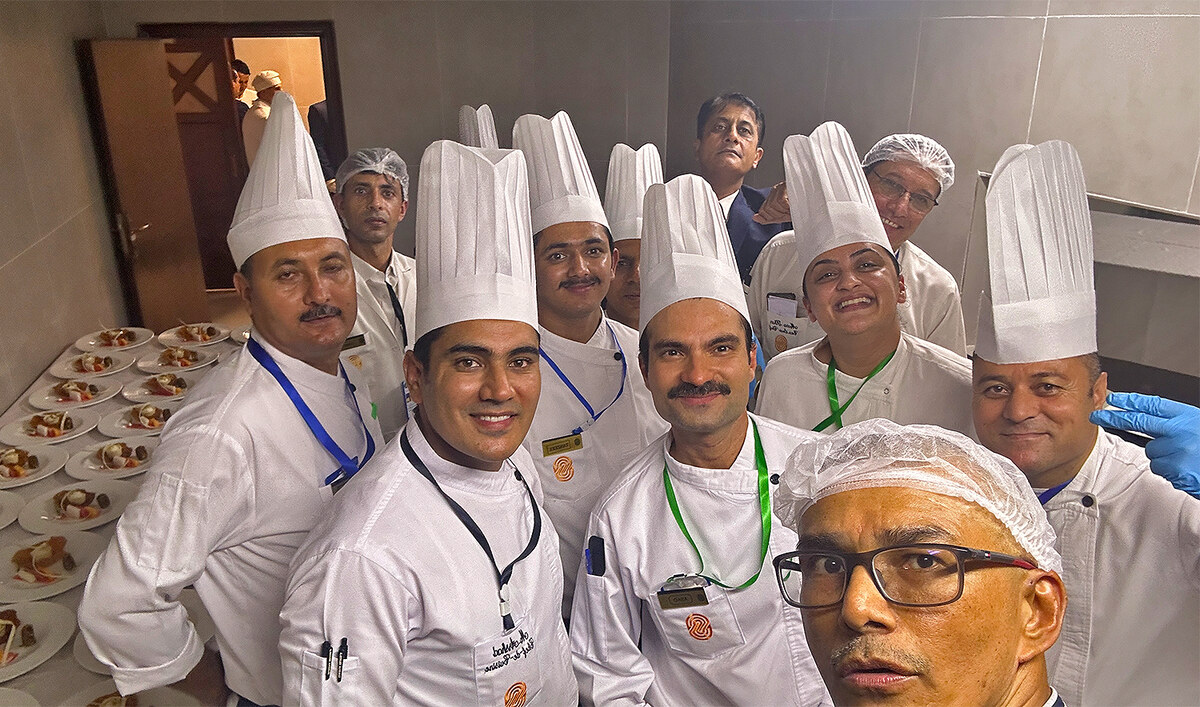


Chef Asad Monga (center in the first row) poses for a picture with other chefs during Shanghai Cooperation Organization (SCO) Summit held in Pakistan's capital, Islamabad, on October 15-16, 2024. (Asad Monga)

Indian External Affairs Minister Subramanyam Jaishankar, who led his country’s delegation at the SCO Summit, was the first high-profile official from New Delhi to visit Pakistan in nearly a decade.

Although he did not hold formal bilateral meetings in Islamabad, Pakistani officials described his trip as an “ice breaker” amid hopes in both countries for a thaw in the frosty relations between the two nuclear-armed neighbors.

“The meal started with the Mezze Platter. There was Yousaf Labneh on the menu, and of course, butters were served with Sumac as a condiment,” Monga said.

“The Middle Eastern influence in our region is strong, and when you serve food in a restaurant or a five-star hotel, you will always find some Middle Eastern cuisine on the table,” he added.
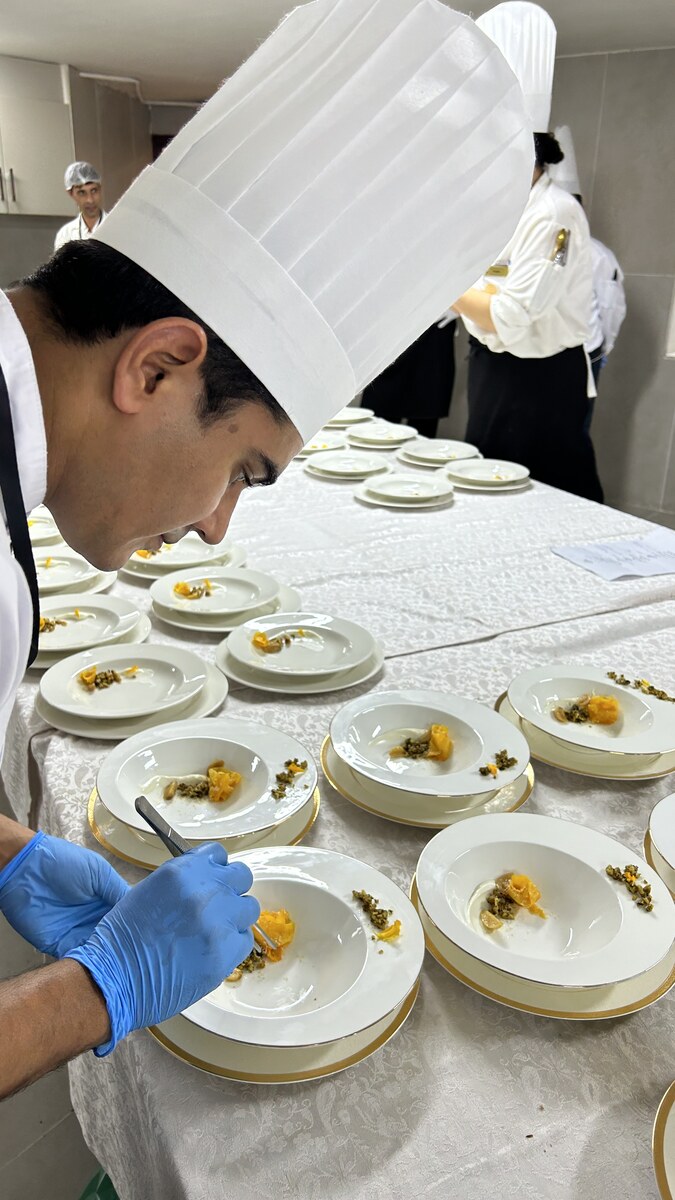


A chef prepares food for the guests at Serena Hotel during Shanghai Cooperation Organization (SCO) Summit held in Pakistan's capital, Islamabad, on October 15-16, 2024. (Asad Monga)

Monga, who was born and raised in Karachi, became passionate about cooking and chose culinary school after A Levels.

He enrolled at Taylor’s University in Kuala Lumpur, Malaysia, in 2011 as part of a dual degree program. After gaining international experience, he returned to Pakistan in late 2016 for personal reasons.

“For Pakistan to succeed in the future, we need to develop a strong service-based economy that focuses on hospitality and the culinary arts,” he reflected, based on his experience of serving the SCO delegates.
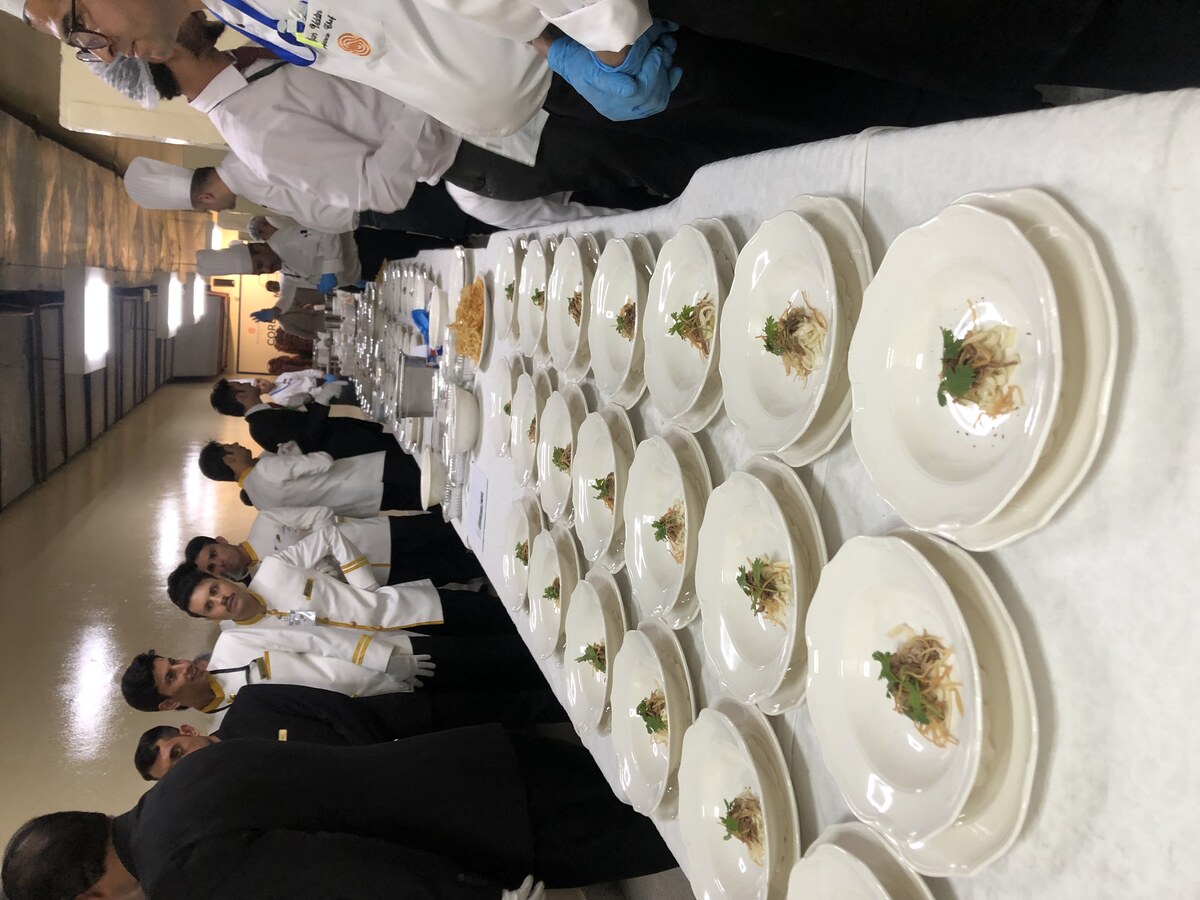


Waiters line up to carry food plates for the guests attending Shanghai Cooperation Organization (SCO) Summit in Islamabad, Pakistan. (Asad Monga)

He noted that by promoting chefs and expanding the hospitality industry, Pakistan could project its warm hospitality to the world and cultivate a softer image.

Monga also shared his desire to set up a small culinary school in the mountains, where he could forage ingredients, ferment them, and develop flavor catalogs.

“I hope to develop a school there where I can teach students who are interested in learning,” Monga said. “They can come and collaborate with me, and together we can shape the future of Pakistani cuisine and its culinary landscape.”


Islamabad says surge in aircraft orders after India standoff could end IMF reliance

Updated 22 min 17 sec ago
Follow

Islamabad says surge in aircraft orders after India standoff could end IMF reliance

  • Pakistani jets came into the limelight after Islamabad claimed to have shot down six Indian aircraft during a standoff in May last year
  • Many countries have since stepped up engagement with Pakistan, while others have proposed learning from PAF’s multi-domain capabilities

ISLAMABAD: Defense Minister Khawaja Asif on Tuesday said Pakistan has witnessed a surge in aircraft orders after a four-day military standoff with India last year and, if materialized, they could end the country’s reliance on the International Monetary Fund (IMF).

The statement came hours after a high-level Bangladeshi defense delegation met Pakistan’s Air Chief Marshal Zaheer Ahmed Baber Sidhu to discuss a potential sale of JF-17 Thunder aircraft, a multi-role fighter jointly developed by China and Pakistan that has become the backbone of the Pakistan Air Force (PAF) over the past decade.

Fighter jets used by Pakistan came into the limelight after Islamabad claimed to have shot down six Indian aircraft, including French-made Rafale jets, during the military conflict with India in May last year. India acknowledged losses in the aerial combat but did not specify a number.

Many countries have since stepped up defense engagement with Pakistan, while delegations from multiple other nations have proposed learning from Pakistan Air Force’s multi-domain air warfare capabilities that successfully advanced Chinese military technology performs against Western hardware.

“Right now, the number of orders we are receiving after reaching this point is significant because our aircraft have been tested,” Defense Minister Asif told a Pakistan’s Geo News channel.

“We are receiving those orders, and it is possible that after six months we may not even need the IMF.”

Pakistan markets the Chinese co-developed JF-17 as a lower-cost multi-role fighter and has positioned itself as a supplier able to offer aircraft, training and maintenance outside Western supply chains.

“I am saying this to you with full confidence,” Asif continued. “If, after six months, all these orders materialize, we will not need the IMF.”

Pakistan has repeatedly turned to the IMF for financial assistance to stabilize its economy. These loans come with strict conditions including fiscal reforms, subsidy cuts and measures to increase revenue that Pakistan must implement to secure disbursements.

In Sept. 2024, the IMF approved a $7 billion bailout for Pakistan under its Extended Fund Facility (EFF) program and a separate $1.4 billion loan under its climate resilience fund in May 2025, aimed at strengthening the country’s economic and climate resilience.

Pakistan has long been striving to expand defense exports by leveraging its decades of counter-insurgency experience and a domestic industry that produces aircraft, armored vehicles, munitions and other equipment.

The South Asian country reached a deal worth over $4 billion to sell military equipment to the Libyan National Army, Reuters report last month, citing Pakistani officials. The deal, one of Pakistan’s largest-ever weapons sales, included the sale of 16 JF-17 fighter jets and 12 Super Mushak trainer aircraft for basic pilot training.