Tropical storm battering Philippines leaves at least 24 people dead in flooding and landslides

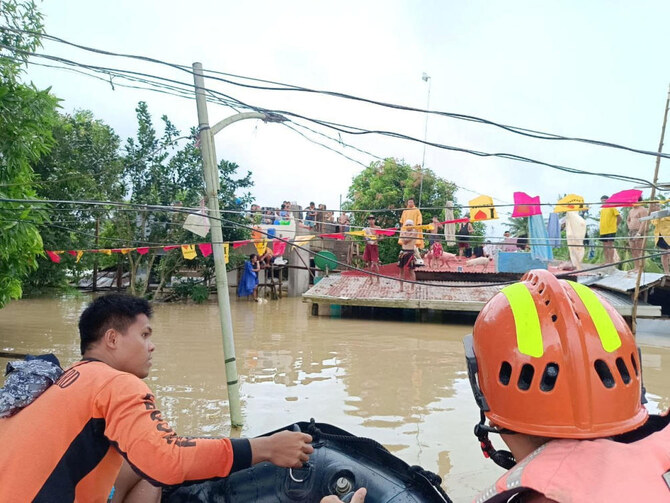
Philippine Coast Guard personnel rescue residents trapped on rooftops after flood waters rose from heavy rains brought by Tropical Storm Trami on Oct. 23, 2024. (Philippine Coast Guard via Reuters)
Short Url
Updated 24 October 2024
Follow

Tropical storm battering Philippines leaves at least 24 people dead in flooding and landslides

  • Deaths mostly due to drowning in the hard-hit Bicol region and nearby Quezon province
  • Most of the storm deaths were reported in the six-province Bicol region, southeast of Manila

MANILA: Widespread flooding and landslides set off by a tropical storm in the northeastern Philippines on Thursday left at least 24 people dead, swept away cars and prompted authorities to scramble for motorboats to rescue trapped villagers, some on roofs.
The government shut down schools and offices — except those urgently needed for disaster response — for the second day on the entire main island of Luzon to protect millions of people after Tropical Storm Trami slammed into the country’s northeastern province of Isabela after midnight.
The storm was blowing over Aguinaldo town in the mountain province of Ifugao after dawn with sustained winds up to 95kph and gusts up to 160kph. It was blowing westward and was forecast to enter the South China Sea later on Thursday, according to state forecasters.
At least 24 people died, mostly due to drowning in the hard-hit Bicol region and nearby Quezon province but the toll was expected to rise as towns and villages isolated by flooding and roads blocked by landslides and toppled trees manage to send out reports, police and provincial officials said.
Most of the storm deaths were reported in the six-province Bicol region, southeast of Manila, where at least 20 people died, including 7 residents in Naga city, which was inundated by flash floods as Trami was approaching Tuesday, dumping more than two months’ worth of rainfall in just 24 hours at high tide, regional police chief Brig. Gen. Andre Dizon and other officials said.
While thousands of villagers, who were trapped in floodwaters, have been rescued by government forces, many more needed to be saved Thursday in the Bicol region, including some on roofs. About 1,500 police officers have been deployed for disaster-mitigation work, Dizon said.
“We can’t rescue them all at once because there are so many and we need additional motorboats,” Dizon told The Associated Press by telephone. “We’re looking for ways to deliver food and water to those who were trapped but could not be evacuated right away.”
Flash floods swept away and submerged cars in some parts of Naga city while mudflows from Mayon, one of the country’s 24 active volcanoes, in nearby Albay province, engulfed several vehicles, Dizon said.
Stormy weather remained in the region, hampering relief efforts, officials said.
The government’s disaster-mitigation agency said more than 2 million people were affected by the storm, including 75,400 villagers who were displaced from their homes and are sheltering on safer ground.
About 20 storms and typhoons batter the Philippines each year. In 2013, Typhoon Haiyan, one of the strongest recorded tropical cyclones in the world, left more than 7,300 people dead or missing and flattened entire villages.


US Justice Department official eyes cases against Cuba leaders as Trump floats ‘friendly takeover’

Updated 07 March 2026
Follow

US Justice Department official eyes cases against Cuba leaders as Trump floats ‘friendly takeover’

  • “Working group” formed to build cases against people connected to the Cuban government
  • Trump’s has increasingly displayed aggressive stance against Cuba’s communist leadership

MIAMI: The top Justice Department prosecutor in Miami is considering criminal investigations of Cuban government officials, according to people familiar with the matter. The inquiry comes as President Donald Trump has raised the possibility of a “friendly takeover” of the communist-run island.
Jason Reding Quiñones, the US attorney for the Southern District of Florida, has created a “working group” that includes federal prosecutors and officials from the Drug Enforcement Administration and other agencies to try to build cases against people connected to the Cuban government and its Communist Party, according to one of the people. They spoke on the condition of anonymity because they were not authorized to publicly discuss the effort.
It was not immediately clear which Cuban officials the office is targeting or what criminal charges prosecutors may be looking to bring.
The Justice Department said in a statement Friday that “federal prosecutors from across the country work every day to pursue justice, which includes efforts to combat transnational crime.”
The effort is taking place against the backdrop of Trump’s increasingly aggressive stance against Cuba’s communist leadership.
Emboldened by the US capture of Cuba’s close ally, Venezuelan President Nicolás Maduro, Trump last month said his administration was in high-level talks with officials in Havana to pursue “a friendly takeover” of the country. He repeated those claims this week, saying his attention would turn back to Cuba once the war with Iran winds down.
“They want to make a deal so bad,” Trump said of Cuba’s leadership.
While Cuba has faded from Washington’s radar as a major national security threat in recent decades, it remains a priority in the US Attorney’s office in Miami, whose political, economic and cultural life is dominated by Cuban-American exiles.
The FBI field office has a dedicated Cuba group that in 2024 was instrumental in the arrest of former US Ambassador Victor Manuel Rocha on charges of serving as a secret agent of Cuba stretching back to the 1970s.
In recent weeks, several Miami Republicans, in addition to Florida Sen. Rick Scott, have called on the Trump administration to reopen its criminal investigation into the 1996 shootdown of four planes operated by anti-communist exiles.
In a letter to Trump on Feb. 13, lawmakers including Reps. Maria Elvira Salazar and Carlos Gimenez highlighted decades-old news reports indicating that former President Raúl Castro — the head of Cuba’s military at the time — gave the order to shoot down the unarmed Cessna aircraft.
“We believe unequivocally that Raúl Castro is responsible for this heinous crime,” lawmakers wrote. “It is time for him to be brought to justice.”
While no indictment against Castro has been announced, Florida’s attorney general said this week that he would open a state-level investigation into the crime.
The Trump administration has also accused Cuba of not cooperating with American counterterrorism efforts, adding it alongside North Korea and Iran to a select few nations the US considers state sponsors of terrorism.
The designation stems from Cuba’s harboring of US fugitives and its refusal to extradite several Colombian rebel leaders while they were engaged in peace talks with the South American nation.