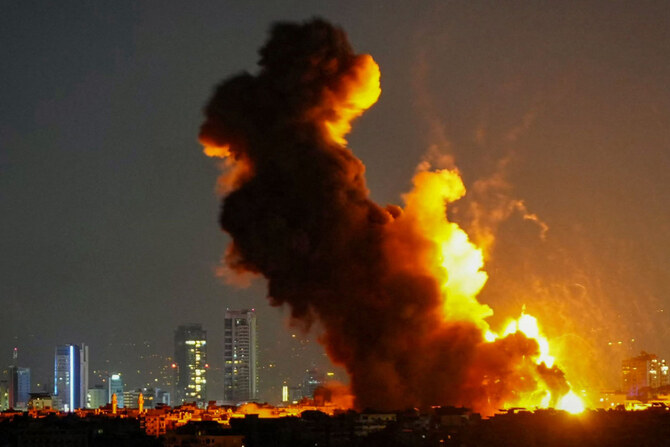


BEIRUT: Israel unleashed a wave of air strikes on Hezbollah’s southern Beirut stronghold on Wednesday night, Lebanese state media said, as the Iran-Hezbollah war reached its one-month mark.
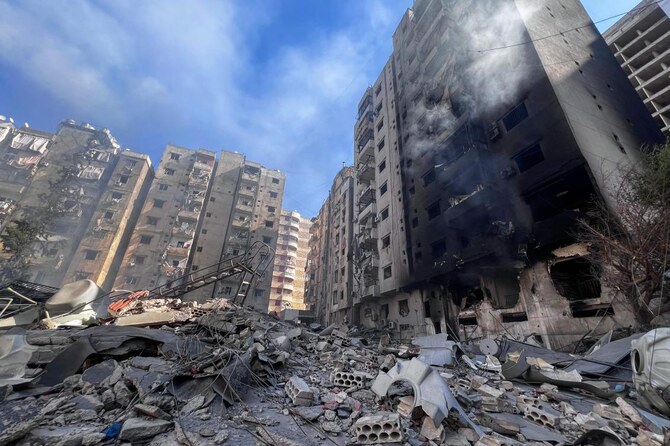
With six buildings levelled in at least 17 Israeli raids, the strikes mark one of the most brutal nights in the capital’s southern suburbs since the war erupted on September 23.
Separately, Syria’s state media reported Israeli air strikes on a residential building in Damascus and a military site in Homs that killed a soldier and wounded seven others.
The raids came after United States Secretary of State Antony Blinken, on a visit to Israel, told the US ally to avoid further escalation with Iran.
Israel is fighting Iran-backed Palestinian militant group Hamas in Gaza and Hezbollah in Lebanon and has vowed to retaliate against Iran for an October 1 missile attack.
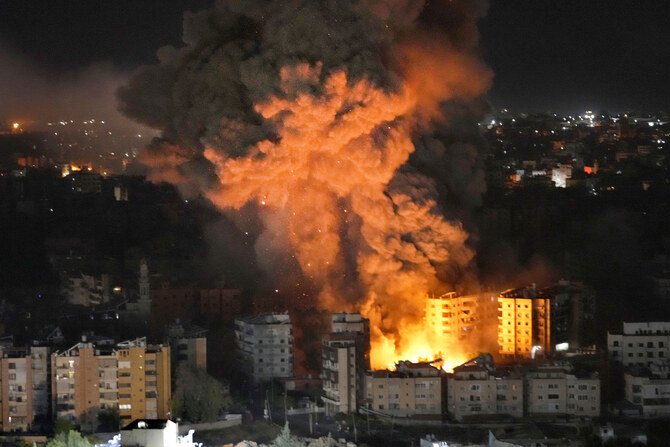
In Lebanon, the official National News Agency reported at least 17 Israeli strikes on Beirut’s southern suburbs, calling the raids “the most violent in the area since the beginning of the war.”
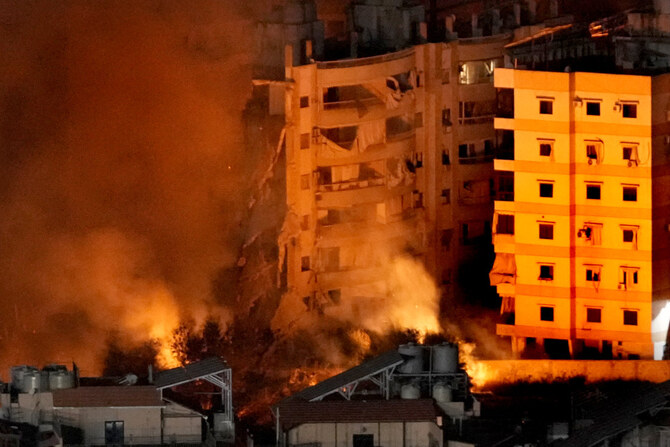
Six buildings were destroyed around the suburb of Laylaki, NNA said, including a residential complex hit by four Israeli strikes “causing a large fire.”
AFPTV footage showed a massive explosion followed by smaller blasts in the embattled suburb after the Israeli army issued an Arabic-language evacuation warning for the area, where Hezbollah holds sway.
There was no warning, however, for a strike that hit the Jnah neighborhood in southern Beirut.
That strike killed one person and wounded five others, according to Lebanon’s health ministry.
In southern Lebanon, Israeli strikes pounded Tyre, leaving swaths of its center in ruins and sparking a new exodus from the once vibrant coastal city.
“The whole city shook,” said resident Rana, who fled to the seafront after the Israeli military issued an evacuation warning.
Bilal Kashmar of Tyre’s disaster management unit said seven buildings were levelled and more than 400 apartments damaged.
“You could say that the entire city of Tyre is being evacuated,” he told AFP.
Black smoke was seen rising from several neighborhoods, with some areas just 500 meters (550 yards) from the city’s ancient ruins.
UNESCO said it was “closely following” the conflict’s impact on Tyre’s World Heritage site.
Blinken’s visit to the region, his 11th since the Gaza war began, was part of continued US efforts to end the war and limit its regional fallout.
The Gaza war began with Hamas’s October 7, 2023 attack on Israel, which resulted in the deaths of 1,206 people, mostly civilians, according to an AFP tally of Israeli official figures.
Israel’s retaliatory offensive has killed 42,792 people in Gaza, also mostly civilians, according to figures from the Hamas-run territory’s health ministry, data which the UN considers reliable.
Blinken said Israel had “achieved most of its strategic objectives” in Gaza and should now aim for lasting success.
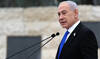
“Now is the time to turn those successes into enduring, strategic success,” he said after meetings with Prime Minister Benjamin Netanyahu and other top officials.
Addressing Israel’s pledge to retaliate for Iran’s October 1 attack, he said: “It’s also very important that Israel respond in ways that do not create greater escalation.”
After Israel, Blinken visited Saudi Arabia, renewing his bid to broker a normalization of diplomatic ties between the two countries.
Speaking at a summit in Russia, Iran’s President Masoud Pezeshkian urged BRICS nations to help “end the war” in Gaza and Lebanon.
A Hamas official said a delegation led by a top official in the movement arrived in Moscow for talks.
Concerns are mounting over tens of thousands of civilians trapped by fighting in Gaza’s aid-starved north, where Israel launched a major air and ground assault this month.
Blinken acknowledged “progress” on aid for Gaza but said more needed to be done.
With winter approaching, displaced Gazans fear the cold.
Ahmad Al-Razz said he sewed sacks together to make his tent on the beach near Deir el-Balah.
“We are freezing every night because we are right by the sea, and we have no blankets or coverings to keep us warm,” said the 42-year-old.
The World Health Organization said it was forced to postpone the last phase of a polio vaccination drive in Gaza due to “intense bombardment” in the north.
The UN agency for Palestinian refugees said another of its workers had been killed in Gaza after a strike hit an UNRWA vehicle.
An AFP photographer reported a strike in the southern city of Khan Yunis, leaving a mangled aid truck and mourners gathered around two bodies.
After nearly a year of war with Hamas in Gaza, Israel shifted its focus to Lebanon last month, vowing to secure its northern border under fire from Hezbollah.
Israel has since ramped up its strikes on Hezbollah strongholds and sent in ground forces, in a war that has killed at least 1,580 people since September 23, according to an AFP tally of Lebanese health ministry figures.
The real number is likely to be higher due to gaps in the data.
Lebanese media said Israeli strikes hit areas of south and east Lebanon on Wednesday.
In the evening, pro-Iran broadcaster Al-Mayadeen said an Israeli strike hit an office it had vacated in Beirut.
Hezbollah said it had fired rockets in several areas of Israel, including a salvo that forced Israeli troops to “retreat behind the frontier” after they attempted to infiltrate from the outskirts of the south Lebanon village of Aitarun.
The Israeli army said air raid sirens sounded across central Israel after “projectiles” were fired from across the Lebanese border.
Netanyahu said on Wednesday that Israel had uncovered that Hezbollah had been plotting an “attack even greater than on October 7” involving jeeps, missiles and underground tunnels.
“They were planning an invasion,” the premier told French broadcasters CNews and Europe 1.
Also on Wednesday, Hezbollah confirmed the death of Hashem Safieddine, a cleric tipped to succeed the group’s slain leader Hassan Nasrallah, a day after Israel announced Safieddine’s death.
A Western diplomat meanwhile told AFP a number of Western countries had floated the idea of deploying international forces to Lebanon in the event of a ceasefire.
About 10,000 UN peacekeepers are already deployed in Lebanon’s south, but the diplomat said a separate multi-national troop deployment was under consideration.