

Modi arrives for BRICS summit in Kazan, seeks stronger ties with Russia

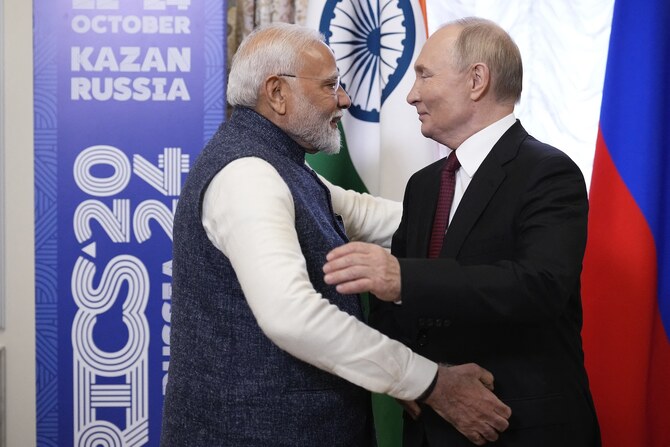
Indian Prime Minister Narendra Modi meets Russian President Vladimir Putin on the sidelines of the BRICS summit in Kazan on Oct. 22, 2024. (AFP)
Short Url
Updated 22 October 2024
Follow

Modi arrives for BRICS summit in Kazan, seeks stronger ties with Russia

  • Modi expected to meet Xi amid signs of thaw in Indian-Chinese ties
  • India ready to support peace efforts amid Russia-Ukraine war, Modi tells Putin

NEW DELHI: Indian Prime Minister Narendra Modi aims to reinforce New Delhi’s special partnership with Moscow, his office said on Tuesday, as he is in Russia to participate in the 2024 BRICS summit.

Initially comprising Brazil, Russia, India, China and South Africa, the group expanded in January this year, with the accession of Egypt, Iran, Ethiopia and the UAE.

Morphing into the most powerful geopolitical forum outside of the Western world, it accounts for 45 percent of the world’s population and 35 percent of its economy.

The bloc’s annual meeting is taking place in Kazan on Oct. 22-24.

Ahead of his departure to Russia, Modi’s office quoted him as saying that his participation would “further reinforce the Special and Privileged Strategic Partnership between India and Russia.”

He held a meeting with Russian President Vladimir Putin immediately after his arrival.

“The fact that I have come to Russia twice in the last two months demonstrates our deep connection and friendship,” he said, referring to the India-Russia Annual Summit, which he attended in Moscow in July.

The meeting on the sidelines of the BRICS summit was livestreamed on Modi’s X account.

He offered India’s support to reach peace amid the ongoing Russia-Ukraine war.

“We fully support the early restoration of peace and stability. All our efforts give priority to humanity,” Modi said. “India is ready to provide all possible cooperation.”

Modi is attending the BRICS summit accompanied by Foreign Affairs Minister S. Jaishankar.

“India is a voice of the Global South and Prime Minister Modi will refer to that, and once again bilaterally assess the possibility of further contribution to the efforts for ceasefire and peace in the Eurasian war,” said Anil Trigunayat, a former ambassador who has served in the Indian missions in the Middle East and Europe, including Russia.

“Regional and global challenges will be discussed as well. Prime Minister Modi in his departure statement clearly underscored the importance of BRICS. He will also be meeting several leaders including Iran and China, apart from the host Russia.”

Modi’s expected meeting with Chinese President Xi Jinping would be the “biggest point” of the summit, according to Prof. Amitabh Singh from the Center for Russian and Central Asian Studies at Jawaharlal Nehru University in New Delhi.

Indian-Chinese ties have been strained since 2020, following deadly clashes on their de facto Himalayan border and military buildup from both sides. Rounds of meetings taking place over the past four years had not yielded any resolution until Monday, when the countries reached a patrolling agreement widely seen as possibly leading to disengagement.

“Modi is going to meet Xi Jinping in all likelihood ... it is also important that India would be starting a new phase of relationship with China after things get worse in 2020,” Singh told Arab News.

“More than economic organization or platform, the BRICS is also becoming a political platform where non-Western countries are coming together.”


Kabul shakes as 5.8-magnitude earthquake hits eastern Afghanistan

Updated 9 sec ago
Follow

Kabul shakes as 5.8-magnitude earthquake hits eastern Afghanistan

  • The 5.8-magnitude quake struck a mountainous area around 130 kilometers northeast of Kabul
  • Earthquakes are common in Afghanistan, particularly along the Hindu Kush mountain range

KABUL: A strong earthquake rocked eastern Afghanistan including the capital Kabul on Friday, AFP journalists and residents said.
The 5.8-magnitude quake struck a mountainous area around 130 kilometers (80 miles) northeast of Kabul, the United States Geological Survey said.
The epicenter was near several remote villages and struck at 5:39 p.m. (1309 GMT), just as people in the Muslim-majority country were sitting down to break their Ramadan fast.
“We were waiting to do our iftars, a heavy earthquake shook us. It was very strong, it went on for almost 30 seconds,” said Zilgay Talabi, a resident of Khenj district near of the epicenter.
“Everyone was horrified and scared,” Talabi told AFP, saying he feared “landslides and avalanches” may follow.
Power was briefly cut in parts of the capital, while east of Kabul an AFP journalist in Nangarhar province also felt it.
Earthquakes are common in Afghanistan, particularly along the Hindu Kush mountain range, near where the Eurasian and Indian tectonic plates meet.
Haqmal Saad, spokesman for the Panjshir province police, described the quake as “very strong” and said the force was “gathering information on the ground.”
Mohibullah Jahid, head of Panjshir Natural Disaster Management agency, told AFP he was in touch with several officials in the area.
The district governor had told him there were reports of “minor damage, such as cracks in the walls, but we have not received anything serious, such as the collapse of houses or anything similar,” Jahid said.
Residents in Bamiyan and Wardak provinces, west of Kabul, told AFP they also felt the earthquake.
In Pakistan’s Khyber Pakhtunkhwa province, rescue service official Bilal Ahmad Faizi said the quake was felt in border areas.
In August last year, a shallow 6.0-magnitude quake in the country’s east wiped out mountainside villages and killed more than 2,200 people.
Weeks later, a 6.3-magnitude quake in northern Afghanistan killed at least 27 people.
Large tremors in western Herat, near the Iranian border, in 2023, and in Nangarhar province in 2022, killed hundreds and destroyed thousands of homes.
Many homes in the predominantly rural country, which has been devastated by decades of war, are shoddily built.
Poor communication networks and infrastructure in mountainous Afghanistan have hampered disaster responses in the past, preventing authorities from reaching far-flung villages for hours or even days before they could assess the extent of the damage.