OSLO: A “doomsday vault” in the Arctic designed to safeguard the world’s plant diversity has received a new deposit of thousands of seed samples, including Palestinian ones amid war and hunger in Gaza, it said on Wednesday.
Opened in 2008, the Global Seed Vault offers a safety net in case of natural catastrophe, war, climate change, disease or manmade disasters.
More than 30,000 samples from a record 23 organizations in 21 countries were deposited in the vault in Norway’s Svalbard archipelago on Tuesday, the Crop Trust, one of the project’s partners, said on Wednesday.
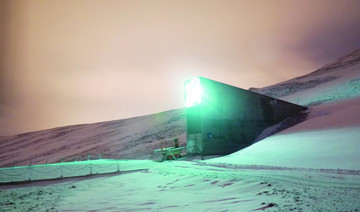
Buried inside a mountain near Longyearbyen on Spitsbergen Island, about 1,300 kilometers (about 800 miles) from the North Pole, the “Noah’s Ark” of food crops is also aimed at preserving plants that can feed a growing population facing climate change.
Launched in 2008 with funding from Norway, the three cold chambers are today home to some 1.3 million varieties of seeds that their owners can withdraw at any moment.
Among those deposited on Tuesday were 21 Palestinian species comprised of vegetables, millet and herbs, provided by the Palestinian non-profit Union of Agricultural Work Committees (UAWC).
According to the Crop Trust, a new delivery of seeds is expected in February from Sudan, a country also ravaged by war and famine.
“Climate change and conflict threaten infrastructure and impact food security for over 700 million people in more than 75 countries worldwide,” Crop Trust director Stefan Schmitz said.
“Genebanks are ramping up efforts to back-up seed collections, and we are proud to support them by providing a safe haven in Svalbard,” he said in a statement.
The vault is designed to be able to resist catastrophes, located far from conflict zones and placed at an altitude that will protect it from rising sea levels.
Even if the refrigeration system were to fail, the vault would maintain its cold temperature thanks to the permafrost around it.


Palestinian seeds join Arctic ‘doomsday vault’

https://arab.news/bdhr9
Palestinian seeds join Arctic ‘doomsday vault’

- The Global Seed Vault offers a safety net in case of natural catastrophe, war, climate change, disease or manmade disasters
- Among varieties of seeds deposited on Tuesday were 21 Palestinian species comprised of vegetables, millet and herbs


Arts festival’s decision to exclude Palestinian author spurs boycott
- A Macquarie University academic who researches Islamophobia and Palestine, Abdel-Fattah responded saying it was “a blatant and shameless act of anti-Palestinian racism and censorship,” with her lawyers issuing a letter to the festival
SYDENY: A top Australian arts festival has seen the withdrawal of dozens of writers in a backlash against its decision to bar an Australian Palestinian author after the Bondi Beach mass shooting, as moves to curb antisemitism spur free speech concerns.
The shooting which killed 15 people at a Jewish Hanukkah celebration at Sydney’s Bondi Beach on Dec. 14 sparked nationwide calls to tackle antisemitism. Police say the alleged gunmen were inspired by Daesh.
The Adelaide Festival board said last Thursday it would disinvite Randa Abdel-Fattah from February’s Writers Week in the state of South Australia because “it would not be culturally sensitive to continue to program her at this unprecedented time so soon after Bondi.”
FASTFACTS
• Abdel-Fattah responded, saying it was ‘a blatant and shameless act of anti-Palestinian racism and censorship.’
• Around 50 authors have since withdrawn from the festival in protest, leaving it in doubt, local media reported.
A Macquarie University academic who researches Islamophobia and Palestine, Abdel-Fattah responded saying it was “a blatant and shameless act of anti-Palestinian racism and censorship,” with her lawyers issuing a letter to the festival.
Around 50 authors have since withdrawn from the festival in protest, leaving it in doubt, local media reported.
Among the boycotting authors, Kathy Lette wrote on social media the decision to bar Abdel-Fattah “sends a divisive and plainly discriminatory message that platforming Australian Palestinians is ‘culturally insensitive.'”
The Adelaide Festival said in a statement on Monday that three board members and the chairperson had resigned. The festival’s executive director, Julian Hobba, said the arts body was “navigating a complex moment.”
a complex and unprecedented moment” after the “significant community response” to the board decision.
In the days after the Bondi Beach attack, Jewish community groups and the Israeli government criticized Prime Minister Anthony Albanese for failing to act on a rise in antisemitic attacks and criticized protest marches against Israel’s war in Gaza held since 2023.
Albanese said last week a Royal Commission will consider the events of the shooting as well as antisemitism and social cohesion in Australia. Albanese said on Monday he would recall parliament next week to pass tougher hate speech laws.
On Monday, New South Wales state premier Chris Minns announced new rules that would allow local councils to cut off power and water to illegally operating prayer halls.
Minns said the new rules were prompted by the difficulty in closing a prayer hall in Sydney linked to a cleric found by a court to have made statements intimidating Jewish Australians.
The mayor of the western Sydney suburb of Fairfield said the rules were ill-considered and councils should not be responsible for determining hate speech.
“Freedom of speech is something that should always be allowed, as long as it is done in a peaceful way,” Mayor Frank Carbone told Reuters.


