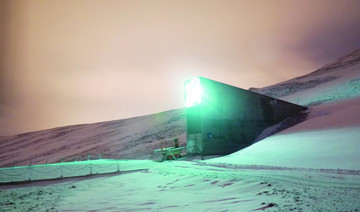
LONDON: A ‘doomsday’ Arctic seed vault on Norway’s Spitsbergen island is set to receive its most diverse batch of seed donations yet as efforts to secure the world’s food supplies ramp up amid rising climate concerns.
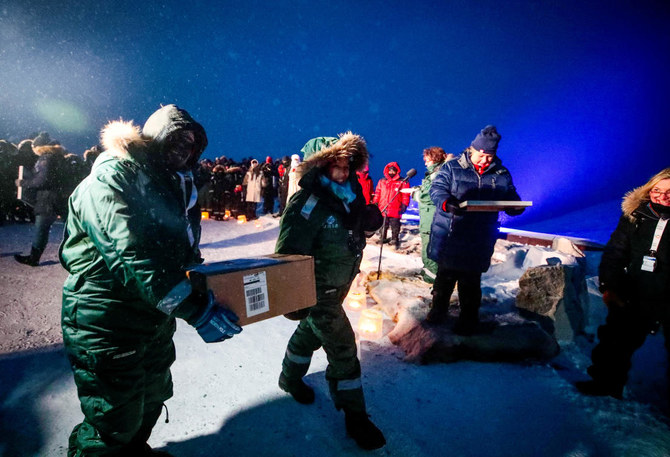
The Svalbard Global Seed Vault, built to protect the world’s food stock from disasters ranging from nuclear war to global warming, will add 19,500 rare seed variety samples from across the world to its collection on Tuesday, taking its total stash to more than 1.2 million.
The vault, set in permafrost caves on an arctic mountainside halfway between mainland Europe and the North Pole, was launched in 2008 as a backup for the world’s national and regional gene banks that store the genetic code for thousands of plant species.
It has seed samples from nearly every country in the world, and played an essential role between 2015 and 2019 in rebuilding seed collections damaged during the war in Syria.
“The whole of humanity relies on the genetic diversity of crops maintained in the world’s gene banks, and the Seed Vault is the last line of defense against the loss of that diversity,” said Sandra Borch, Minister of Agriculture and Food for Norway.
Svalbard, which also serves as a backup for plant breeders to develop new crop varieties more resistant to climate change, opened its doors to public at large for the first time on Tuesday by launching a free virtual tour of its subterranean seed chambers.
The chambers, which are only opened three times a year to limit the seeds’ exposure to the outside world, boast temperatures of around -18 degrees Celsius.
The virtual tour launch, as well as the seed deposits from some 20 gene banks, were timed to mark Svalbard’s 15-year anniversary.
“From here in Svalbard, the world looks different. This Seed Vault represents hope, unity and security,” said Stefan Schmitz, executive director of the Crop Trust, an international non profit that operates Svalbard along with the Norwegian authorities.
“In a world where the climate crisis, biodiversity loss, natural catastrophes and conflicts increasingly destabilize our food systems, it has never been more important to prioritize safeguarding these tiny seeds.”
The world used to cultivate over 6,000 different plants but UN experts say we now get about 40 percent of our calories from three main crops — maize, wheat and rice — making food supplies vulnerable if climate change causes harvests to fail.

‘Doomsday’ Arctic seed vault gets boost as efforts to secure food supplies ramp up
https://arab.news/ccfkq
‘Doomsday’ Arctic seed vault gets boost as efforts to secure food supplies ramp up
- The Svalbard Global Seed Vault will add 19,500 rare seed variety samples from across the world to its collection on Tuesday
- Its subterranean seed chambers are only opened three times a year to limit the seeds’ exposure to the outside world
Australian state parliament reconvenes to push through stricter gun laws after Bondi mass shooting
- The state parliament was recalled for two days from Monday to debate the firearm legislation, which would cap the number of firearms a person can own at four
SYDNEY: Australia’s New South Wales state parliament was recalled on Monday to vote on proposed new laws that would impose major curbs on firearm ownership, ban the display of terror symbols and restrict protests, following a mass shooting at Bondi Beach.
The state parliament was recalled for two days from Monday to debate the firearm legislation, which would cap the number of firearms a person can own at four, or up to 10 for certain groups, such as farmers.
There is currently no limit to firearm ownership if the reason can be justified to police, and there are more than 50 people in the state who own more than 100 guns, the Australian Broadcasting Corp. said in a report, citing police data.
One of the alleged Bondi gunmen, Sajid Akram, 50, was shot dead by police and owned six firearms. His 24-year-old son Naveed Akram has been charged with 59 offenses, including murder and terrorism, according to police.
Fifteen people were killed and dozens injured in the mass shooting at a Jewish Hanukkah celebration at Sydney’s Bondi Beach on December 14. The attack has shocked the nation and sparked calls for tougher gun laws and heightened efforts to stop antisemitism.
The proposed legislation would also give police more powers to remove face coverings during protests or rallies. The state government has vowed to ban the chant “globalize the intifada” which it says encourages violence in the community.
Jewish leaders on Sunday called for a royal commission, the most powerful type of Australian government inquiry, to be set up to investigate the attack at Bondi.
The opposition Liberal Party leader Sussan Ley backed those calls on Monday, and told a news conference that she has called on Prime Minister Anthony Albanese to meet with her to review the terms of reference for a royal commission.
ALBANESE APPROVAL DIPS
Albanese has faced mounting criticism from opponents who argue his government has not done enough to curb a rise in antisemitism. He was booed by sections of the crowd during a memorial event in Bondi attended by tens of thousands of people on Sunday, one week after the shooting.
Albanese’s government has said it has consistently denounced antisemitism and highlighted legislation passed over the last two years to criminalize hate speech and doxxing. It also expelled Iran’s ambassador earlier this year after accusing Tehran of directing antisemitic attacks in Sydney and Melbourne.
“You’ve seen us crack down on hate speech. You’ve seen us criminalize doxxing. You’ve seen us be very clear about counterterrorism laws banning Nazi salutes and so forth,” Foreign Minister Penny Wong told ABC Radio on Monday.
A poll conducted for the Sydney Morning Herald newspaper among 1,010 voters released on Monday found Albanese’s approval rating slumped 15 points to -9 from +6 at the beginning of December, the lowest since his resounding election win in May.
Authorities on Monday started clearing flowers, candles, letters and other items placed by the public at Bondi Beach.
The tributes would be preserved for display at the Sydney Jewish Museum and the Australian Jewish Historical Society, authorities said.
Thirteen people remain in hospital, including four in critical but stable condition, health officials said.