

Saudi hotel spending rises 8.5% despite overall drop in POS transactions: SAMA

According to figures from the Saudi Central Bank, hotels were the only sector to see an increase, while spending across all other sectors fell. Shutterstock
Short Url
Updated 23 October 2024
Follow

Saudi hotel spending rises 8.5% despite overall drop in POS transactions: SAMA

  • POS transactions dropped by 7.5% to SR11.3 billion, continuing a downward trend after a 2.6% increase in early October
  • Education sector experienced the biggest decline, with spending down 25.3% to SR94.1 million

RIYADH: Hotel spending in Saudi Arabia surged by 8.5 percent during the week of Oct. 13— 19, reaching SR293.8 million ($78.2 million), despite an overall decline in point-of-sale transactions, official data showed. 

According to figures from the Saudi Central Bank, also known as SAMA, hotels were the only sector to see an increase, while spending across all other sectors fell. 

Overall, POS transactions dropped by 7.5 percent to SR11.3 billion, continuing a downward trend after a 2.6 percent increase in early October. 

The education sector experienced the biggest decline, with spending down 25.3 percent to SR94.1 million. Telecommunications and public utilities followed with drops of 14.7 percent and 12.4 percent, recording SR103.6 million and SR48.4 million, respectively. 

Spending on construction and building materials recorded the smallest decline, dipping 4.1 percent to SR331.2 million. 
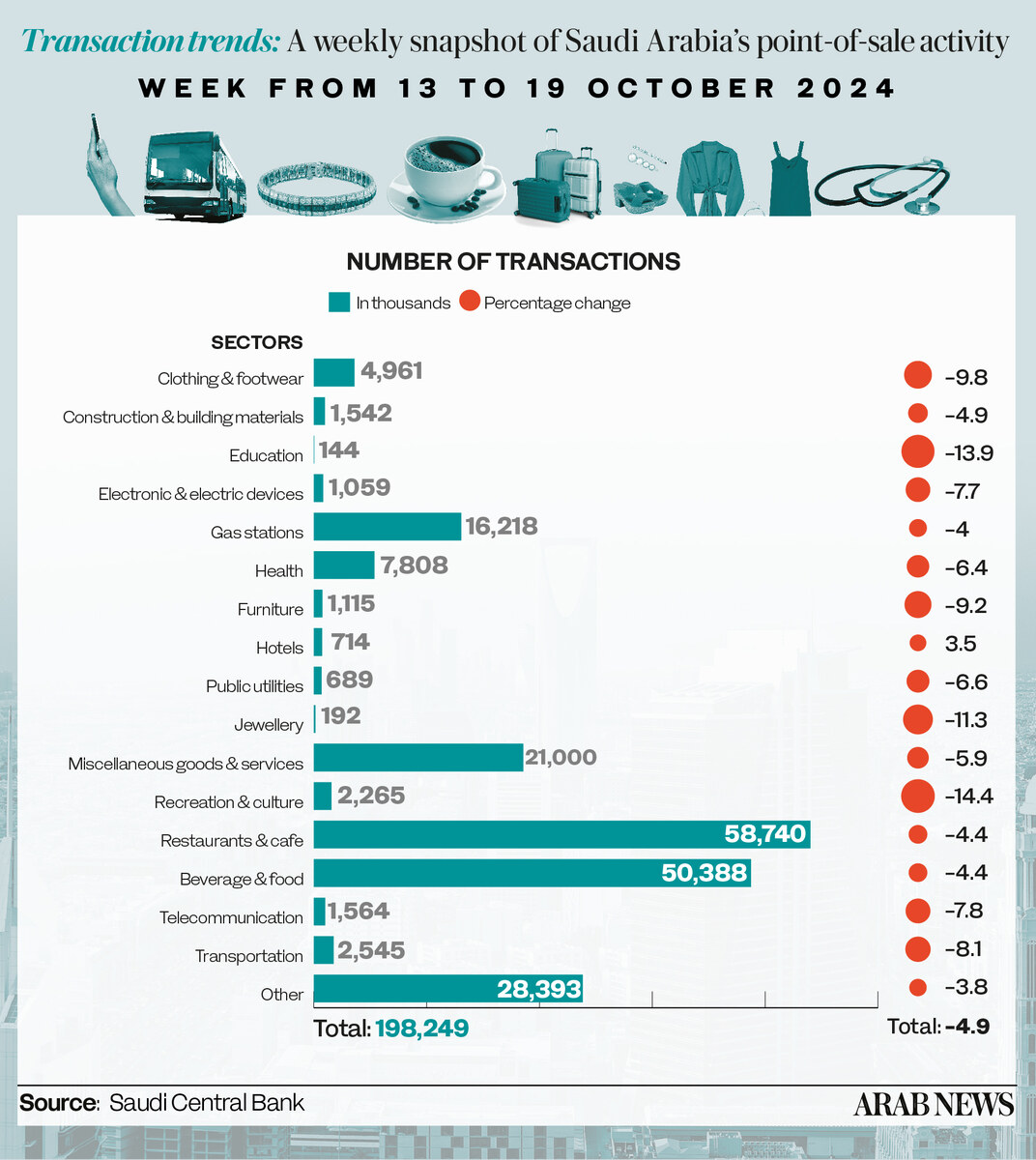
Restaurant and cafe expenditures fell 5 percent to SR1.76 billion, while gas station spending dropped 5.7 percent to SR866.4 million. 

Looking at the biggest value of transactions this week, the food and beverages sector stepped down from the first spot as the biggest share of the POS, recording an 8.6 percent decrease to SR1.74 billion. 

This was followed by miscellaneous goods and services at SR1.3 billion, with an 8.3 percent dip. 

The top three categories accounted for nearly 45 percent of the week’s total POS value at SR5.1 billion. 

Riyadh dominated POS transactions, representing 34.7 percent of the total, with spending in the capital reaching SR3.9 billion, recording a decrease of 6.9 percent. 

Jeddah followed closely with a 6.8 percent dip to SR1.5 billion, accounting for 13.8 percent of the total, and Dammam came in third at SR587 million, down by 6.3 percent. 

Hail saw the biggest decrease in spending, down by 10.3 percent to SR174 million. Abha and Buraidah also experienced declines, with expenditures dipping 8.3 percent and 9.1 percent to SR137 million and SR266.6 million, respectively. 

In terms of the number of transactions, Hail recorded the highest decrease for the second week in a row at 7.9 percent, reaching 3,478. Tabuk and Madinah followed with declines at 7.7 percent and 5.3 percent, reaching 4,362 and 8,038 transactions, respectively. 


European gas prices soar almost 50% as Iran conflict halts Qatar LNG output

Updated 02 March 2026
Follow

European gas prices soar almost 50% as Iran conflict halts Qatar LNG output

  • Analysts warn prolonged disruption could push prices higher
  • Some shipments of oil, LNG through Strait of Hormuz suspended
  • Benchmark Asian LNG price up almost 39 percent

LONDON: ​Benchmark Dutch and British wholesale gas prices soared by almost 50 percent on Monday, after major liquefied natural gas exporter Qatar Energy said it had halted production due to attacks in the Middle East.

Qatar, soon to cement its role as the world’s second largest LNG exporter after the US, plays a major role in balancing both Asian and European markets’ demand of LNG.

Most tanker owners, oil majors and ‌trading houses ‌have suspended crude oil, fuel and liquefied natural ​gas shipments ‌via ⁠the ​Strait of ⁠Hormuz, trade sources said, after Tehran warned ships against moving through the waterway.

Europe has increased imports of LNG over the past few years as it seeks to phase out Russian gas following Russia’s invasion of Ukraine.

Around 20 percent of the world’s LNG transits through the Strait of Hormuz and a prolonged suspension or full closure would increase global competition for other ⁠sources of the gas, driving up prices internationally.

“Disruptions to ‌LNG flows would reignite competition between ‌Asia and Europe for available cargoes,” said ​Massimo Di Odoardo, vice president, gas ‌and LNG research at Wood Mackenzie.

The Dutch front-month contract at the ‌TTF hub, seen as a benchmark price for Europe, was up €14.56 at €46.52 per megawatt hour, or around $15.92/mmBtu, by 12:55 p.m. GMT, ICE data showed.

Prices were already some 25 percent higher earlier in the day but extended gains ‌after QatarEnergy’s production halt.

Benchmark Asian LNG prices jumped almost 39 percent on Monday morning with the S&P Global ⁠Energy Japan-Korea-Marker, widely used ⁠as an Asian LNG benchmark, at $15.068 per million British thermal units, Platts data showed.

“If LNG/gas markets start to price in an extended period of losses to Qatari LNG supply, TTF could potentially spike to 80-100 euros/MWh ($28-35/mmBtu),” Warren Patterson, head of commodities strategy at ING, said. The British April contract was up 40.83 pence at 119.40 pence per therm, ICE data showed.

Europe is also relying on LNG imports to help fill its gas storage sites which have been depleted over the winter and are currently around 30 percent full, the latest data from Gas Infrastructure ​Europe showed. In the European carbon ​market, the benchmark contract was down €1.10 at €69.17 a tonne