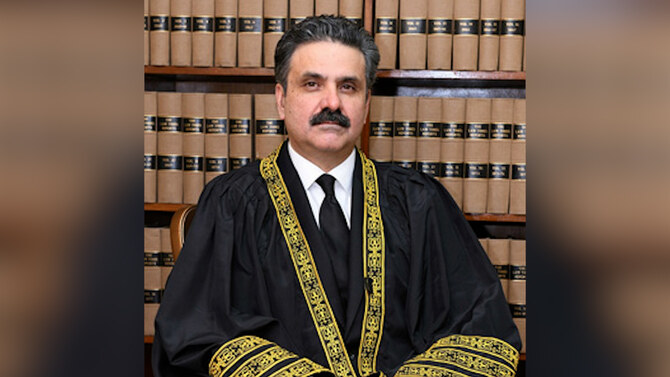
ISLAMABAD: President Asif Ali Zardari on Wednesday appointed Justice Yahya Afridi, the third on the seniority list of judges, as Pakistan’s next chief justice after a 12-member special parliamentary committee selected him a day earlier for the position.
Afridi’s appointment was made by the committee formed under the contentious 26th Constitutional Amendment, which was tasked with choosing one of the three senior-most judges of the Supreme Court to succeed Chief Justice of Pakistan Qazi Faez Isa, who is set to retire on Friday.
The committee also included opposition lawmakers from the Pakistan Tehreek-e-Insaf (PTI) party, who boycotted the proceedings after objecting to the government’s handling of the constitutional amendment, accusing it of encouraging defections and undermining party loyalty.
“In exercise of the powers conferred by clause (3) of Article 175 A read with Articles 177 and 179 of the Constitution of the Islamic Republic of Pakistan, the President of the Islamic Republic of Pakistan is pleased to appoint Hon’ble Mr. Justice Yahya Afraid, Judge of Supreme Court, as Chief Justice of Pakistan, for a term of three years with effect from 26.10.2024,” said a notification circulated by the law ministry.
Among the three senior-most judges considered for the key post, the other two were Justices Mansoor Ali Shah and Munib Akhtar, with the government offering no explanation as to why they were passed over for the position.
The contentious constitutional amendment passed by Prime Minister Shehbaz Sharif’s administration has sparked heated debate in the country, with opposition parties and prominent lawyers alleging that the new law aims to curtail the judiciary’s independence.
The government has rejected these allegations, with several officials stating that the amendment is intended to empower parliament and provide speedy justice to citizens through judicial reforms.
However, lawyers across the country threatened to protest before the adoption of the constitutional amendment if Justice Shah, who was expected to succeed the current chief justice, was not appointed.
These lawyers suspected the government of sidelining Shah due to recent Supreme Court rulings in political cases.
Pakistan’s Planning Minister Ahsan Iqbal, who was part of the parliamentary committee that agreed on Afridi’s appointment, defended the decision, saying it was made through a majority vote.
According to Law Minister Azam Nazeer Tarar, Afridi’s name was chosen by “a two-thirds majority” of the committee members.

Pakistan president appoints Justice Yahya Afridi as new Supreme Court chief justice
https://arab.news/mtaf9
Pakistan president appoints Justice Yahya Afridi as new Supreme Court chief justice
- Justice Afridi was third on the seniority list provided to a parliamentary committee that took the decision
- His appointment was made under the contentious 26th Constitutional Amendment with ‘two-thirds majority’
Pakistan opposition to continue protest over ex-PM Khan’s health amid conflicting reports
- Pakistan’s government insists that the ex-premier’s eye condition has improved
- Khan’s personal doctor says briefed on his condition but cannot confirm veracity
ISLAMABAD: Pakistan’s opposition alliance on Monday vowed to continue their protest sit-in at parliament and demanded “clarity” over the health of jailed former prime minister Imran Khan, following conflicting medical reports about his eye condition.
The 73-year-old former cricket star-turned-politician has been held at the high-security Adiala prison in Rawalpindi since 2023. Concerns arose about his health last week when a court-appointed lawyer, Barrister Salman Safdar, was asked to visit Khan at the jail to assess his living conditions. Safdar reported that Khan had suffered “severe vision loss” in his right eye due to central retinal vein occlusion (CRVO), leaving him with just 15 percent sight in the affected eye.
On Sunday, a team of doctors from various hospitals visited the prison to examine Khan’s eye condition, according to the Adiala jail superintendent, who later submitted his report in the court. On Monday, a Supreme Court bench led by Chief Justice Yahya Afridi observed that based on reports from the prison authorities and the amicus curiae, Khan’s “living conditions in jail do not presently exhibit any perverse aspects.” It noted that Khan had “generally expressed satisfaction with the prevailing conditions of his confinement” and had not sought facilities beyond the existing level of care.
Having carefully perused both reports in detail, the bench observed that their general contents and the overall picture emerging therefrom are largely consistent. The opposition alliance, which continued to stage its sit-in for a fourth consecutive day on Monday, held a meeting at the parliament building on Monday evening to deliberate on the emerging situation and discuss their future course of action.
“The sit-in will continue till there is clarity on the matter of [Khan's] health,” Sher Ali Arbab, a lawmaker from Khan's Pakistan Tehreek-e-Insaf (PTI) party who has been participating in the sit-in, told Arab News, adding that PTI Chairman Gohar Ali Khan and Opposition Leader in Senate Raja Nasir Abbas had briefed them about their meeting with doctors who had visited Khan on Sunday.
Speaking to reporters outside parliament, Gohar said the doctors had informed them that Khan’s condition had improved.
“They said, 'There has been a significant and satisfactory improvement.' With that satisfactory improvement, we also felt satisfied,” he said, noting that the macular thickness in Khan’s eye had reportedly dropped from 550 to 300 microns, a sign of subsiding swelling.
Gohar said the party did not want to politicize Khan’s health.
“We are not doctors, nor is this our field,” he said, noting that Khan’s personal physician in Lahore, Dr. Aasim Yusuf, and his eye specialist Dr. Khurram Mirza had also sought input from the Islamabad-based medical team.
“Our doctors also expressed satisfaction over the report.”
CONFLICTING ACCOUNTS
Despite Gohar’s cautious optimism, Khan’s personal physician, Dr. Yusuf, issued a video message on Monday, saying he could neither “confirm nor deny the veracity” of the government’s claims.
“Because I have not seen him myself and have not been able to participate in his care... I’m unable to confirm what we have been told,” Yusuf said.
He appealed to authorities to grant him or fellow physician, Dr. Faisal Sultan, immediate access to Khan, arguing that the ex-premier should be moved to Shifa International Hospital in Islamabad for specialist care.
Speaking to Arab News, PTI’s central information secretary Sheikh Waqas Akram said Khan’s sister and their cousin, Dr. Nausherwan Burki, will speak to media on Tuesday to express their views about the situation.
The government insists that Khan’s condition has improved.
“His eye [condition] has improved and is better than before,” State Minister Talal Chaudhry told the media in a brief interaction on Monday.
“The Supreme Court of Pakistan is involved, and doctors are involved. What medicine he receives, whether he needs to be hospitalized or sent home, these decisions are made by doctors. Neither lawyers nor any political party will decide this.”


