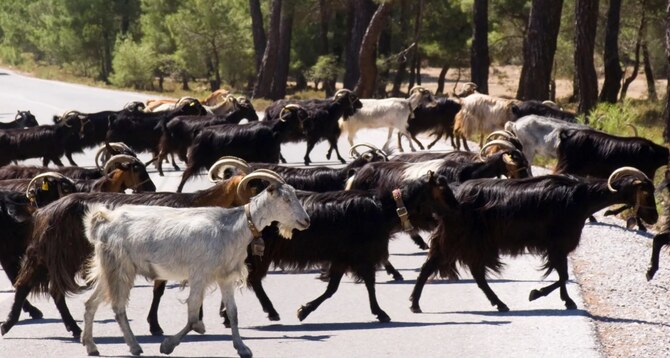
Greece imposes restrictions to contain spread of pox among sheep, goats

Authorities are investigating the initial source of the outbreak and tests are being conducted in the wider area where the cases were first detected, in line with EU rules, it said. (Getty images)
Short Url
Updated 23 October 2024
Follow

Greece imposes restrictions to contain spread of pox among sheep, goats

  • Authorities are investigating the initial source of the outbreak and tests are being conducted in the wider area where the cases were first detected, in line with EU rules, it said

ATHENS: Greece has banned the transportation and reproduction of sheep and goats across the country for 10 days after detecting more than 100 pox infections, the agriculture ministry said.
The measures are precautionary and are aimed at containing the spread of the virus, which does not affect humans, the ministry said in a statement late on Tuesday.
So far, 104 cases have been detected, most of them in the northern area of Evros. About 17,500 animals have been culled.
Authorities are investigating the initial source of the outbreak and tests are being conducted in the wider area where the cases were first detected, in line with EU rules, it said.
Greece is home to the largest number of goats in Europe, the ministry has said. Their milk, used in Greece’s trademark feta cheese, is a major economic driver.
“Starting today, we announce a complete ban on the movement of sheep and goats for breeding, fattening, grazing and slaughter, throughout the Greek territory for 10 days,” Agriculture Minister Costas Tsiaras said.
In June, Greece imposed similar restrictions to contain a viral infection known as “goat plague.”


Iran war unsettles India’s packaged water makers as bottles, caps get pricey

Updated 55 min 10 sec ago
Follow

Iran war unsettles India’s packaged water makers as bottles, caps get pricey

  • Higher polymer ‌prices hurt bottled water industry
  • Industry worth $5 billion has big multinational players like Pepsi, Coca-Cola

NEW ​DELHI: The Iran war is rattling India’s $5 billion packaged water market just ahead of the sweltering summer season.
One of the world’s fastest growing bottled water markets is seeing some manufacturers hike prices for distributors, as supply disruptions linked to the war fuel higher costs in everything from plastic bottles to caps, labels and cardboard boxes.
Though retail prices are yet to feel the heat and bigger companies are absorbing the pain, about 2,000 smaller bottled water makers have increased rates for their resellers by around 1 rupee per ‌bottle, a ‌5 percent hike, which will rise by a further 10 percent in ​coming ‌days, ⁠according ​to the ⁠Federation of All India Packaged Drinking Water Manufacturers’ Association.
Consumers usually pay less than 20 rupees, or around 20 US cents, for a one-liter bottle.
“There is chaos and within the next 4-5 days, this will start impacting customer prices,” said Apurva Doshi, the federation’s secretary general.
Rising oil prices have increased the cost of polymer, which is made from crude oil and is a key material for the industry’s plastic bottles. The cost of material used in making ⁠plastic bottles has risen by 50 percent to 170 rupees per kilogram, ‌while the price of the caps has more than ‌doubled to 0.45 rupees apiece. Even corrugated boxes, labels and ​adhesive tape are costing much more, ‌industry letters showed.
Clean water is a privilege in the country of 1.4 billion people where ‌researchers say 70 percent of the groundwater is contaminated, leaving people reliant on bottled water. Companies including Bisleri, Coca-Cola’s Kinley, Pepsi’s Aquafina, billionaire Mukesh Ambani’s Reliance and Tata all compete for a share of the $5 billion market. The companies did not respond to Reuters request for comment.
PREMIUM WATER FACES HEAT ‌TOO
Within the broad bottled water market, natural mineral water is a $400 million business in India and a new, fast-growing wellness product for ⁠India’s wealthy.
The premium ⁠water segment accounted for 8 percent of the bottled water market last year in India, compared to just 1 percent in 2021, Euromonitor says.
Aava, which sells mineral water sourced from the foothills of the Aravalli mountains, has increased prices of its water bottles by 18 percent for resellers, Shiroy Mehta, CEO of the company, told Reuters.
“Most manufacturers are absorbing 40-50 percent of the cost to ensure that they don’t lose clients. It’s a poor situation for the beverage industry ahead of the summer season,” he said.
The mass market, however, is dominated by companies that produce “drinking water” to be sold in 1-liter bottles to customers. Clear Premium Water, a brand of India’s Energy Beverages, said in a notice to its distributors there ​had been an “unprecedented and continuous surge” in ​prices of key raw materials used in packaging and production.
“It is no longer possible for us to absorb the escalating costs while maintaining existing product prices,” the notice said.